Private Member Bills on Work-Life Balance and Federal Issues
Source:The Hindu ↗
Why It Matters
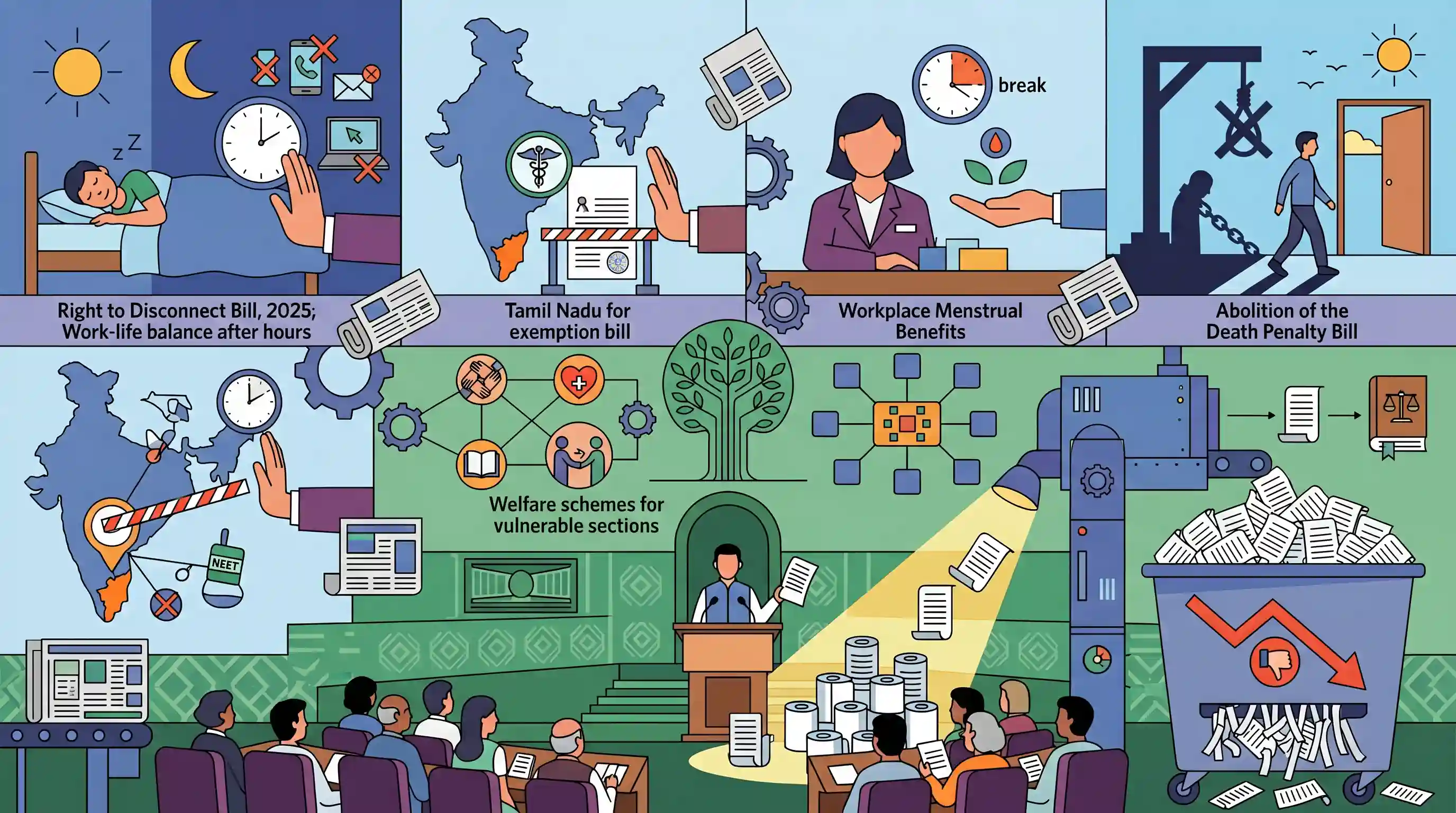
The article illustrates the functioning of Private Member's Bills in highlighting pressing social and federal issues such as work-life balance (Right to Disconnect), women's workplace rights, and Centre-State disputes over education (NEET). It is crucial for understanding parliamentary procedures and the legislative tools available to non-ministerial MPs.
Summary
Recently, several notable Private Member's Bills were introduced in the Lok Sabha. Key among them is the 'Right to Disconnect Bill, 2025', which aims to provide employees the right to disconnect from work-related communications after regular working hours to ensure work-life balance. Other significant bills introduced address state-specific concerns like exempting Tamil Nadu from the NEET examination, as well as broader social issues like workplace menstrual benefits and the abolition of the death penalty. While these bills highlight important societal and federal issues, Private Member's Bills in the Indian Parliament are historically rarely passed and often withdrawn post government response.
Key Points
- Several Private Member's Bills were introduced in the Lok Sabha, reflecting diverse political and social priorities.
- The 'Right to Disconnect Bill, 2025' seeks to establish an employees' welfare authority and confer the right to ignore work calls and emails after office hours.
- A bill seeking to exempt Tamil Nadu from the NEET exam for undergraduate medical admissions highlights ongoing federalism debates.
- Other notable bills introduced include the 'Menstrual Benefits Bill, 2024' for workplace facilities and a bill to abolish the death penalty.
- Historically, Private Member's Bills are rarely passed into law and are usually withdrawn after the government provides a reply or assurance.
Important Terms
Private Member's Bill

A legislative proposal introduced by any Member of Parliament who is not a Minister. These bills are discussed only on Fridays and typically serve to raise public awareness or influence future government policy.
UPSC context
GS Paper 2 (Parliamentary Functioning); tests knowledge of legislative procedures, the role of non-ministerial MPs, and historical passage rates.
Right to Disconnect Bill, 2025
A Private Member's Bill proposing a legal right for employees to ignore work-related communications outside official hours. It aims to prevent burnout and ensure work-life balance through an Employees' Welfare Authority.
UPSC context
GS Paper 2 (Governance/Human Resources); explores evolving labor rights, mental health advocacy, and workplace regulations in the digital age.
Menstrual Benefits Bill, 2024
A legislative proposal seeking to mandate statutory paid leave and workplace rest facilities for female employees during their menstrual cycle. It highlights the biological needs and rights of women in the workforce.
UPSC context
GS Paper 2 (Welfare Schemes for Vulnerable Sections); tests understanding of gender-sensitive policies, labor laws, and social justice.
Lok Sabha
The directly elected lower house of India's Parliament. It serves as the primary forum for introducing and debating Private Member's Bills and is central to the country’s representative democracy.
UPSC context
GS Paper 2 (Parliamentary Structure); fundamental for questions on legislative power, the law-making process, and the executive's accountability to the people.
National Eligibility cum Entrance Test (NEET)
A centralized national entrance exam for medical and dental admissions in India. It is a significant point of federal debate between the Centre and states like Tamil Nadu regarding educational autonomy.
UPSC context
GS Paper 2 (Federal Structure/Education); examines the constitutional distribution of powers and the impact of centralizing educational standards.
Special Economic Zones (Amendment) Bill, 2024
A legislative proposal to update the 2005 SEZ framework, often aiming to enhance safety protocols in hazardous industries or provide administrative and fiscal incentives to attract investments.
UPSC context
GS Paper 3 (Economy/Infrastructure); tests knowledge of export-promotion strategies, regulatory reforms, and regional industrial development.
Prelims Trap
Private Member's Bills can only be introduced by Members of Parliament belonging to opposition parties.
Any MP who is not a Minister is considered a Private Member. Ruling party MPs who are not Ministers can also introduce these bills.
Static Concepts Connected
How do Private Member's Bills differ from Government Bills?
- Introduction: Introduced by any MP who is not a Minister. Requires one month's notice, unlike the 7 days for Government Bills.
- Impact & Drafting: Drafted by the concerned member. Its rejection in the House does not amount to a no-confidence motion against the government.
- Historical Passage: Highly unlikely to become law; only 14 have been passed since independence, with the last one enacted in 1970.
How does the Constitution handle Repugnancy under Article 254?
- General Rule: Under Article 254(1), central laws prevail over state laws in case of a conflict on Concurrent List subjects (like Education).
- Presidential Exception: Under Article 254(2), a conflicting state law can prevail within that state only if it is reserved for and receives the President's assent.
Cross-Topic Patterns
Article 21 + Labor Reforms
The Right to Disconnect bridges fundamental privacy rights (Puttaswamy) with modern labor codes, demanding a relook at work-life balance in the digital economy.
Concurrent List + Federal Friction
Attempting to bypass NEET highlights federal friction over Concurrent List subjects, specifically referencing the 42nd Amendment which moved Education from the State to the Concurrent List.

Private Member Bills + Article 254(2) exception for Concurrent List laws are high-probability statements for Polity Prelims 2026.
Linked PYQs · 3
Linked PYQs · 3
- 2017PrelimsGS1
With reference to the Parliament of India, consider the following statements: 1. A private member's bill is a bill presented by a Member of Parliament who is not elected but only nominated by the President of India. 2. Recently, a private member's bill has been passed in the Parliament of India for the first time in its history. Which of the statements given above is/are correct?
- 2024PrelimsGS1
Under which of the following Articles of the Constitution of India, has the Supreme Court of India placed the Right to Privacy ?
- 2024MainsGS2
What changes has the Union Government recently introduced in the domain of Centre-State relations ? Suggest measures to be adopted to build the trust between the Centre and the States and for strengthening federalism.
