Arbitrator Appointments to Expedite Highway Land Acquisition Cases
Source:Indian Express ↗
Why It Matters
It highlights a practical governance solution (Arbitration/Tribunals) to one of India's biggest economic bottlenecks—land acquisition delays. The use of ADR ensures that farmers receive timely compensation while critical national highway infrastructure projects are accelerated.
Summary
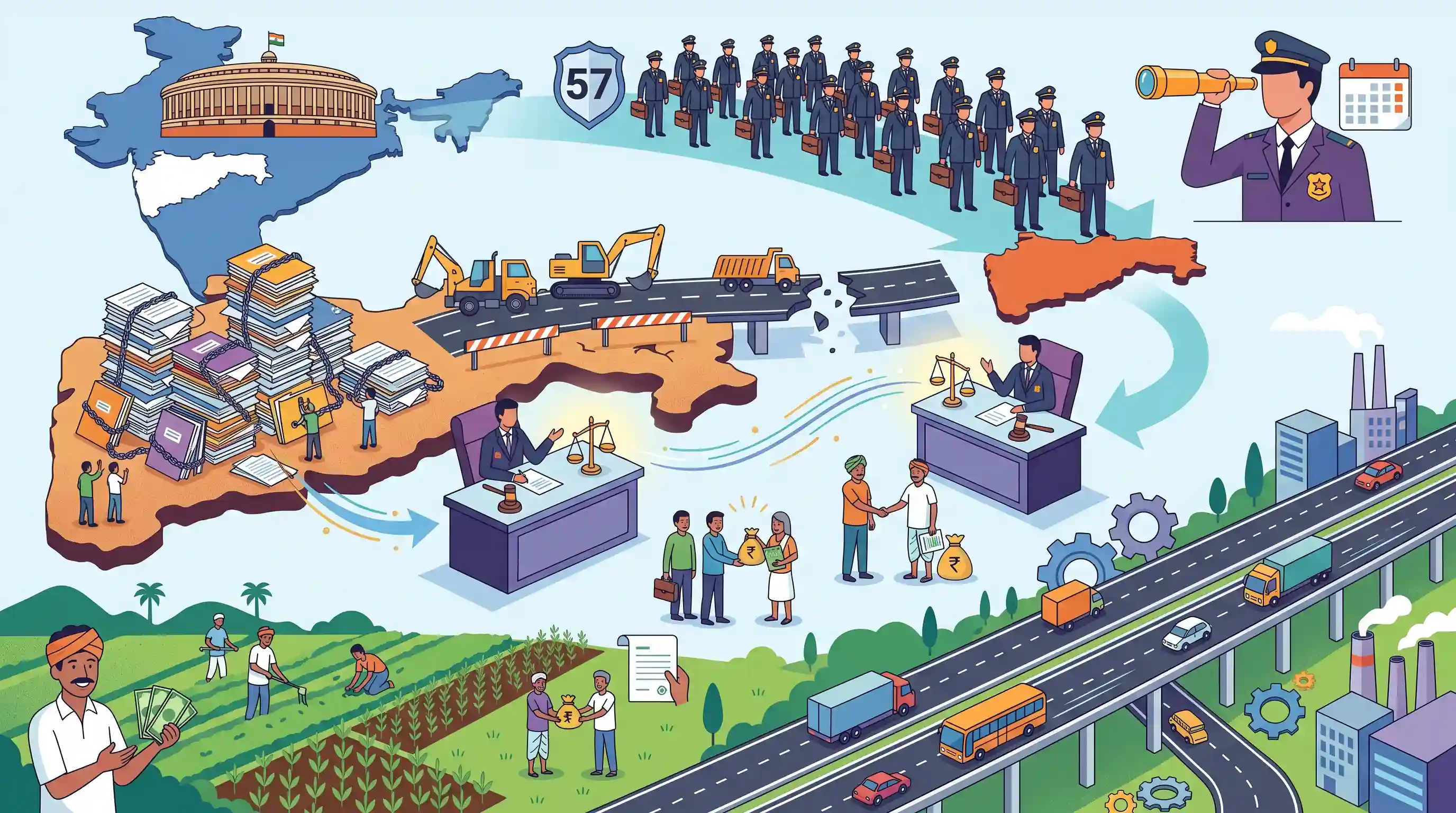
The Central Government has appointed 57 new arbitrators in Maharashtra, selected from the cadre of Additional Commissioners and Additional District Collectors, to expedite the resolution of over 28,000 pending land acquisition cases related to National Highways Authority of India (NHAI) projects. This targeted alternative dispute resolution (ADR) initiative aims to deliver long-delayed compensation to project-affected farmers, enhance transparency in settlements, and remove critical land acquisition bottlenecks that stall state and national infrastructure development. Divisional Commissioners will conduct monthly reviews to ensure timely disposal of claims.
Key Points
- Dedicated Arbitrators for Backlog: 57 experienced state revenue officers have been designated as arbitrators specifically to clear 28,000+ pending NHAI land acquisition claims across Maharashtra.
- Speedy Dispute Resolution (ADR): The move leverages alternative dispute resolution (arbitration) to bypass traditional court delays, assigning all claims related to the same award to the same officer for consistency.
- Farmer Welfare & Compensation: Focuses on safeguarding the rights of project-affected persons (primarily farmers) who have been waiting years for enhanced compensation, ensuring timely and transparent payouts.
- Accelerating Infrastructure: Unblocking these protracted land disputes will directly speed up the execution of delayed national highway projects in the state, boosting overall economic development.
- Accountability Mechanism: Divisional Commissioners are tasked with conducting monthly reviews of the arbitrators' performance, while NHAI will fund the necessary administrative and manpower expenses.
Important Terms
RFCTLARR Act, 2013

A 2013 law replacing the 1894 Act to ensure fair compensation, transparency, rehabilitation, and resettlement for individuals whose land is acquired for public projects.
UPSC context
GS2 (Govt Policies) & GS3 (Land Reforms); tests the balance between industrial growth and social equity.
National Highways Act, 1956
Legislation governing the development and maintenance of National Highways; Section 3G specifically empowers the government to acquire land and mandates arbitration for compensation disputes.
UPSC context
GS3 (Infrastructure); crucial for understanding the legal authority behind connectivity projects like Bharatmala.
National Highways Authority of India (NHAI)
An autonomous statutory body under the Ministry of Road Transport and Highways responsible for the development, maintenance, and management of India's national highways network.
UPSC context
GS3 (Infrastructure); essential for questions on logistics, connectivity, and infrastructure bottlenecks.
Alternative Dispute Resolution (ADR)
Non-judicial mechanisms like arbitration and mediation used to resolve disputes outside formal courts to reduce pendency and provide faster, cost-effective justice.
UPSC context
GS2 (Judiciary/Governance); central to discussing judicial reforms and Article 39A (Free Legal Aid).
Arbitrator (Section 3G)
A neutral authority, typically a senior revenue official, appointed by the Central Government to settle compensation disputes under Section 3G(5) of the National Highways Act.
UPSC context
GS2 (Statutory/Quasi-judicial Bodies); tests knowledge of administrative officials performing specialized legal roles.
Revenue Department
State administrative wing responsible for land records and revenue; its officers (Collectors/Commissioners) often serve as the competent authority or arbitrators in land acquisition.
UPSC context
GS2 (Governance); illustrates the intersection of administrative roles and judicial functions in district governance.
Prelims Trap
Arbitrators for NHAI land acquisition disputes are appointed by the State Government because they are state revenue officers.
False. Under Section 3G of the National Highways Act, 1956, the Central Government uniquely holds the power to appoint these statutory arbitrators.
Static Concepts Connected
What are the primary mechanisms of Alternative Dispute Resolution (ADR) in India?
- Arbitration: A formal process where a neutral third party renders a legally binding award. Can be contractual or statutory (e.g., under the National Highways Act).
- Conciliation: A non-binding process where the conciliator actively evaluates the dispute and proposes settlement solutions to the disputing parties.
- Mediation: A voluntary process where a mediator facilitates communication but does not impose or actively propose solutions; recently formalized by the Mediation Act 2023.
How is land acquisition specifically managed for National Highways?
- Statutory backing: Acquisition is executed under the National Highways Act, 1956 (Section 3), which allows the Centre to acquire land rapidly for infrastructure purposes.
- Compensation parity: Though acquired under the NH Act, the compensation and rehabilitation payouts must align with the First and Second Schedules of the RFCTLARR Act, 2013.
- Dispute mechanism: Any dispute regarding the determined compensation amount is strictly decided by an arbitrator appointed by the Central Government.
Cross-Topic Patterns
Quasi-judicial role of the Executive
Appointing state revenue officers as arbitrators touches upon the GS2 theme of executive agencies performing quasi-judicial functions, raising debates about neutrality in government-driven land acquisitions.
Infrastructure delays and NPA stress
Land dispute backlogs stall NHAI projects, causing severe cost overruns that historically translate into stressed assets for banks, linking GS2 governance to GS3 macroeconomic stability.

Expect a Prelims question comparing the Mediation Act 2023 provisions with statutory arbitration powers under sector-specific laws.
Linked PYQs · 5
Linked PYQs · 5
- 2024MainsGS2
Explain and distinguish between Lok Adalats and Arbitration Tribunals. Whether they entertain civil as well as criminal cases ?
- 2025MainsGS2
Comment on the need of administrative tribunals as compared to the court system. Assess the impact of the recent tribunal reforms through rationalization of tribunals made in 2021.
- 2014MainsGS3
The Right to Fair Compensation and Transparency in Land Acquisition, Rehabilitation and Resettlement Act, 2013 has come into effect from 1st January, 2014. What are the key issues which would get addressed with the Act in place? What implications would it have on industrialization and agriculture in India?
- 2021MainsGS3
“Investment in infrastructure is essential for more rapid and inclusive economic growth.” Discuss in the light of India's experience.
- 2024MainsGS3
What were the factors responsible for the successful implementation of land reforms in some parts of the country? Elaborate.
