India Nepal Bilateral Relations and Regional Political Shifts
Source:The Hindu ↗
Why It Matters
Understanding the shifting domestic political dynamics in South Asia—specifically the rise of new leaderships driven by youth protests—is crucial for analyzing the challenges and future trajectory of India's 'Neighbourhood First' policy. It also provides context on ongoing territorial disputes and areas of mutual cooperation with Nepal.
Summary
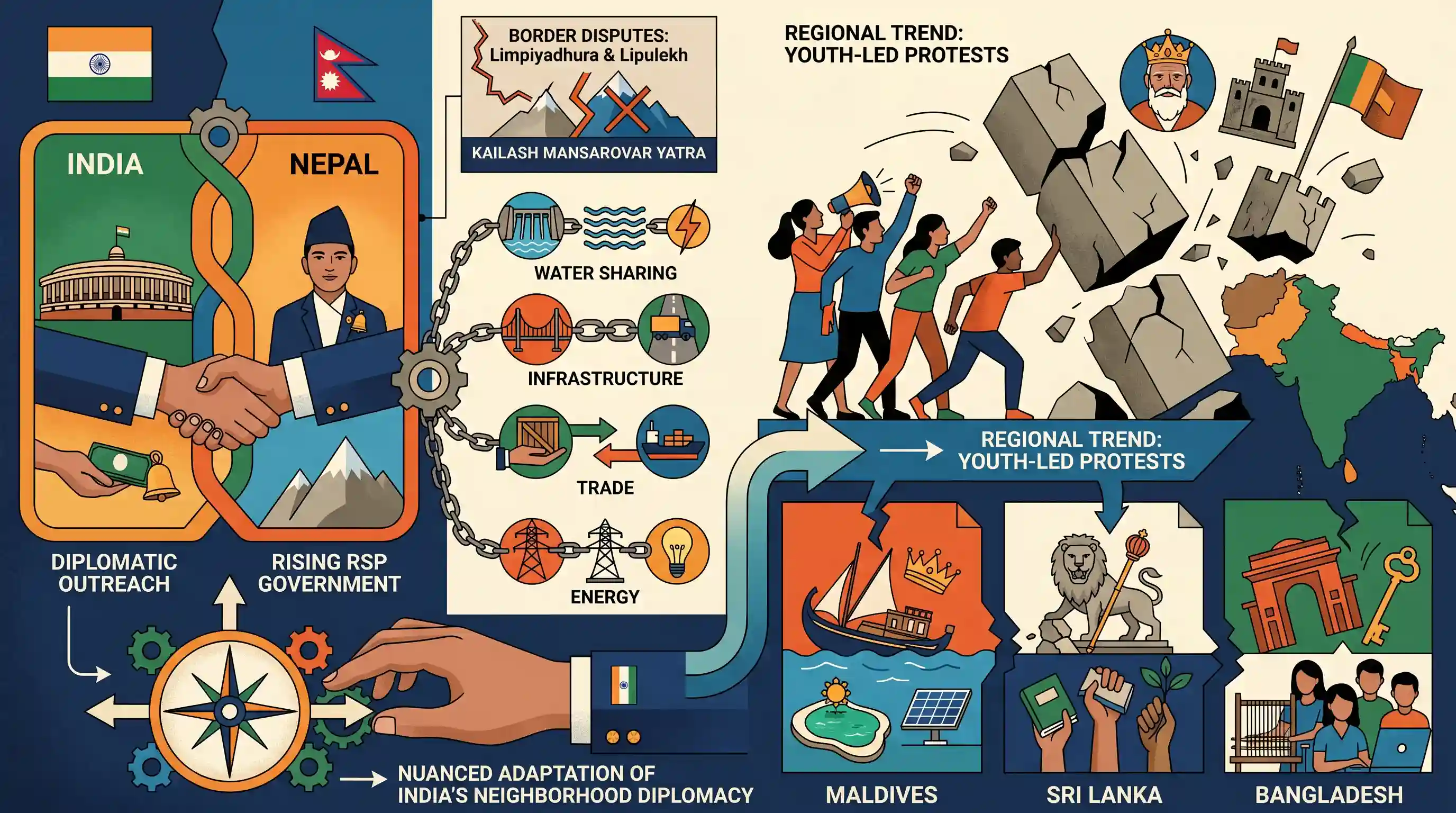
The editorial analyses the recent diplomatic outreach between India and Nepal following the rise of a new government in Kathmandu led by PM Balen Shah's Rastriya Swatantra Party (RSP). The relationship faces challenges from unresolved border disputes over Limpiyadhura and Lipulekh, which may flare up during the Kailash Mansarovar Yatra. However, there is a comprehensive bilateral agenda covering water sharing, infrastructure, trade, and energy. Importantly, the article contextualizes Nepal's political shift within a broader regional trend where youth-led protests have upended traditional power structures in Maldives, Sri Lanka, and Bangladesh, necessitating a nuanced adaptation of India's neighborhood diplomacy.
Key Points
- The visit of Nepal Foreign Minister Shisir Khanal to Delhi initiates contact with Nepal’s new Rastriya Swatantra Party (RSP) leadership under PM Balen Shah.
- Border disputes over Limpiyadhura and Lipulekh remain contentious, with the Nepali PM employing aggressive rhetoric regarding territorial claims.
- Bilateral relations encompass a broader agenda, including border management, water-sharing agreements, infrastructure, trade, and energy cooperation.
- Youth-led anti-incumbency movements have recently ousted established regimes in Nepal, Maldives, Sri Lanka, and Bangladesh, forcing India to recalibrate its regional diplomacy.
Important Terms
Rastriya Swatantra Party (RSP)

A youth-centric, centrist political party in Nepal that rose to power in 2026 on an anti-corruption and meritocracy platform. Led by Prime Minister Balen Shah, it represents a generational shift in Nepal's leadership.
UPSC context
GS Paper II: India’s Neighborhood. Tests understanding of internal political dynamics in neighbor states and their subsequent impact on bilateral diplomacy.
Lipulekh-Kalapani-Limpiyadhura Dispute
A territorial conflict at the India-Nepal-China tri-junction. Friction stems from competing interpretations of the 1816 Treaty of Sugauli regarding the geographic source of the Mahakali (Kali) River.
UPSC context
GS Paper II: Bilateral Relations. Tests knowledge of border management, historical treaties, and strategic tri-junctions involving India, Nepal, and China.
1816 Treaty of Sugauli
The 1816 agreement between the British East India Company and the Kingdom of Nepal that defined Nepal's western border. It is the primary legal reference for current territorial disputes.
UPSC context
GS Paper I (History) and II (IR). Essential for understanding the historical evolution of India-Nepal borders and modern diplomatic friction.
1950 Treaty of Peace and Friendship
Foundational bilateral agreement establishing open borders and 'national treatment' for each other's citizens. It is frequently debated in Nepal due to perceived unequal provisions and strategic constraints.
UPSC context
GS Paper II: Bilateral Relations. A recurring theme in India-Nepal ties, security cooperation, and regional sovereignty debates.
Neighborhood First Policy
India’s core diplomatic framework prioritizing stable, prosperous relations with immediate neighbors through connectivity, energy cooperation, and development assistance while managing regional geopolitical competition.
UPSC context
GS Paper II: India and its Neighborhood. The central theme for questions on regional stability, economic integration, and countering external influences.
Kailash Mansarovar Yatra
A high-altitude annual pilgrimage to Tibet. The use of the Lipulekh Pass route by India is a recurring diplomatic flashpoint as Nepal claims the area as sovereign territory.
UPSC context
GS Paper I (Culture) and II (Bilateral Relations). Illustrates the intersection of cultural heritage and territorial sovereignty in diplomatic standoffs.
Prelims Trap
"The 1950 Treaty of Peace and Friendship demarcated the India-Nepal boundary along the Kali River."
The 1816 Treaty of Sugauli demarcated the boundary using the Kali River. The 1950 treaty governs the open border, national treatment of citizens, and security ties, not the territorial boundary itself.
Static Concepts Connected
What is the geographical and historical basis of the Kalapani territorial dispute?
- Treaty of Sugauli (1816): Fixed the Kali (Mahakali) River as Nepal's western boundary with India after the Anglo-Nepalese War.
- Source Ambiguity: The dispute stems from divergent interpretations of the Kali River's exact origin—Nepal claims it begins at Limpiyadhura, while India maps it originating near Kalapani.
- Strategic Tri-junction: The Lipulekh pass forms a tri-junction between India, Nepal, and Tibet, serving as the shortest route to Kailash Mansarovar and a critical military vantage point.
What are the major transboundary water-sharing frameworks between India and Nepal?
- Mahakali Treaty (1996): Aims at equitable sharing of the Mahakali river waters and established the framework for the Pancheshwar Multipurpose Project for hydropower and flood control.
- Kosi & Gandak Agreements: Older bilateral agreements designed to manage transboundary river flooding in Bihar and UP while providing irrigation and power generation.
- Hydropower Diplomacy: India heavily invests in Nepali run-of-the-river hydropower (e.g., Arun-III) to boost cross-border energy trade and regional grid integration.
Cross-Topic Patterns
Demographics upending neighborhood diplomacy
The rise of youth-led, anti-incumbent movements in Nepal, Bangladesh, and Sri Lanka demands India's 'Neighbourhood First' policy pivot from relying on traditional political elites to actively engaging broader civil society.
Kailash Yatra routes and border friction
Pilgrimage infrastructure, such as the Lipulekh link road for the Kailash Mansarovar Yatra, frequently overlaps with contested borderlands, turning cultural connectivity into a hard-security flashpoint.

Expect a Prelims map question pairing Lipulekh/Kalapani with the Kali River, or a Mains Q on recalibrating 'Neighbourhood First'.
Linked PYQs · 3
Linked PYQs · 3
- 2012MainsGS2
Discuss the contentious issues that have caused the prolonged constitutional logjam in Nepal.
- 2022MainsGS2
India is an age-old friend of Sri Lanka.’ Discuss India's role in the recent crisis in Sri Lanka in the light of the preceding statement.
- 2024MainsGS2
Discuss the geopolitical and geostrategic importance of Maldives for India with a focus on global trade and energy flows. Further also discuss how this relationship affects India's maritime security and regional stability amidst international competition ?
