India artificial intelligence regulations and deepfake victim rights
Source:Indian Express ↗
Why It Matters
The proliferation of deepfakes is a growing cyber threat that compromises individual privacy and dignity. Understanding the limitations of India's current AI regulatory framework—specifically its failure to adopt a victim-centric approach—is essential for answering questions on technology regulation, privacy rights, and the ethical implications of AI across GS2, GS3, and GS4.
Summary
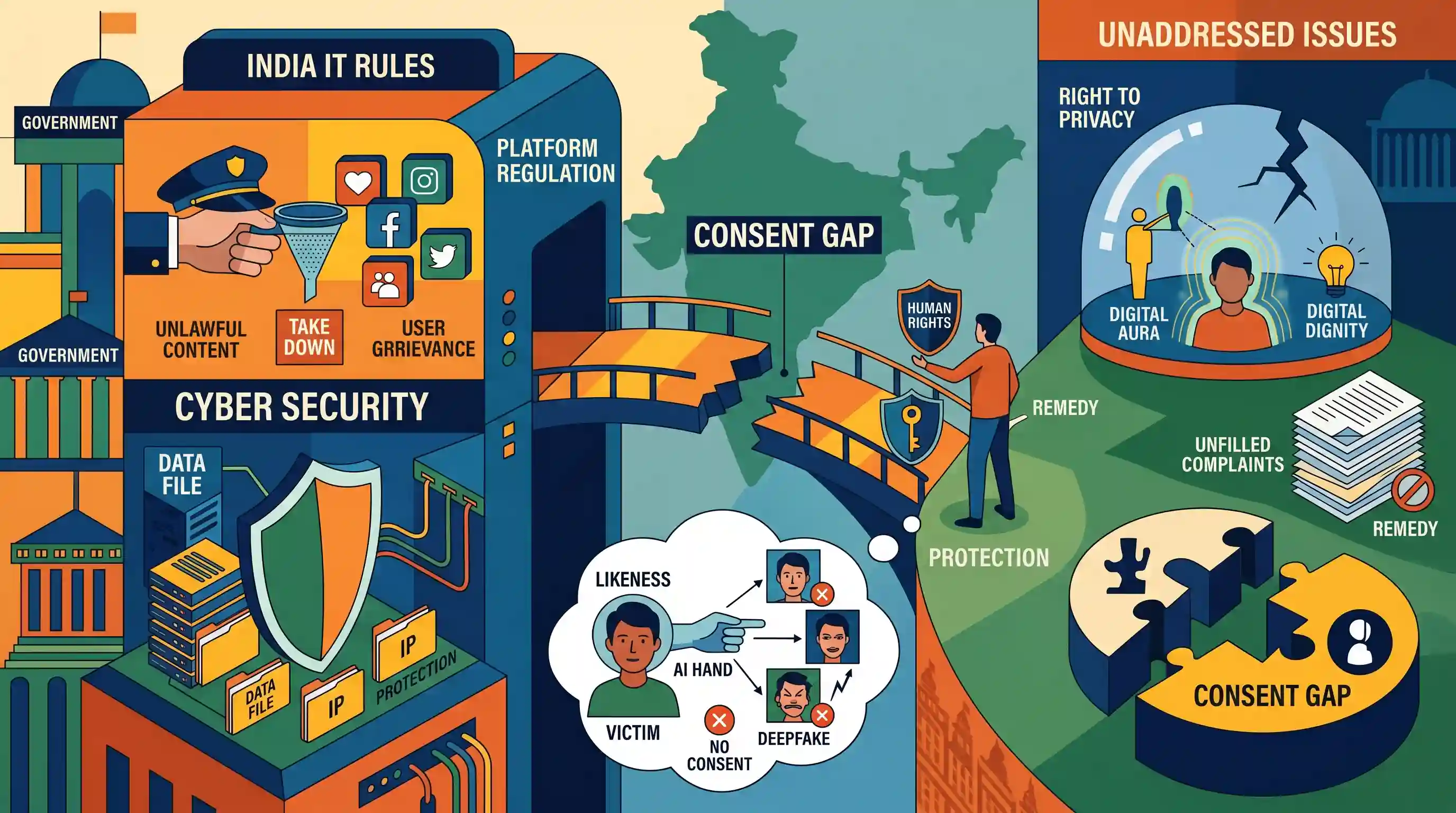
The article critiques India's emerging AI and IT regulations concerning deepfake images, identifying a critical 'consent gap.' It argues that while the current regulatory framework focuses heavily on protecting digital files and policing platforms, it largely ignores the human victims whose likenesses are exploited. By failing to center the rights, consent, and digital dignity of individuals affected by deepfakes, the rules fall short of providing adequate protection or remedies against the non-consensual use of personal images, highlighting major privacy and ethical concerns in the digital age.
Key Points
- India's recent AI and IT regulations attempt to curb the spread of deepfake images but suffer from a significant 'consent gap'.
- The regulations primarily focus on the technical aspects and digital platforms (protecting the 'file'), overlooking the human element and the actual victims.
- A victim-centric approach is lacking, as current rules do not adequately address the non-consensual exploitation of a person's likeness or offer swift remedies.
- Deepfakes pose severe ethical and legal challenges, severely infringing on an individual's Right to Privacy (Article 21) and digital dignity.
Important Terms
Information Technology (Intermediary Guidelines and Digital Media Ethics Code) Rules, 2021

Secondary legislation under the IT Act, 2000, that regulates social media, OTT platforms, and digital news through due diligence requirements and a three-tier grievance redressal mechanism.
UPSC context
GS Paper 2 & 3: Tests understanding of digital governance, intermediary liability (safe harbour), and regulation of online content.
Digital Personal Data Protection (DPDP) Act, 2023
India’s first comprehensive framework for processing digital personal data, establishing rights for individuals (Data Principals) and obligations for entities (Data Fiduciaries) to ensure privacy.
UPSC context
GS Paper 2: Fundamental Rights/Polity. Crucial for discussions on the Right to Privacy and data sovereignty.
Deepfakes
Synthetic media created using Artificial Intelligence (deep learning) to manipulate or generate authentic-looking images, videos, or audio, often used to depict people saying or doing things they never did.
UPSC context
GS Paper 3: Science & Tech/Cyber Security. Concerns include misinformation, election integrity, and non-consensual imagery.
Digital Dignity
A rights-based concept emphasizing an individual's autonomy and control over their digital likeness, representational authenticity, and informational integrity in an era of pervasive surveillance and AI.
UPSC context
GS Paper 4: Ethics. Explores the moral obligation of technology to respect human agency and personal identity.
Synthetically Generated Information (SGI)
A legal term introduced in IT Rule amendments referring to images, videos, or audio generated or altered algorithmically to appear authentic; specifically used to regulate deepfakes.
UPSC context
GS Paper 3: Science & Tech. Tests knowledge of specific terminology used in India’s emerging AI regulatory framework.
Right to Privacy (Article 21)
A fundamental right under Article 21, as affirmed in the K.S. Puttaswamy judgment (2017), protecting individuals from unauthorized state or private interference in personal matters.
UPSC context
GS Paper 2: Constitution/Polity. The foundational legal principle for all data protection and surveillance-related legislation in India.
Prelims Trap
India recently enacted a dedicated Deepfake Act to explicitly ban non-consensual AI image generation.
India lacks a dedicated deepfake law. Authorities currently penalize deepfakes using Section 66D of the IT Act (cheating by personation) and IT Rules 2021 amendments.
Static Concepts Connected
How is the Right to Privacy structurally protected under the Indian Constitution?
- Puttaswamy Judgment: Declared privacy as an intrinsic part of the right to life and personal liberty under Article 21, moving it beyond mere statutory rights.
- Informational Privacy: Recognized an individual's control over their personal data, digital footprint, and likeness as a fundamental right requiring protection.
- Three-fold Test: Any state restriction on privacy must pass the tests of legality, legitimate state aim, and proportionality.
What is 'Safe Harbour' protection for intermediaries under the IT Act, 2000?
- Section 79 Immunity: Section 79 grants immunity to social media platforms and intermediaries from legal liability for third-party, user-generated content hosted on their platforms.
- Due Diligence Condition: Protection is conditional. Intermediaries must observe strict due diligence, including the rapid takedown of unlawful content (e.g., non-consensual deepfakes within 2 hours under recent IT Rules).
Cross-Topic Patterns
DPDP Act limits vs. Deepfake regulation
While the DPDP Act protects personal data, it struggles with synthetically generated likenesses (deepfakes), which often blur the legal line between proprietary personal data and newly generated synthetic media.
Digital Ethics and Bodily Autonomy
The shift from policing the 'file' to protecting the 'human' reflects a core GS4 ethical debate: prioritizing human dignity and bodily autonomy over mere procedural compliance in tech regulation.

Expect a GS2/GS3 question analyzing whether existing IT Rules and Section 66D suffice to tackle the AI 'consent gap' and deepfakes.
Linked PYQs · 5
Linked PYQs · 5
- 2023MainsGS3
Introduce the concept of Artificial Intelligence (AI). How does Al help clinical diagnosis? Do you perceive any threat to privacy of the individual in the use of Al in healthcare?
- 2020MainsGS3
Discuss different types of cyber crimes and measures required to be taken to fight the menace.
- 2024MainsGS4
The application of Artificial Intelligence as a dependable source of input for administrative rational decision-making is a debatable issue. Critically examine the statement from the ethical point of view.
- 2025MainsGS4
In the present digital age, social media has revolutionised our way of communication and interaction. However, it has raised several ethical issues and challenges. Describe the key ethical dilemmas in this regard.
- 2024MainsGS2
Right to privacy is intrinsic to life and personal liberty and is inherently protected under Article 21 of the constitution. Explain. In this reference discuss the law relating to D.N.A. testing of child in the womb to establish its paternity.
