ICU Fire Safety Hazards and Electrical Harmonics in Hospitals
Source:The Hindu ↗
हे का महत्त्वाचे आहे
This article highlights critical infrastructure vulnerability in public and private healthcare facilities. Understanding modern fire hazards (like electrical harmonics) and disaster protocols (like RACE and horizontal evacuation) is essential for GS3 Disaster Management answers, particularly regarding vulnerable populations and resilient infrastructure.
सारांश
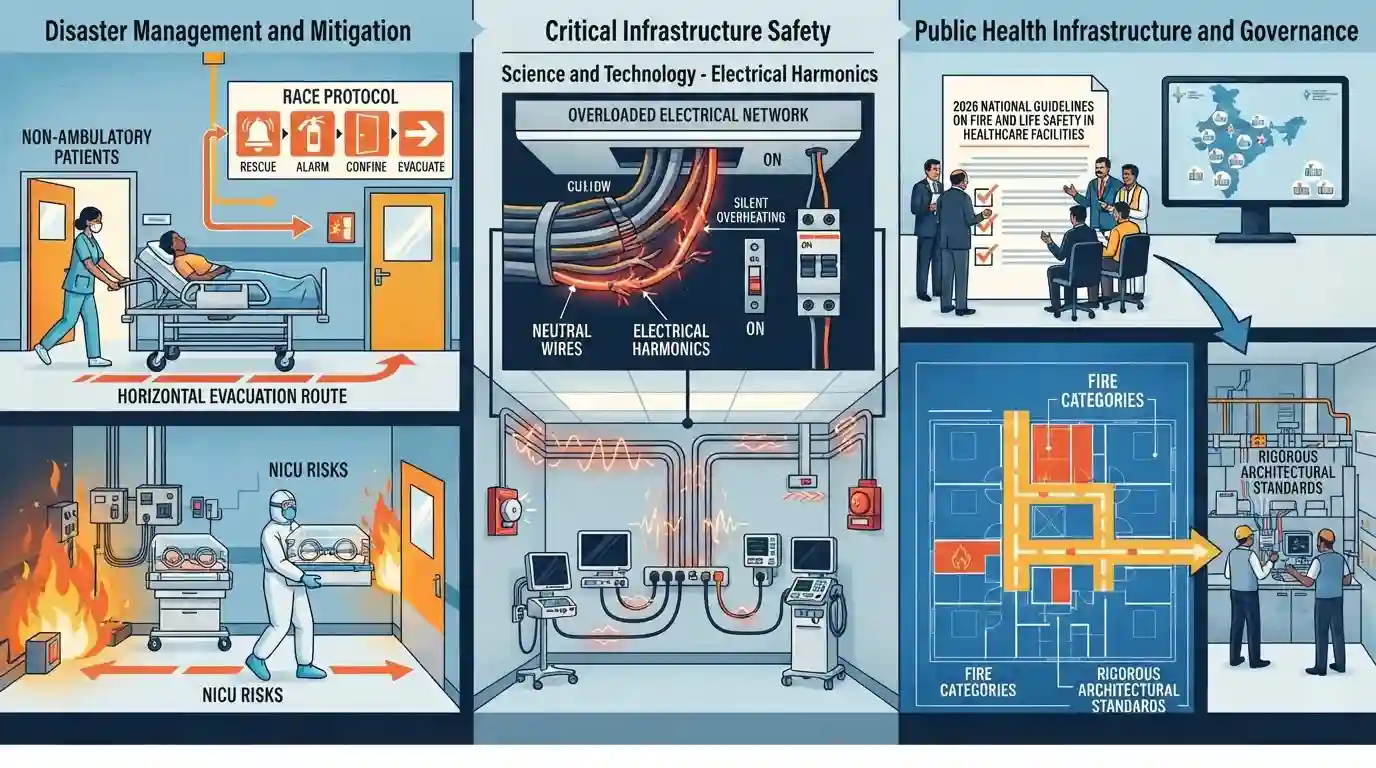
The editorial analyzes the escalating threat of 'new-age' fire disasters in India's healthcare facilities, specifically targeting Intensive Care Units (ICUs) and Neonatal ICUs (NICUs). Driven by overloaded electrical networks and a lack of maintenance, these fires are compounded by sealed, oxygen-rich ICU environments and the non-ambulatory status of patients. Beyond typical short circuits, the article identifies electrical harmonics—where modern electronic equipment silently overheats neutral wiring without tripping circuit breakers—as a major unaddressed risk. It advocates for ICU-specific fire categories, rigorous architectural standards (like horizontal evacuation routes), and active implementation of the 2026 National Guidelines on Fire and Life Safety in Healthcare Facilities alongside the RACE evacuation protocol.
मुख्य मुद्दे
- Shifting Fire Risks: Fire hazards in India have shifted over the last 15 years from industrial sites and commercial spaces to residential structures, hotels, and critically, healthcare units like ICUs and NICUs.
- Extreme Vulnerability of ICUs/NICUs: ICUs are sealed, oxygen-rich environments where smoke accumulates rapidly. Newborns and critical patients are non-ambulatory, meaning they cannot self-evacuate and rely entirely on external rescue protocols.
- Electrical Harmonics as a Silent Threat: Modern medical equipment draws distorted current, generating electrical harmonics that silently overheat neutral wiring, connections, and transformers. This occurs without tripping standard circuit breakers and is often misdiagnosed as generic short circuits.
- Architectural and Operational Safeguards: Effective ICU layouts require at least three independent exits (with two for horizontal evacuation), automatic sprinklers, independent power lines, oxygen cylinder bed supports, and oxygen outlets placed away from electrical sockets.
- Regulatory Frameworks and Protocols: Compliance with the National Guidelines on Fire and Life Safety in Healthcare Facilities 2026 is critical. Safety standards must incorporate the RACE protocol (Rescue, Alarm, Confine, Extinguish/Evacuate), regular power audits, and bi-annual fire drills.
महत्त्वाच्या संज्ञा
National Guidelines on Fire and Life Safety in Healthcare Facilities 2026

A revised national framework by India's Ministry of Health and Family Welfare mandating strict fire-risk assessments, electrical audits, and specialized evacuation protocols for high-risk zones like ICUs and NICUs.
UPSC context
GS II & III: Tests safety compliance, hospital infrastructure standards, and disaster management regulations in critical healthcare facilities.
RACE Protocol
A standard fire emergency response protocol representing Rescue (move patients), Alarm (activate alerts), Confine (contain smoke/fire), and Extinguish/Evacuate, used to streamline hospital emergency evacuations.
UPSC context
GS III: Tests standard operating procedures, emergency management, and rapid evacuation planning for vulnerable, non-ambulatory patients.
National Neonatology Forum
A premier professional body of neonatologists in India that advocates for newborn care standards and champions mandatory fire-safety certifications and power audits for NICUs.
UPSC context
GS II: Tests the role of civil society and professional associations in shaping public health policies and safety standards.
Electrical Harmonics
Distortions in electrical current waveforms caused by modern electronic devices that silently overheat neutral wiring and transformers without tripping circuit breakers, posing a hidden fire risk.
UPSC context
GS III: Tests technical understanding of engineering failures, critical infrastructure safety, and non-conventional fire hazard mitigation.
पूर्वपरीक्षा सापळा
Standard circuit breakers (MCBs) will instantly trip to prevent fires caused by neutral-wire overheating from electrical harmonics.
MCBs detect overcurrent/short circuits on phase lines. Harmonics silently overheat neutral lines and transformers without triggering these standard protective safety devices.
संबंधित स्थिर संकल्पना
What are electrical harmonics and why are they hazardous to modern power systems?
- Non-linear loads: Devices like SMPS in medical equipment draw current in pulses, distorting the standard sinusoidal AC waveform.
- Neutral wire risk: Triplen harmonics (odd multiples like 3rd, 9th) accumulate in the neutral wire, causing cumulative thermal overload.
- Breaker immunity: Because phase currents may remain below the trip threshold, standard MCBs fail to detect this hazardous neutral overheating.
What is the constitutional and administrative jurisdiction of fire safety services in India?
- State Subject: Fire services fall under municipal functions listed in the Twelfth Schedule (Article 243W) of the Constitution of India.
- Model Bill: The Central government provides the Model Fire Force Bill, but actual enactment and enforcement lie entirely with state legislatures.
- NBC Status: The National Building Code (NBC) is a guiding document by BIS; it becomes legally binding only when incorporated into local municipal building bye-laws.
आंतर-विषय नमुने
Asymmetric Federalism & Fire Safety
Center-led 2026 health guidelines face implementation bottlenecks because fire services and municipal building bye-laws fall under state jurisdiction, creating uneven national safety compliance.
Airtight Green Buildings & ICU Fires
Energy-efficient glass facades lower cooling costs but act as toxic traps in oxygen-rich ICUs, illustrating a direct conflict between thermal insulation and fire safety.

S&T questions on electrical harmonics might be paired with disaster mitigation strategies like the 2026 Healthcare Fire Guidelines.
संबंधित PYQ · 2
संबंधित PYQ · 2
- 2019MainsGS3
Vulnerability is an essential element for defining disaster impacts and its threat to people. How and in what ways can vulnerability to disasters be characterized? Discuss different types of vulnerability with reference to disasters.
- 2024MainsGS3
What is disaster resilience? How is it determined? Describe various elements of a resilience framework. Also mention the global targets of Sendai Framework for Disaster Risk Reduction (2015–2030).
