Election Commission Independence and Institutional Checks and Balances
Source:The Hindu ↗
Why It Matters
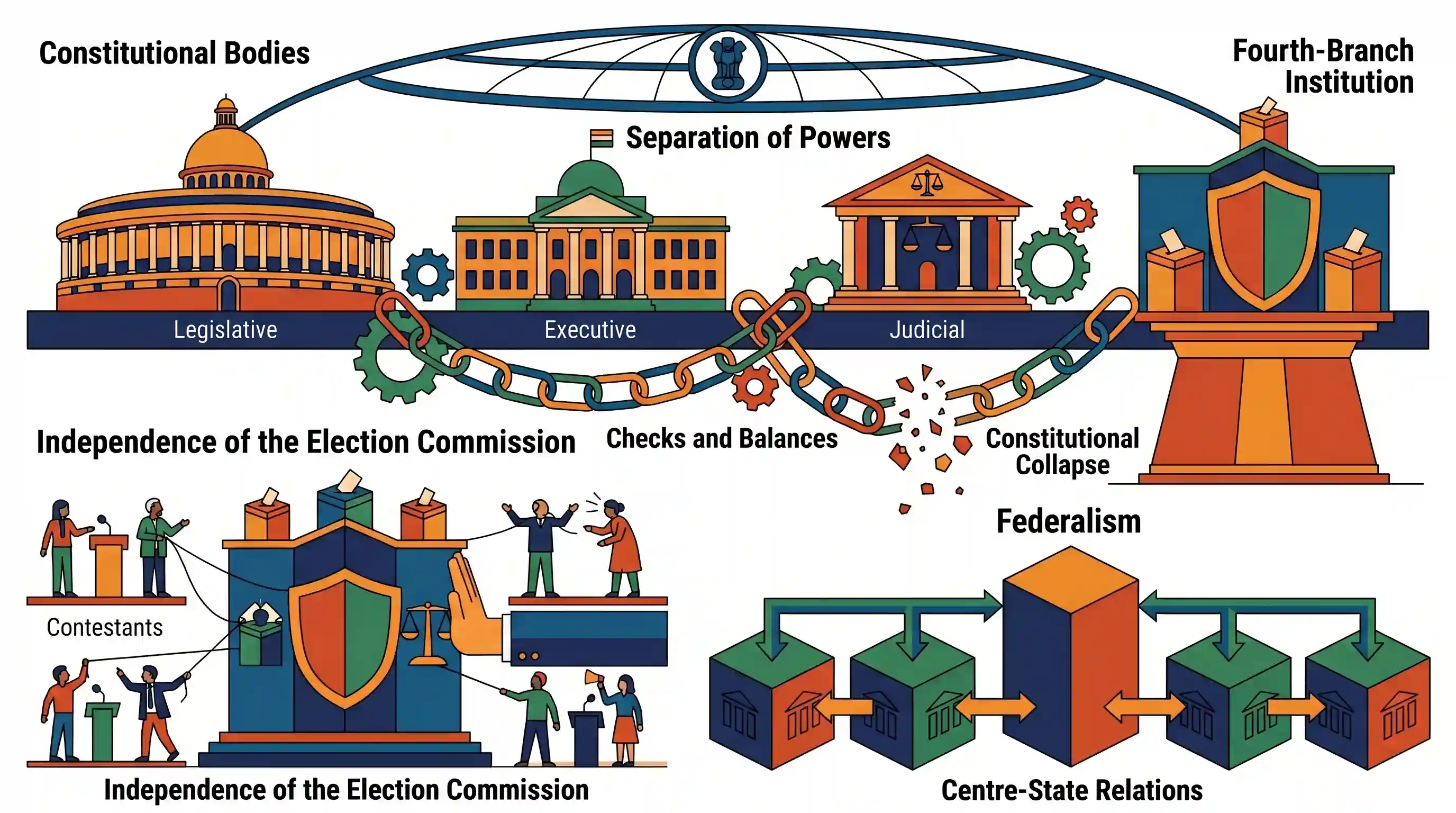
The structural independence of constitutional bodies like the Election Commission is a recurrent theme in UPSC GS Paper 2. Justice Nagarathna's remarks on "fourth-branch institutions", separation of powers, and the "coordinate" nature of federalism provide rich, quotable perspectives for Mains answers regarding institutional autonomy and constitutional checks and balances.
Summary
Supreme Court Judge Justice B.V. Nagarathna has emphasized the critical need for the structural independence of the Election Commission, asserting that electoral neutrality cannot be guaranteed if the body conducting polls depends on the contestants. Speaking at the Chanakya National Law University, she highlighted the significance of "fourth-branch institutions" like the EC that operate outside the traditional tripartite separation of powers to maintain constitutional order. Furthermore, she warned that institutional failure to exercise checks and balances could lead to constitutional collapse, while also advocating for robust federalism where states are viewed as coordinates rather than subordinates.
Key Points
- Justice B.V. Nagarathna stressed that the structural independence of the Election Commission is vital, warning that electoral neutrality is compromised if the body depends on election contestants.
- She highlighted the emergence of "fourth-branch institutions" like the EC, which sit outside the classical tripartite separation of powers but are essential for maintaining constitutional order.
- Justice Nagarathna cautioned that a constitutional collapse could occur if institutions fail to act as checks and balances against each other.
- On the topic of federalism, she advocated that states should be treated as "coordinates and not subordinates" to ensure a constitutional arrangement of co-equals.
Important Terms
Election Commission of India (ECI)

A permanent constitutional body under Article 324 mandated to conduct free and fair elections to the Parliament, state legislatures, and the offices of President and Vice-President.
UPSC context
GS II (Constitutional Bodies); essential for understanding electoral governance and institutional autonomy.
Fourth-branch institutions
Autonomous oversight bodies (e.g., ECI, CAG) that function alongside the traditional tripartite branches to ensure transparency, accountability, and the protection of democratic integrity against executive overreach.
UPSC context
GS II (Governance/Polity); tests knowledge of modern accountability frameworks and "integrity institutions."
Coordinate Federalism
A federal arrangement where the Union and State governments are treated as co-equal, independent entities within their constitutional spheres, rather than states being subordinates to the central authority.
UPSC context
GS II (Federalism); critical for analyzing Centre-State relations and the spirit of cooperative federalism.
Structural Independence
The institutional insulation of a body from external political influence, typically ensured through transparent appointment processes, security of tenure, and financial autonomy.
UPSC context
GS II (Polity); vital for evaluating the neutrality of constitutional and oversight bodies.
Separation of Powers
A constitutional doctrine dividing governance into three branches—Legislature, Executive, and Judiciary—to prevent the concentration of power and provide mutual checks and balances.
UPSC context
GS II (Polity); a "Basic Structure" pillar often tested via institutional friction and judicial review.
Supreme Court of India
The highest judicial authority and guardian of the Constitution in India, responsible for interpreting the law and ensuring that all state actions adhere to constitutional principles.
UPSC context
GS II (Judiciary); central to questions on judicial activism, fundamental rights, and constitutional law.
Prelims Trap
"The Constitution of India explicitly categorises the Election Commission and CAG as 'Fourth-Branch' integrity institutions."
"Fourth-branch" is a political science concept, not a constitutional classification. The Constitution only formally delineates the Executive, Legislature, and Judiciary, despite granting structural independence to certain bodies.
Static Concepts Connected
What are "Fourth-Branch" integrity institutions in modern democratic governance?
- Definition: Independent watchdogs that operate outside the classical tripartite separation of powers to safeguard democratic frameworks.
- Indian Examples: The Election Commission, CAG, UPSC, and statutory bodies like Information and Human Rights Commissions.
- Primary Function: To act as referees or guarantors of constitutional order, immune from executive or legislative partisan pressures.
What are the constitutional gaps in the structural independence of the ECI?
- No Qualifications: Article 324 does not prescribe any educational, legal, or administrative qualifications for the appointment of Election Commissioners.
- Post-Retirement Appointments: Unlike the CAG or UPSC members, retiring Election Commissioners are not explicitly debarred from further government appointments.
- Differential Tenure: Only the Chief Election Commissioner is fully protected from arbitrary removal; other ECs can be removed on the CEC's recommendation.
Cross-Topic Patterns
EC Appointments + 2023 Act
Justice Nagarathna’s warning maps directly onto concerns regarding the 2023 CEC Act, which replaced the CJI with a Union Cabinet Minister, giving the executive a 2:1 majority in the ECI selection panel.
Federalism + Gubernatorial Overreach
The assertion that States are "coordinates, not subordinates" provides excellent fodder for GS2 answers analyzing Centre-State frictions over the partisan role of Governors and delayed assent to State Bills.

Expect a GS2 Mains question evaluating 'Fourth-Branch' institutions in India, tying the 2023 ECI Act to the broader separation of powers.
Linked PYQs · 3
Linked PYQs · 3
- 2019MainsGS2
Do you think that Constitution of India does not accept principle of strict separation of powers rather it is based on the principle of 'checks and balance'? Explain.
- 2022MainsGS2
Discuss the role of the Election Commission of India in the light of the evolution of the Model Code of Conduct.
- 2024MainsGS2
What changes has the Union Government recently introduced in the domain of Centre-State relations ? Suggest measures to be adopted to build the trust between the Centre and the States and for strengthening federalism.
