International humanitarian law and European sanctions in Middle East
Source:Indian Express ↗
Why It Matters
Highlights the intersection of international humanitarian law, geopolitics, and economic sanctions. It is crucial for understanding how multilateral institutions (like the ICC) and regional blocs (like the EU) respond to prolonged conflicts and potential human rights violations, which frequently features in UPSC GS2 IR questions.
Summary
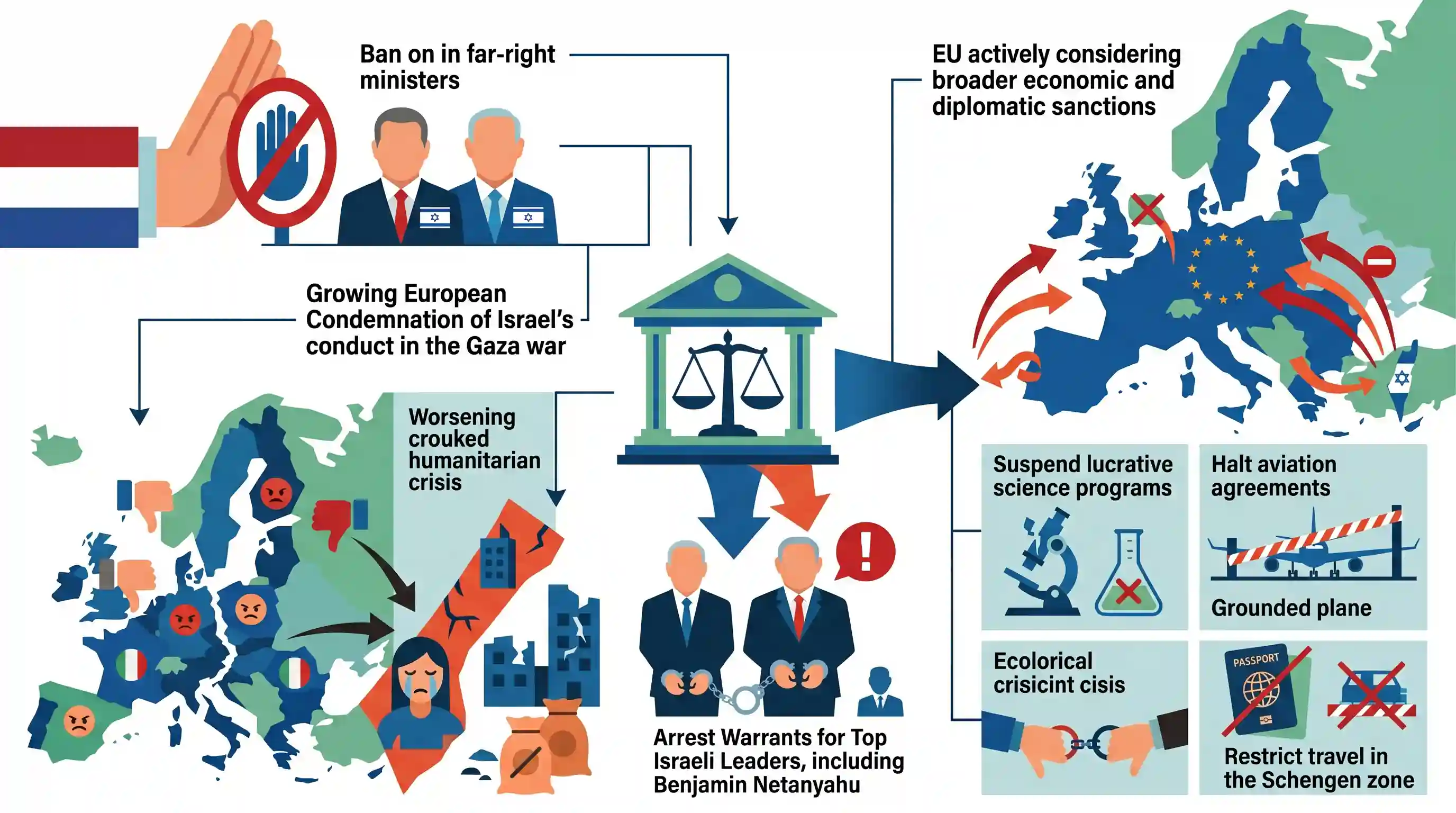
The Netherlands has banned two far-right Israeli ministers from entering the country, signaling growing European condemnation of Israel's conduct in the Gaza war and the worsening humanitarian crisis. This action coincides with the International Criminal Court's (ICC) recent issuance of arrest warrants for top Israeli leaders, including Prime Minister Benjamin Netanyahu. Consequently, the European Union is actively considering a broader set of economic and diplomatic sanctions against Israel, such as suspending lucrative science programs, halting aviation agreements, and restricting travel in the Schengen zone, marking a significant escalation in international pressure on Israel regarding compliance with international law.
Key Points
- The Netherlands has banned Israel's far-right ministers Itamar Ben-Gvir and Bezalel Smotrich from entering the country over their support for the Gaza war and obstruction of humanitarian aid.
- This diplomatic move follows the International Criminal Court (ICC) issuing arrest warrants for Israeli Prime Minister Benjamin Netanyahu and former Defense Minister Yoav Gallant.
- The European Union is deliberating broad sanctions on Israel, which may include suspending its participation in a €900 million science and technology programme.
- Other potential EU sanctions involve halting an aviation agreement, blocking imports from Israeli settlements in the West Bank, and restricting travel within Europe's Schengen zone.
Important Terms
International Criminal Court (ICC)

A permanent international tribunal in The Hague, established by the Rome Statute (2002) to prosecute individuals for genocide, war crimes, and crimes against humanity. It acts as a "court of last resort."
UPSC context
GS Paper II (International Relations). Tests knowledge of international judicial bodies, their jurisdiction, and India's stance (India is not a member).
European Union (EU)
A supranational political and economic union of 27 member states in Europe, operating through shared institutions to manage a single market, common trade policies, and collective foreign and security objectives.
UPSC context
GS Paper II (International Relations/Global Groupings). Focuses on regional integration, India-EU strategic partnership, and the EU's role in global geopolitics.
International Humanitarian Law (IHL)
A set of rules, primarily the Geneva Conventions, that seek to limit the effects of armed conflict by protecting non-combatants and restricting the means and methods of warfare.
UPSC context
GS Paper II (International Relations/Human Rights). Relates to global governance, the Geneva Conventions, and ethics in international conflicts.
Schengen Area
A zone comprising 29 European countries that have officially abolished internal border controls for the free movement of people. It includes most EU members and four non-EU states.
UPSC context
GS Paper II (International Relations). Relevant for understanding European integration, migration policies, and visa-free travel regimes affecting Indian citizens.
Hamas
A Palestinian Sunni-Islamic fundamentalist, militant, and political organization that has governed the Gaza Strip since 2007. It is designated as a terrorist organization by multiple countries and international entities.
UPSC context
GS Paper II (International Relations). Critical for understanding the West Asia conflict, non-state actors in global politics, and India's foreign policy in the region.
Prelims Trap
The International Criminal Court (ICC) is the principal judicial organ of the United Nations.
Aspirants confuse the ICC with the ICJ. The ICJ is the UN's principal judicial organ, whereas the ICC is an independent treaty-based tribunal established by the Rome Statute.
Static Concepts Connected
How does the ICC differ from the International Court of Justice (ICJ)?
- Jurisdiction: The ICC prosecutes individuals for war crimes and genocide; the ICJ settles legal disputes strictly between sovereign states.
- Institutional Origin: The ICC was established by the independent Rome Statute; the ICJ is the official, principal judicial organ of the United Nations.
- India's Membership: India is a founding member of the UN and ICJ, but is not a state party to the Rome Statute governing the ICC.
How does the European Union impose foreign policy sanctions?
- Unanimity Rule: Under the Common Foreign and Security Policy (CFSP), imposing broad diplomatic or economic sanctions structurally requires unanimous approval from all EU member states.
- Scope of Sanctions: Measures can include arms embargoes, asset freezes, travel bans within the border-free Schengen area, and the suspension of trade or science agreements.
Cross-Topic Patterns
Geneva Conventions & Occupied Territories
The illegality of West Bank settlements under the Fourth Geneva Convention overlaps with global debates on occupying powers, similar to recent discussions around Russia-Ukraine.
India's Rome Statute Abstention
India's refusal to join the ICC stems from state sovereignty concerns and the UNSC's referral powers, a recurring theme in global governance and UN reform debates.

Expect a Prelims question contrasting ICJ vs ICC jurisdiction, explicitly testing India and Israel's non-membership in the Rome Statute.
Linked PYQs · 3
Linked PYQs · 3
- 2018MainsGS2
“India’s relations with Israel have, of late, acquired a depth and diversity, which cannot be rolled back.” Discuss.
- 2012MainsGS2
How have the US sanctions against Iran affected India's bilateral relations with Iran?
- 2024MainsGS2
‘Terrorism has become a significant threat to global peace and security.’ Evaluate the effectiveness of the United Nations Security Council's Counter Terrorism Committee (CTC) and its associated bodies in addressing and mitigating this threat at the international level.
