Israel Position on International Security Force for Gaza
Source:The Hindu ↗
Why It Matters
The ongoing negotiations over post-war governance in Gaza highlight the complexities of conflict resolution in the Middle East. Understanding the dynamics of proposed multinational forces, regional diplomacy, and the role of international bodies like the UN is crucial for analyzing the shifting geopolitical landscape of West Asia.
Summary
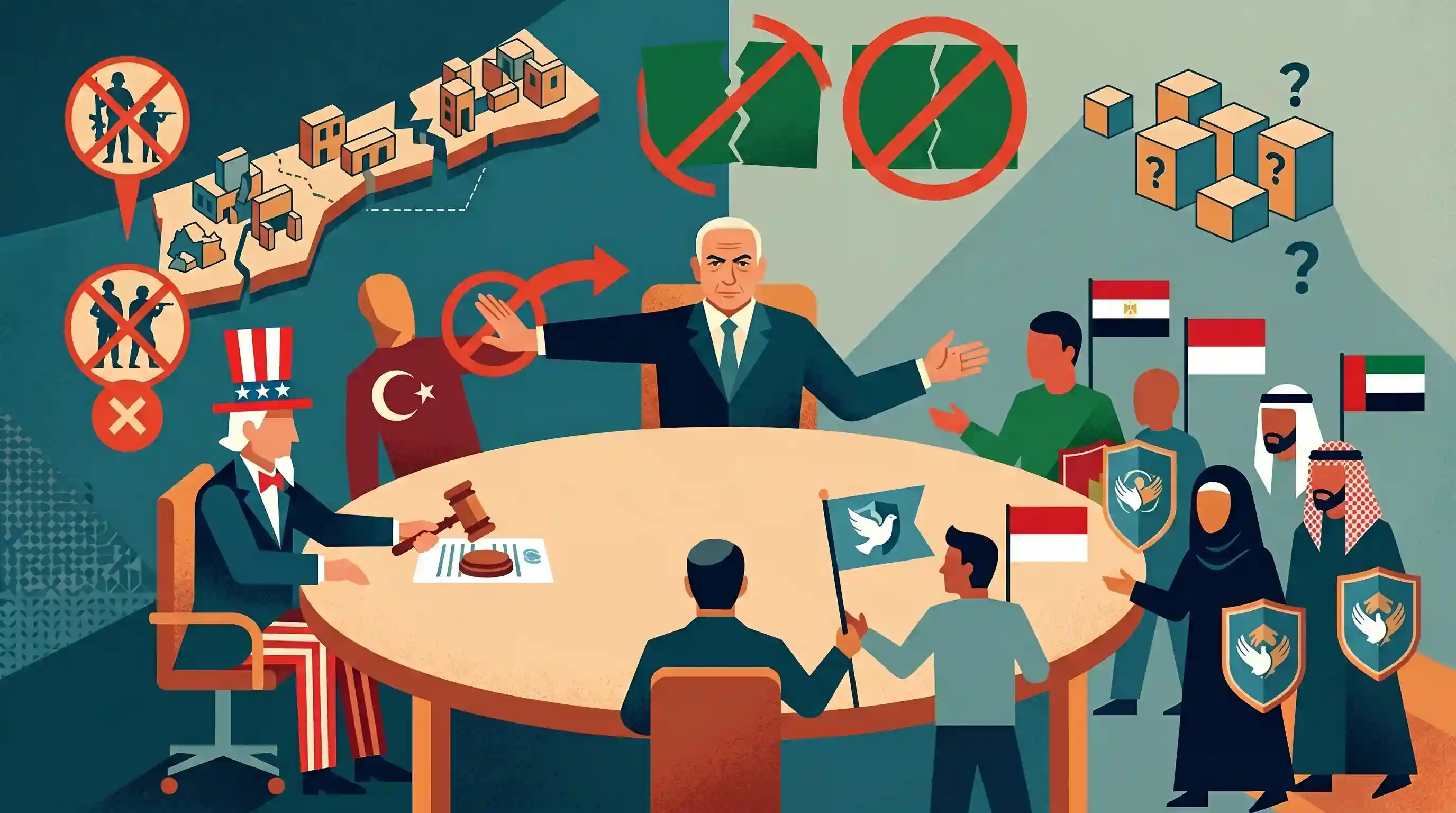
Israeli Prime Minister Benjamin Netanyahu has declared that Israel will determine which countries can participate in a proposed international security force for post-war Gaza. With the U.S. ruling out the deployment of American troops, officials are looking towards a multinational force potentially involving Egypt, Indonesia, and Gulf Arab states, authorized through a UN resolution or international agreement. However, Israel retains veto power over the force's makeup and has explicitly rejected the involvement of Turkish troops due to deteriorated diplomatic ties. The eventual governance of Gaza remains undefined, aside from a consensus that Hamas will be excluded.
Key Points
- Israeli Prime Minister Benjamin Netanyahu asserted that Israel will have the final say on the composition of any international force deployed in post-war Gaza.
- The U.S. has ruled out deploying American troops, instead seeking a multinational force comprising troops from nations acceptable to Israel, potentially including Egypt, Indonesia, and Gulf Arab countries.
- Israel has explicitly opposed the inclusion of Turkish security forces due to severely strained bilateral relations following Turkey's strong criticism of Israel's military campaign.
- U.S. officials are exploring the possibility of a United Nations resolution or a broader international agreement to authorize the deployment of this multinational security mission.
- The future governance model for Gaza remains unresolved, though the U.S. and Israel agree it cannot include Hamas.
Important Terms
West Asia Geopolitics

The strategic interactions and power dynamics among nations in West Asia (Middle East), significantly impacting global energy security, trade routes, and regional stability.
UPSC context
GS Paper 2 (International Relations); critical for India's 'Link West' policy and managing ties with Israel and Arab nations.
International Stabilization Force (ISF)
A proposed 5,000-strong multinational security body tasked with maintaining order, demilitarizing non-state actors, and overseeing post-war reconstruction in the Gaza Strip.
UPSC context
GS Paper 2 (Global Governance/Security); relates to international peacekeeping mandates and regional security architecture.
Hamas
A Palestinian militant and political organization that governed Gaza; currently the focus of international efforts regarding disarmament and exclusion from future governance frameworks.
UPSC context
GS Paper 3 (Internal Security/Terrorism); concerns the role of non-state actors in regional instability.
Board of Peace
A proposed transitional governance body for Gaza established under a 20-point peace roadmap to manage demilitarization and economic redevelopment until 2027.
UPSC context
GS Paper 2 (International Relations); tests understanding of transitional justice and post-conflict administrative frameworks.
Two-State Solution
A proposed diplomatic framework envisioning two independent, sovereign states—Israel and Palestine—living side-by-side in peace and security based on pre-1967 borders.
UPSC context
GS Paper 2 (International Relations); a long-standing pillar of Indian foreign policy in West Asia.
Trump Administration
The executive branch of the U.S. government (2025-2026) that brokered the 'Comprehensive Plan to End the Gaza Conflict' and lead negotiations for a UN-mandated security force.
UPSC context
GS Paper 2 (International Relations); pertains to bilateral ties with the U.S. and its shifting Middle East policies.
Prelims Trap
Israel's demand to vet international security forces violates the fundamental protocols of United Nations Peacekeeping Operations.
A foundational principle of UN Peacekeeping is the 'consent of the parties.' Host states must agree to the deployment, making Israel's condition aligned with standard peacekeeping norms.
Static Concepts Connected
What are the three fundamental principles of UN Peacekeeping Operations?
- Consent of parties: Operations require a commitment to a political process and acceptance by the main parties to the conflict.
- Impartiality: Peacekeepers must implement their mandate without favor or prejudice to any party involved in the conflict.
- Non-use of force: Force is strictly limited to self-defense and the defense of the peacekeeping mandate.
How do multinational security forces operate outside the UN framework?
- Independent treaties: When the UN Security Council is deadlocked, alternative forces can be deployed through independent international treaties between consenting states.
- Prominent example: The Multinational Force and Observers (MFO) operating in the Sinai Peninsula was created by Egypt and Israel outside the UN framework.
Cross-Topic Patterns
Abraham Accords and regional security
The potential inclusion of Gulf Arab troops in a Gaza force underscores how the 2020 Abraham Accords decoupled Arab-Israeli diplomatic normalization from the final resolution of the Palestine question.
India's De-hyphenation Policy in West Asia
As West Asian alignments shift, India avoids regional military entanglements, utilizing 'de-hyphenation' to maintain strategic ties with Israel completely independent of its traditional support for a Palestinian state.

Expect a 2026 Prelims question testing the distinction between UN Peacekeeping principles (consent) and Chapter VII peace enforcement.
Linked PYQs · 3
Linked PYQs · 3
- 2018MainsGS2
“India’s relations with Israel have, of late, acquired a depth and diversity, which cannot be rolled back.” Discuss.
- 2019MainsGS2
‘Too little cash, too much politics, leaves UNESCO fighting for life.’ Discuss the statement in the light of US' withdrawal and its accusation of the cultural body as being 'anti-Israel bias'.
- 2025MainsGS2
"The reform process in the United Nations remains unresolved, because of the delicate imbalance of East and West and entanglement of the USA vs. Russo-Chinese alliance.” Examine and critically evaluate the East-West policy confrontations in this regard.
