Israel Considers Reducing Dependence on US Military Aid
Source:The Hindu ↗
Why It Matters
This development highlights shifting geopolitical realities in West Asia and the potential recalibration of the US-Israel strategic alliance. For UPSC aspirants, it is essential for GS-II (International Relations) as it impacts regional stability in the Middle East—a region vital for India's energy security, diaspora, and trade. Furthermore, Israel's call for defense self-reliance provides comparative context to India's own indigenisation push in the defense sector.
Summary
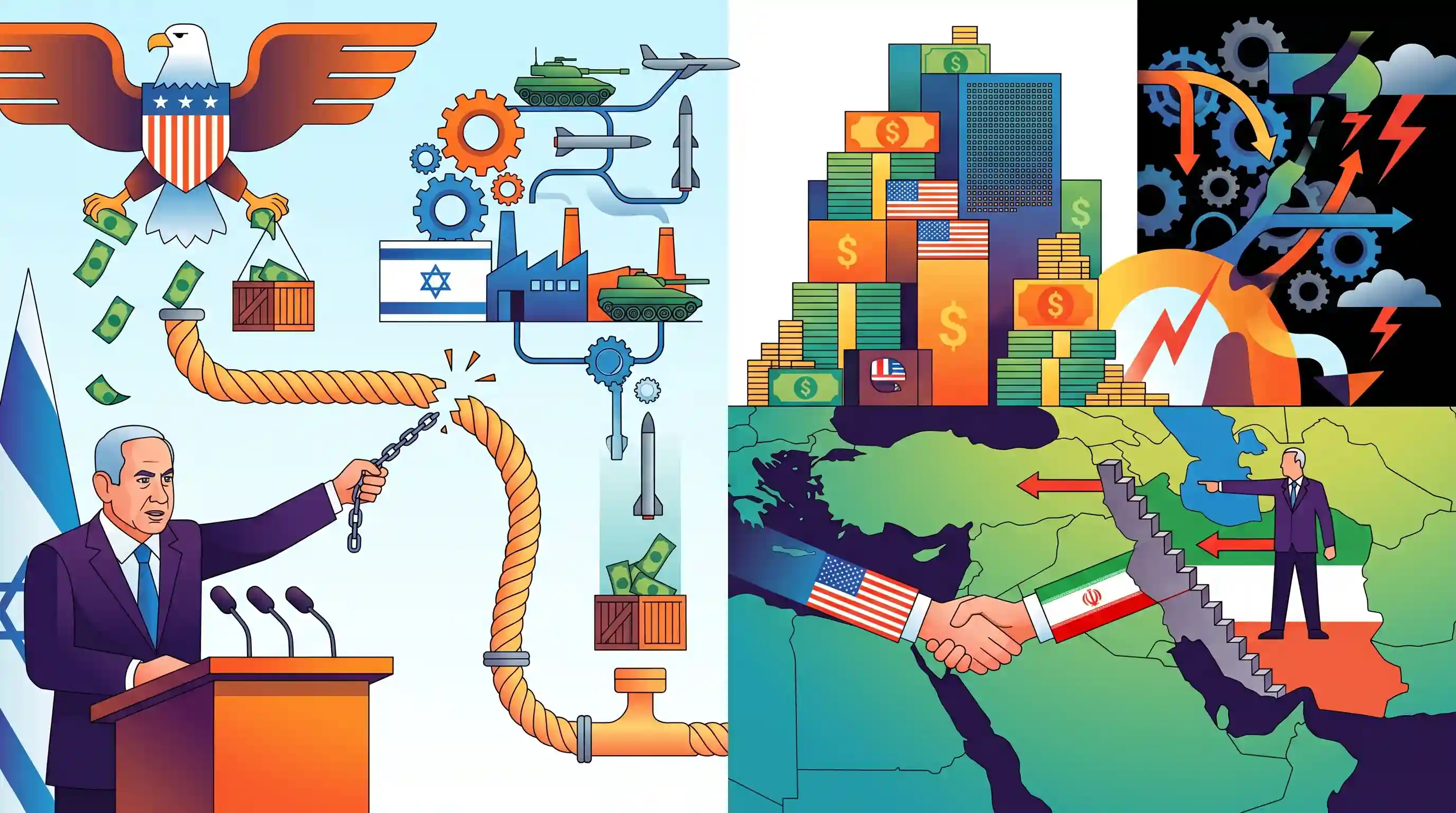
Israeli Prime Minister Benjamin Netanyahu has stated that Israel must reduce its dependency on U.S. military aid and build an independent armaments network. This declaration comes amidst growing tensions over a U.S.-Iran deal aimed at ending the conflict in West Asia, which Israel firmly opposed. Historically, Israel has been the largest recipient of U.S. aid, securing over $300 billion since 1948 and currently receiving $3.8 billion annually under a 10-year defense pact. Netanyahu's remarks signal a potential recalibration of the deeply entrenched U.S.-Israel strategic alliance as geopolitical dynamics in the Middle East rapidly evolve.
Key Points
- Israeli Prime Minister Benjamin Netanyahu emphasized the need for Israel to reduce its reliance on US military aid and build an independent armaments network.
- The statement follows a US-brokered deal with Iran aimed at ending the conflict in West Asia, which Israel strongly opposed.
- Since its founding in 1948, Israel has received over $300 billion in US economic and military assistance, making it the largest historical recipient of US aid.
- Under a 10-year agreement (2019-2028) signed in 2016, the US provides Israel with $3.8 billion annually in military assistance, covering roughly 15% of its defense budget.
- The push for self-reliance marks a potential strategic shift in the US-Israel alliance amid growing differences over regional geopolitics and the approach towards Iran and Hezbollah.
Important Terms
Hamas

A Palestinian Sunni-Islamic militant and nationalist organization governing the Gaza Strip since 2007. It is a central actor in the ongoing Israel-Palestine conflict.
UPSC context
GS Paper 2 (International Relations). Tests knowledge of non-state actors and regional instability affecting India’s "Link West" policy.
Hezbollah
A Lebanon-based Shia Islamist militant group and political party supported by Iran. It is a major regional force in the "Axis of Resistance" against Israel.
UPSC context
GS Paper 2 (International Relations). Essential for understanding Iran’s regional influence and security dynamics in the Middle East.
Defence Indigenisation
The development and production of military equipment within a country using domestic resources to achieve self-reliance and reduce dependency on foreign imports.
UPSC context
GS Paper 3 (Security). Tests understanding of self-reliance and the reduction of strategic vulnerability through domestic manufacturing.
Strategic Autonomy
A state's ability to pursue national interests and independent foreign policy without excessive reliance on or constraint by other nations.
UPSC context
GS Paper 2 (International Relations). A cornerstone of foreign policy; tests conceptual understanding of sovereign decision-making.
West Asia
A geopolitical subregion comprising the Middle East. It is a focal point of global conflict, energy security, and major power rivalries.
UPSC context
GS Paper 2 (International Relations). Key for mapping, energy security analysis, and diaspora-related questions.
Memorandum of Understanding (MoU)
A formal, non-binding agreement between parties. The U.S.-Israel version provides a 10-year framework for $38 billion in military assistance.
UPSC context
GS Paper 2 (International Relations). Tests knowledge of diplomatic instruments used in long-term strategic defense partnerships.
Prelims Trap
The US recently terminated its 10-year military aid pact with Israel due to the Iran deal.
The US did not terminate the aid; the $3.8 billion annual pact remains active until 2028. It is Israel proposing future self-reliance.
Static Concepts Connected
What is the I2U2 grouping and its strategic rationale in West Asia?
- Member Nations: Comprises India, Israel, the UAE, and the United States, frequently referred to as the 'West Asian Quad'.
- Strategic Rationale: Leverages the momentum of the Abraham Accords to combine US/Israeli technology, UAE financial capital, and India's market capacity.
- Core Focus: Unlike security alliances, it primarily targets joint investments in water, energy, transport, space, health, and food security.
How does foreign military dependence threaten a nation's strategic autonomy?
- Diplomatic Leverage: Supplier nations can use arms embargoes or condition aid to force diplomatic concessions, constraining the recipient's independent foreign policy.
- Supply Chain Shocks: Over-reliance creates critical vulnerabilities during prolonged conflicts if the supplier restricts vital ammunition, spares, or technology transfers.
- Indigenisation Imperative: This vulnerability drives initiatives like India's 'Atmanirbhar Bharat' in defense, a doctrine now echoed by Israel's push for an independent armaments network.
Cross-Topic Patterns
US-Israel rift and I2U2 stability
A fracture in the US-Israel alliance could destabilize minilateral initiatives like I2U2 and IMEEC, which historically rely on synchronized US-Israeli security umbrellas and the Abraham Accords.
Strategic Autonomy via Defence Indigenisation
Israel's push to break free from US military aid parallels India’s 'Atmanirbhar Bharat' defense strategy—both seek resilient domestic supply chains to survive hostile regional neighborhoods without foreign pressure.

Expect a GS-2 Mains question in 2026 linking US strategic recalibration in West Asia to the viability of minilaterals like I2U2.
Linked PYQs · 2
Linked PYQs · 2
- 2018MainsGS2
“India’s relations with Israel have, of late, acquired a depth and diversity, which cannot be rolled back.” Discuss.
- 2017MainsGS2
The question of India's Energy Security constitutes the most important part of India's economic progress. Analyze India's energy policy cooperation with West Asian countries.
