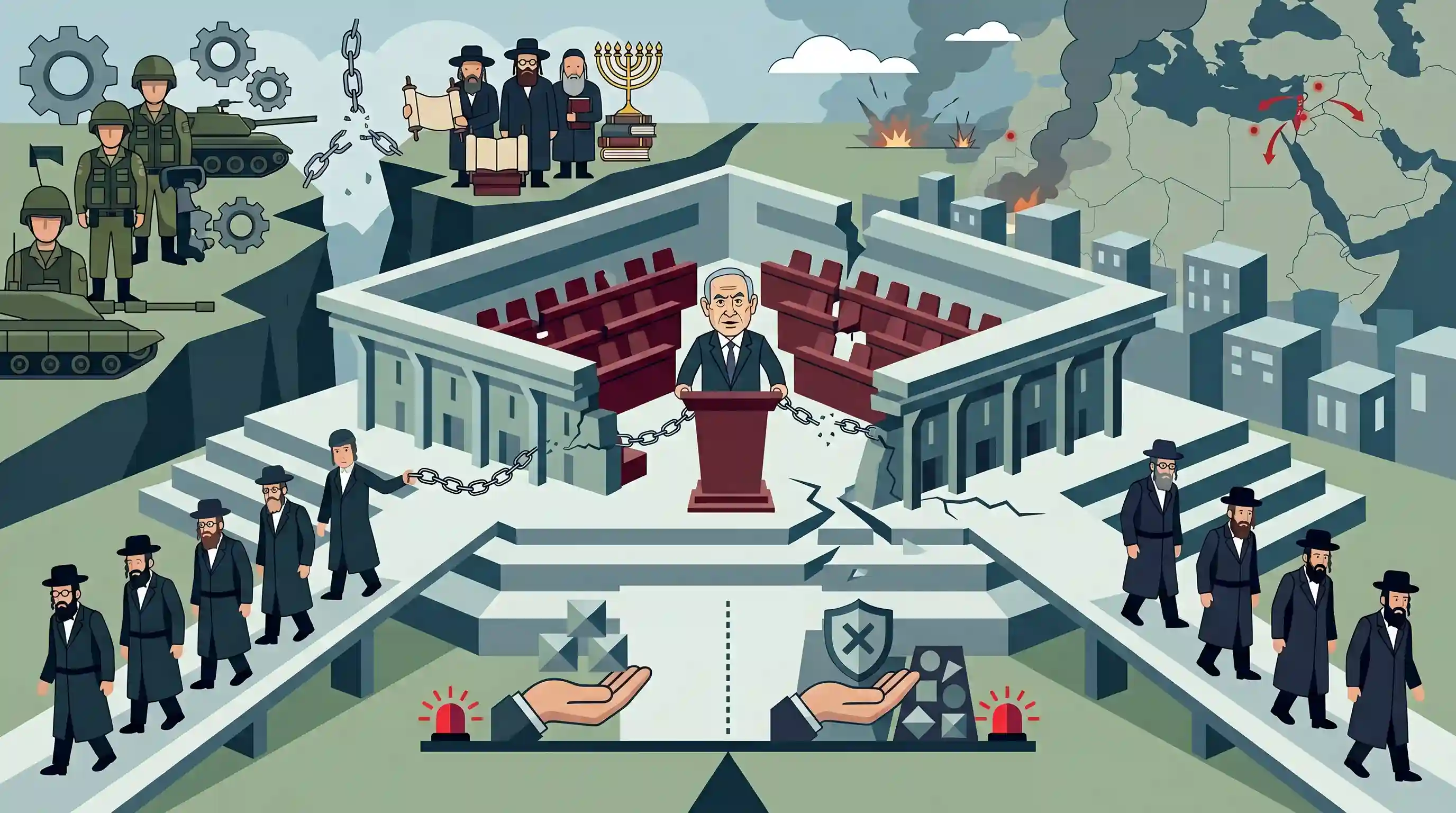
Israel Coalition Crisis Erupts over Military Draft Exemptions
Source:Indian Express ↗
Why It Matters
Israel's internal political fragility, driven by socioreligious divides, complicates its strategic maneuverability in the Middle East. This instability has broader implications for regional security dynamics, which indirectly affect India's energy security and expanding bilateral ties with Israel.
Summary
Israel faces a significant domestic political crisis as Prime Minister Benjamin Netanyahu’s government is reduced to a minority in the Knesset. This follows the back-to-back resignations of two ultra-Orthodox coalition partners, Shas and United Torah Judaism. The fracture stems from a contentious and long-standing dispute over whether ultra-Orthodox Jews should receive exemptions from mandatory military service. The instability poses governance challenges during a period of heightened regional volatility, though Shas has hinted at providing outside legislative support.
Key Points
- Israeli Prime Minister Benjamin Netanyahu's coalition has lost its majority in the 120-seat Knesset after two key parties resigned.
- The ultra-Orthodox parties Shas and United Torah Judaism quit over a prolonged dispute regarding military draft exemptions for their communities.
- The resignations highlight the deep-seated domestic friction in Israel regarding the balance of secular duties and religious privileges.
- Although exiting the formal coalition, Shas indicated it may still provide outside support for certain legislation, preventing immediate government collapse.
Important Terms
Knesset

The unicameral national legislature of Israel, comprising 120 members. It is the country's supreme authority, responsible for passing laws, electing the President, and approving the government cabinet.
UPSC context
GS Paper-2 (Comparative Polity); useful for comparing parliamentary systems and legislative functioning between India and other democracies.
Shas
An ultra-Orthodox religious political party in Israel representing Sephardic and Mizrahi Jews. It focuses on religious education, social welfare, and maintaining the traditions of Middle Eastern and North African Jewish communities.
UPSC context
GS Paper-2 (International Relations); relevant for understanding domestic political drivers affecting the stability of key West Asian partners.
United Torah Judaism (UTJ)
An alliance of Ashkenazi ultra-Orthodox parties (Agudat Yisrael and Degel HaTorah) in Israel. It prioritizes Haredi community interests, religious funding, and opposition to mandatory military service for religious students.
UPSC context
GS Paper-2 (International Relations); important for analyzing the role of religious factions in coalition stability and regional policy.
Haredi (Ultra-Orthodox)
A strictly observant stream of Orthodox Judaism. In Israel, the 'Haredim' often live in segregated communities and have traditionally received controversial exemptions from mandatory military service to pursue Torah study.
UPSC context
GS Paper-1 (Social Issues) and GS Paper-2; examines the tension between religious identity and civic obligations in modern states.
Coalition Government
A governing body formed by multiple political parties cooperating to achieve a majority. In Israel’s proportional system, no single party usually wins outright, making such alliances essential but often unstable.
UPSC context
GS Paper-2 (Polity); essential for comparing multi-party political systems, stability challenges, and the 'kingmaker' role of smaller parties.
Prelims Trap
A minority government formed after coalition partners resign must automatically dissolve the legislature and call for elections.
In parliamentary systems like India and Israel, a minority government can survive without fresh elections if it secures 'outside support' (confidence and supply) from non-cabinet parties.
Static Concepts Connected
How does Israel's Proportional Representation differ from India's FPTP system?
- Electoral mechanism: Under PR, parties gain seats proportional to their national vote share. FPTP awards seats to the individual candidate securing the most votes in a specific geographic constituency.
- Coalition necessity: PR heavily fragments mandates, making multi-party coalitions (like Israel's Knesset) inevitable. FPTP often translates a plurality of votes into a single-party legislative majority.
- Threshold limit: To prevent extreme fragmentation, Israel's PR system enforces a 3.25% minimum national vote threshold to enter the parliament.
How do minority governments survive in parliamentary democracies?
- Core definition: A government formed by a ruling party or coalition that lacks an absolute majority in the legislature.
- Outside support: Survival depends on 'confidence and supply' arrangements, where external parties agree to support budgets and defeat no-confidence motions without joining the cabinet.
- Indian precedents: India has seen minority governments survive via outside support, notably under Prime Ministers V.P. Singh (1989) and H.D. Deve Gowda (1996).
Cross-Topic Patterns
Israeli domestic crises & I2U2 momentum
Instability in Israel’s government complicates the operationalization of the I2U2 bloc and the IMEC corridor, both of which rely heavily on long-term Israeli state stability and infrastructural commitments.
Conscription vs. Fundamental Duties
Israel's mandatory draft contrasts with India's non-justiciable Article 51A, where military service is not compulsory but citizens are duty-bound to 'defend the country' if called upon by the State.

Expect a comparative polity question contrasting Israel's proportional representation system with India's First-Past-The-Post framework.
Linked PYQs · 3
Linked PYQs · 3
- 2018MainsGS2
“India’s relations with Israel have, of late, acquired a depth and diversity, which cannot be rolled back.” Discuss.
- 2022PrelimsGS1
The term "Levant" often heard in the news roughly corresponds to which of the following regions?
- 2025MainsGS2
"Energy security constitutes the dominant kingpin of India's foreign policy, and is linked with India's overarching influence in Middle Eastern countries.” How would you integrate energy security with India's foreign policy trajectories in the coming years?
