Israeli PM Defends Military Operations in Gaza at UNGA
Source:Indian Express ↗
Why It Matters
The geopolitical trajectory of the Israel-Palestine conflict is central to Middle East stability, affecting global energy markets, security dynamics, and India's strategic interests (such as the I2U2 minilateral and IMEC). Understanding the "two-state solution" debate, UN dynamics, and Israel's diplomatic positioning is crucial for International Relations in GS2.
Summary
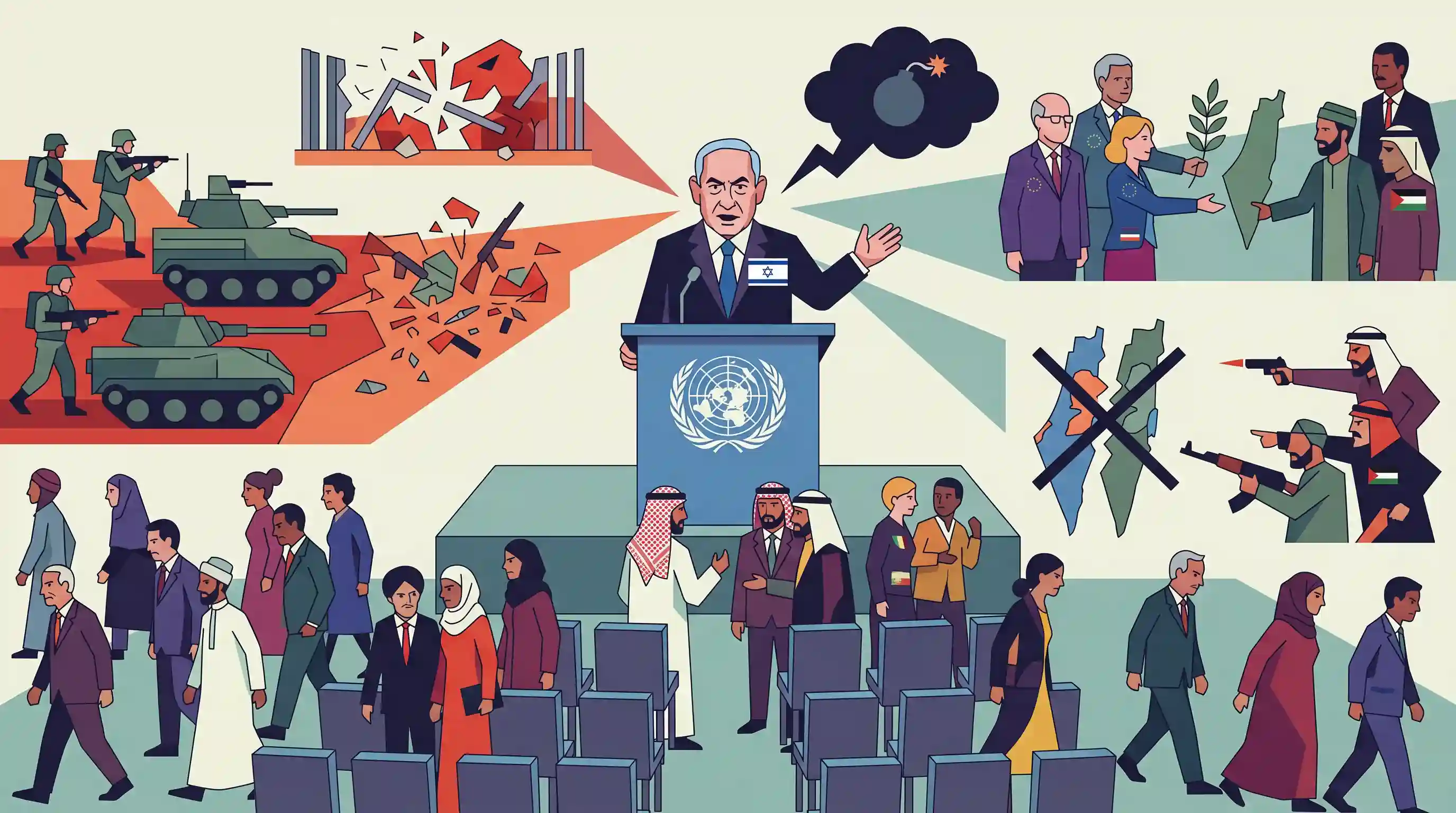
During his address at the UN General Assembly, Israeli Prime Minister Benjamin Netanyahu defended Israel's ongoing military campaign in Gaza, vowing to "finish the job" by demilitarizing the enclave and entirely defeating Hamas. He aggressively criticized Western countries for formally recognizing the State of Palestine, framing it as a capitulation to terrorism following the October 7 attacks. Rejecting the viability of a two-state solution, he argued that Palestinian leadership seeks the destruction of Israel rather than peaceful coexistence. The diplomatic fallout was evident as numerous international delegates walked out of his speech, underscoring Israel's increasing global isolation, despite Netanyahu's stated ambitions to forge peace deals with other Arab nations.
Key Points
- Israeli PM Netanyahu strongly opposed the two-state solution during his UNGA address, arguing that a Palestinian state would be a threat to Israel's existence.
- He criticized Western nations for officially recognizing the State of Palestine, terming such recognition as a reward for the October 7 Hamas attacks.
- Reiterated Israel's objective to complete its military operation in Gaza, emphasizing the necessity to fully disarm Hamas and demilitarize the region.
- The speech saw a massive walkout by international delegates, highlighting Israel's growing diplomatic isolation and global condemnation of the Gaza war.
- Netanyahu hinted at continuing regional normalization efforts with Arab nations, building on frameworks like the Abraham Accords.
Important Terms
Two-State Solution

A proposed diplomatic resolution to the Israeli-Palestinian conflict advocating for two independent, sovereign states—Israel and Palestine—coexisting within secure and recognized borders.
UPSC context
GS Paper-II (IR); central to India’s "de-hyphenated" policy and historical support for a sovereign Palestinian state alongside Israel.
Abraham Accords
A series of 2020 normalization agreements between Israel and several Arab nations (UAE, Bahrain, Sudan, and Morocco), brokered by the US to foster regional stability.
UPSC context
GS Paper-II (Regional Groupings); critical for analyzing shifting West Asian geopolitics and India's participation in the I2U2 grouping.
UN General Assembly
The primary deliberative, policymaking, and representative organ of the United Nations, where all 193 member states have equal representation and a single vote.
UPSC context
GS Paper-II (International Organizations); tests knowledge of global governance, multilateral diplomacy, and India's calls for UN reform.
Hamas
A Palestinian Sunni-Islamic militant and nationalist organization that has governed the Gaza Strip since 2007, following its victory in the 2006 legislative elections.
UPSC context
GS Paper-II (International Relations); critical for understanding Middle Eastern security dynamics, non-state actors, and regional instability.
United Nations
An international organization founded in 1945 to maintain international peace and security, develop friendly relations among nations, and achieve international cooperation.
UPSC context
GS Paper-II (International Institutions); fundamental for understanding the global order, international law, and collective security mechanisms.
Prelims Trap
UN General Assembly resolutions demanding a ceasefire or recognizing Palestinian statehood are legally binding on member states.
UNGA resolutions are recommendatory and reflect global diplomatic consensus but lack enforcement power. Only UN Security Council resolutions (UNSC) under Chapter VII are legally binding on member states.
Static Concepts Connected
What is the Two-State Solution framework and its historical origin?
- UN Resolution 181: Originated from the 1947 UN Partition Plan (Resolution 181) intended to divide Mandatory Palestine into separate, independent Arab and Jewish states.
- Oslo Accords: 1990s agreements that established the Palestinian Authority, granting it limited self-governance in parts of the West Bank and Gaza Strip as a transitional step.
- Global Consensus: It is the official stance of the UN and India, advocating for an independent, viable Palestinian state existing peacefully alongside Israel.
What is the geopolitical significance of the Abraham Accords?
- Diplomatic Normalization: US-brokered 2020 pacts that officially normalized Israel’s diplomatic, trade, and security relations with the UAE and Bahrain (later Morocco and Sudan).
- Arab Consensus Broken: Bypassed the 2002 Arab Peace Initiative, which had demanded a Palestinian state as a strict, non-negotiable precondition for any Arab state recognizing Israel.
Cross-Topic Patterns
India's De-hyphenation & I2U2 Minilateral
India successfully balances its historical backing for Palestinian statehood with the I2U2 framework (India, Israel, UAE, USA), leveraging the Abraham Accords despite escalating regional violence.
Transatlantic Divide on Palestine
Recognition of Palestine by European nations like Spain, Ireland, and Norway signals a fracturing of traditional Western consensus, contrasting sharply with the US and Israeli stances.

Expect a 2026 GS-2 Mains question analyzing India’s de-hyphenated Middle East policy amidst the collapse of the Two-State solution framework.
Linked PYQs · 2
Linked PYQs · 2
- 2018MainsGS2
“India’s relations with Israel have, of late, acquired a depth and diversity, which cannot be rolled back.” Discuss.
- 2025MainsGS2
"The reform process in the United Nations remains unresolved, because of the delicate imbalance of East and West and entanglement of the USA vs. Russo-Chinese alliance.” Examine and critically evaluate the East-West policy confrontations in this regard.
