India Israel strategic partnership review amid West Asia conflict
Source:The Hindu ↗
Why It Matters
This development underscores the complex diplomatic balancing act India must perform in West Asia, balancing its strategic ties with Israel against its critical energy security dependencies and maritime interests in the Persian Gulf and Strait of Hormuz.
Summary
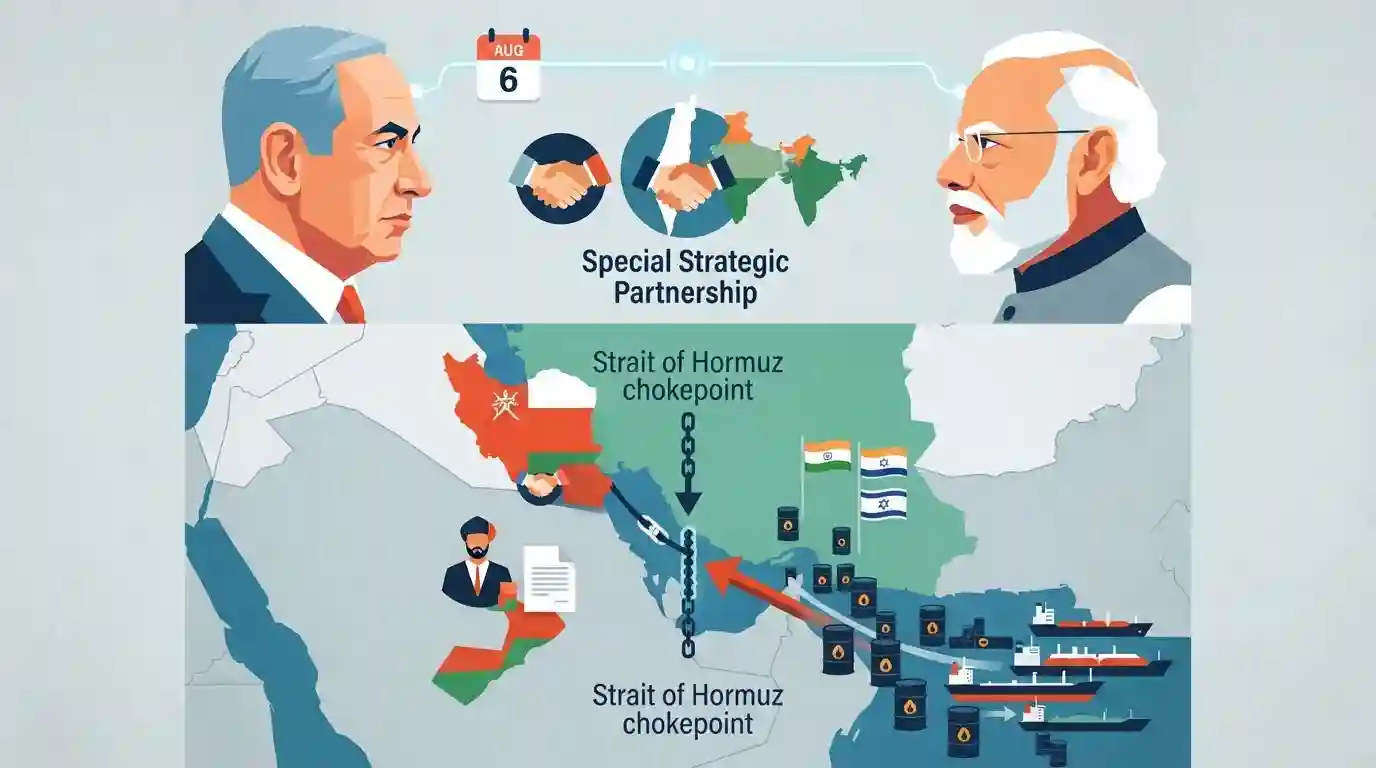
Israeli Prime Minister Benjamin Netanyahu called Prime Minister Narendra Modi on August 6, 2026, to discuss the ongoing conflict in West Asia and review the progress of the India-Israel Special Strategic Partnership. The talks occur amid deep regional volatility, where Iran is reportedly finalizing an agreement with Oman concerning the Strait of Hormuz—a maritime chokepoint through which one-fifth of global oil and natural gas historically passed before the current phase of the war.
Key Points
- Prime Minister Narendra Modi and Israeli PM Benjamin Netanyahu held a phone conversation to discuss the escalating conflict and geopolitical developments in West Asia.
- The two leaders reviewed the sustained progress of the India-Israel Special Strategic Partnership and reaffirmed their commitment to deepen cooperation across multiple bilateral sectors.
- Concurrently, Iran announced that it is in the final stages of drafting an agreement with Oman regarding the highly critical Strait of Hormuz waterway.
- The Strait of Hormuz remains a crucial choke point for global shipping and energy security, historically accounting for the transit of nearly 20% (one-fifth) of global oil and natural gas prior to the West Asia conflict.
- The ongoing regional conflict, which began in February following U.S. and Israeli strikes on Iran, continues to cause instabilities, with casualties reported in Lebanon.
Important Terms
India-Israel Special Strategic Partnership

A mature bilateral framework upgraded in 2026, focusing on security, defense joint-production, emerging technologies (AI/semiconductors), agriculture, and connectivity initiatives like IMEC and I2U2.
UPSC context
Relevant for GS Paper II (Bilateral Relations and Foreign Policy), testing India's strategic ties, balancing acts, and maritime corridors in West Asia.
Prime Minister's Office (PMO) of India
An extra-constitutional, highly centralized staff agency that provides secretarial and policy-coordination assistance to the Prime Minister, administratively headed by the Principal Secretary.
UPSC context
Important for GS Paper II (Polity and Governance), analyzing executive decision-making, centralization of power, and Indian administrative systems.
Strait of Hormuz
A strategically critical maritime chokepoint between Iran and Oman, linking the Persian Gulf with the Gulf of Oman, through which approximately 20% of global oil passes.
UPSC context
Essential for GS Paper I (Geography) and GS Paper III (Energy Security), assessing maritime trade routes and geopolitical risks to oil imports.
West Asia Geopolitics
The complex political and security dynamics of the Middle East, balancing relations with key actors like Israel, Iran, and Arab nations to protect national interests.
UPSC context
Highly relevant for GS Paper II (International Relations), testing India's "de-hyphenation" policy, strategic autonomy, and diaspora welfare in the region.
Prelims Trap
The Strait of Hormuz is geographically bordered by Iran on the north and the United Arab Emirates on the south.
Aspirants often assume the southern coast of the Strait of Hormuz belongs to the UAE due to proximity, forgetting that the strategic Musandam Peninsula is an exclave of Oman.
Static Concepts Connected
What are the key maritime chokepoints in West Asia and their geographical boundaries?
- Strait of Hormuz: Connects the Persian Gulf to the Gulf of Oman; bordered by Iran and Oman's Musandam Peninsula exclave.
- Bab-el-Mandeb Strait: Connects the Red Sea to the Gulf of Aden; bordered by Yemen (Asia) and Djibouti and Eritrea (Africa).
- Suez Canal: An artificial sea-level waterway in Egypt connecting the Mediterranean Sea to the Red Sea, bypassing the African continent.
What is the strategic significance of Oman's Port of Duqm for India?
- Geographic position: Located on the southeastern coast of Oman along the Arabian Sea, it lies outside the volatile Strait of Hormuz.
- Maritime footprint: India secured military and logistical access here in 2018, allowing the Indian Navy to sustain long-range deployments.
- Geopolitical balance: Serves as a crucial maritime counterweight to China's presence at Pakistan's Gwadar Port and its military base in Djibouti.
Cross-Topic Patterns
Strait of Hormuz & domestic energy inflation
Disruptions in the Strait of Hormuz directly spike crude oil import costs for India, widening the current account deficit and triggering domestic supply-side inflation.
India's West Asia de-hyphenation policy
Balancing deep security ties with Israel alongside crucial strategic relations with Iran and Oman tests India's non-aligned strategic autonomy under regional escalation.

Map-based questions linking the Musandam Peninsula, Bab-el-Mandeb, and Port Duqm's strategic bypass value are highly probable in 2026.
Linked PYQs · 3
Linked PYQs · 3
- 2018MainsGS2
“India’s relations with Israel have, of late, acquired a depth and diversity, which cannot be rolled back.” Discuss.
- 2025MainsGS2
"Energy security constitutes the dominant kingpin of India's foreign policy, and is linked with India's overarching influence in Middle Eastern countries.” How would you integrate energy security with India's foreign policy trajectories in the coming years?
- 2026PrelimsGS1
Ships from which of the following countries have to cross the Strait of Hormuz to reach out to the Indian Ocean ? 1. Bahrain 2. Syria 3. Qatar 4. Egypt Select the answer using the code given below :
