Netanna Sevalo Scheme and Backward Classes Welfare in Andhra Pradesh
Source:The Hindu ↗
Why It Matters
Knowledge of recent state government welfare initiatives (like Netanna Sevalo and NTR Pension Bharosa), socioeconomic policies targeting Backward Classes, and regional infrastructure projects (Visakhapatnam textile unit, Chirala tourism corridor) is frequently tested in the APPSC Group 1 Prelims.
Summary
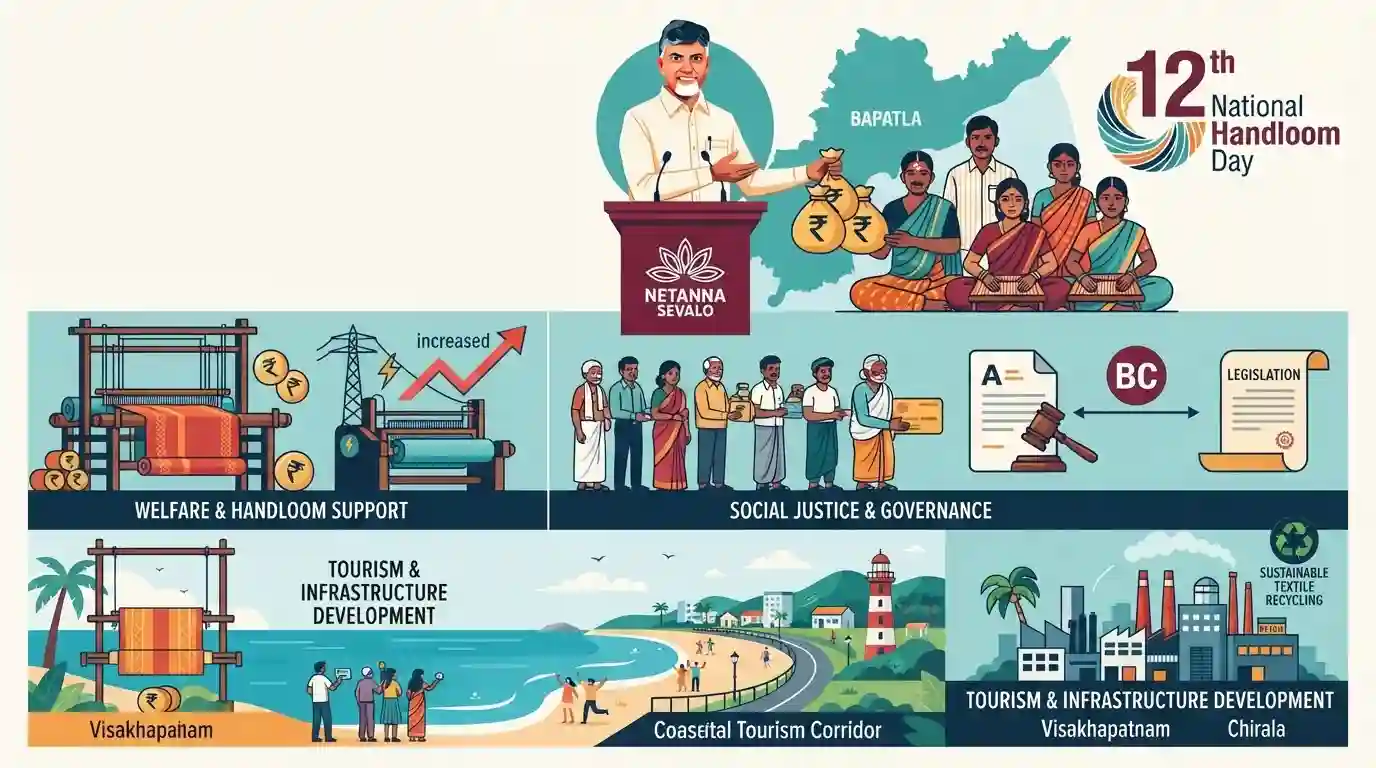
Chief Minister N. Chandrababu Naidu launched the 'Netanna Sevalo' welfare scheme on the 12th National Handloom Day in Bapatla district, providing financial assistance of ₹25,000 each to eligible handloom weaving families. Emphasizing the state's rich handloom traditions across various towns, the Chief Minister announced upcoming legislation to safeguard the interests of Backward Classes (BCs). Key policy shifts include increased free power allocations for handlooms and power looms, early age eligibility for the ₹4,000 NTR Bharosa pension, and major infrastructure investments such as a sustainable textile recycling plant in Visakhapatnam and a coastal tourism corridor near Chirala.
Key Points
- Andhra Pradesh Chief Minister launched the 'Netanna Sevalo' scheme on National Handloom Day, offering ₹25,000 to eligible handloom families.
- A new legislation aimed at protecting the interests and rights of Backward Classes (BCs) was announced.
- Power subsidies for the handloom sector were increased, providing up to 200 units of free power per month for handloom households and 500 units for power looms.
- Under the NTR Pension Bharosa scheme, handloom workers will receive a monthly pension of ₹4,000 from the age of 50.
- A ₹4,200 crore sustainable textile recycling unit is planned for Visakhapatnam, alongside a ₹97 crore coastal tourism corridor from Surya Lanka to Chirala under the Swadesh Darshan scheme.
Important Terms
Netanna Sevalo

An Andhra Pradesh welfare scheme launched on National Handloom Day to support traditional livelihoods by providing ₹25,000 in annual financial assistance to eligible handloom weaving families.
UPSC context
GS-2 (Welfare Schemes). Tests knowledge of targeted state-level policies supporting vulnerable artisanal communities and traditional industries.
Swadesh Darshan Scheme
A Central Sector Scheme by the Ministry of Tourism for developing thematic tourism circuits. It is currently funding a ₹97 crore coastal tourism corridor near Chirala, Andhra Pradesh.
UPSC context
GS-3 (Infrastructure/Tourism). Important for evaluating Central initiatives that link infrastructure development with regional economic growth.
NTR Bharosa Pension Scheme
Andhra Pradesh's flagship social security scheme providing enhanced monthly pensions via Direct Benefit Transfer (DBT) to vulnerable groups, including weavers, senior citizens, and persons with disabilities.
UPSC context
GS-2 (Social Justice). Relevant for analyzing state-level social safety nets, DBT implementation, and vulnerable population support mechanisms.
Fabindia
An Indian retail brand specializing in handmade rural crafts. It recently partnered with the Andhra Pradesh government to promote the handloom sector and provide market linkages to local artisans.
UPSC context
GS-3 (Economy). Illustrates Public-Private Partnerships (PPP) in formalizing rural artisanal supply chains and boosting traditional craft economies.
Prelims Trap
The Swadesh Darshan Scheme is a Centrally Sponsored Scheme where states bear 40% of the cost for coastal corridor development.
Swadesh Darshan is a 100% centrally funded Central Sector Scheme; the state governments do not share the project development costs.
Static Concepts Connected
Why is National Handloom Day observed on August 7, and what is its history?
- Swadeshi Movement Proclamation: It commemorates August 7, 1905, when the formal Swadeshi Movement resolution was passed at Calcutta Town Hall to boycott foreign cloth.
- Indigenous Handloom Focus: The movement aimed to revive domestic industries, particularly handloom weaving, as a tool of economic resistance against British colonial rule.
What is the design and funding mechanism of the Swadesh Darshan Scheme?
- Central Sector Scheme: It is 100% funded by the Central Government, targeting the development of theme-based tourist circuits across India.
- Synergy with State: While centrally funded, project implementation relies on State Governments or UT Administrations to leverage regional tourism potential.
Cross-Topic Patterns
Circular Economy in Textiles
Visakhapatnam's sustainable recycling unit highlights how state-led industrial policies align with India's global commitments to net-zero and sustainable production (SDG 12).
Tourism and GI Handloom Clusters
Integrating handloom towns like Venkatagiri and Mangalagiri with coastal tourism corridors demonstrates a multi-sectoral approach to boosting rural livelihoods and preserving GI heritage.

Modern handloom welfare and Swadesh Darshan tourism linkages likely to be tested via the lens of the 1905 Swadeshi Movement's legacy.
Linked PYQs · 4
Linked PYQs · 4
- 2023APPSC_PRELIMSGS1
One of the following welfare programmes implemented by Government of Andhra Pradesh is not part of Navaratnalu.
- 2023APPSC_PRELIMSGS1
Government of Andhra Pradesh is implementing YSR Rythu Bharosa - PM Kisan Scheme for the benefit of farmers of Andhra Pradesh. Which of the following statements are correct about the above scheme ?
- 2024APPSC_PRELIMSGS1
Which of the following statements are valid regarding the interventions of the Government of Andhra Pradesh in the context of Healthcare ? I. Telemedicine facility is available in all Ayushman Bharat Health and Wellness Centres (AB-HWCs) to avail specialist services through district hub. II. The Family Doctor Programme has been planned to be implemented as a standalone project without the need to be integrated with Primary Health Centres (PHCs). III. Dr. YSR Aarogyasri Scheme has been revamped, by increasing the income limit from ₹ 2.5 lakh to ₹ 5 lakh per annum per family. IV. 'Aarogya Aasara' Scheme is intended to provide post-operative sustenance allowance with certain eligible conditions complied with. Select the correct answer using the codes given below :
- 2024APPSC_PRELIMSGS1
Tourism in India has turned out to be a key service sub-sector. Which of the following statements are valid regarding the Tourism sector in India ? I. NIDHI is a technology-driven system meant for providing services to Hospitality and Travel industry. II. The Government has resolved to make India a one trillion USD tourism economy by 2047 with 100 million international investors. III. The Hotel Occupancy Rate has been rapidly increasing alongside a consistent rise in the average daily rate and revenue per available room. IV. India's Services Purchasing Managers' Index (PMI) has been in the expanding zone. Select the correct answer using the codes given below :
