Factors Responsible for Plummeting Net FDI Inflows in India
Source:The Hindu ↗
Why It Matters
FDI is a stable, non-debt creating capital flow essential for infrastructure development, technology transfer, and job creation. Fluctuations in net FDI impact India's forex reserves and macroeconomic stability, making it a critical topic for UPSC Economy and IR sections.
Summary
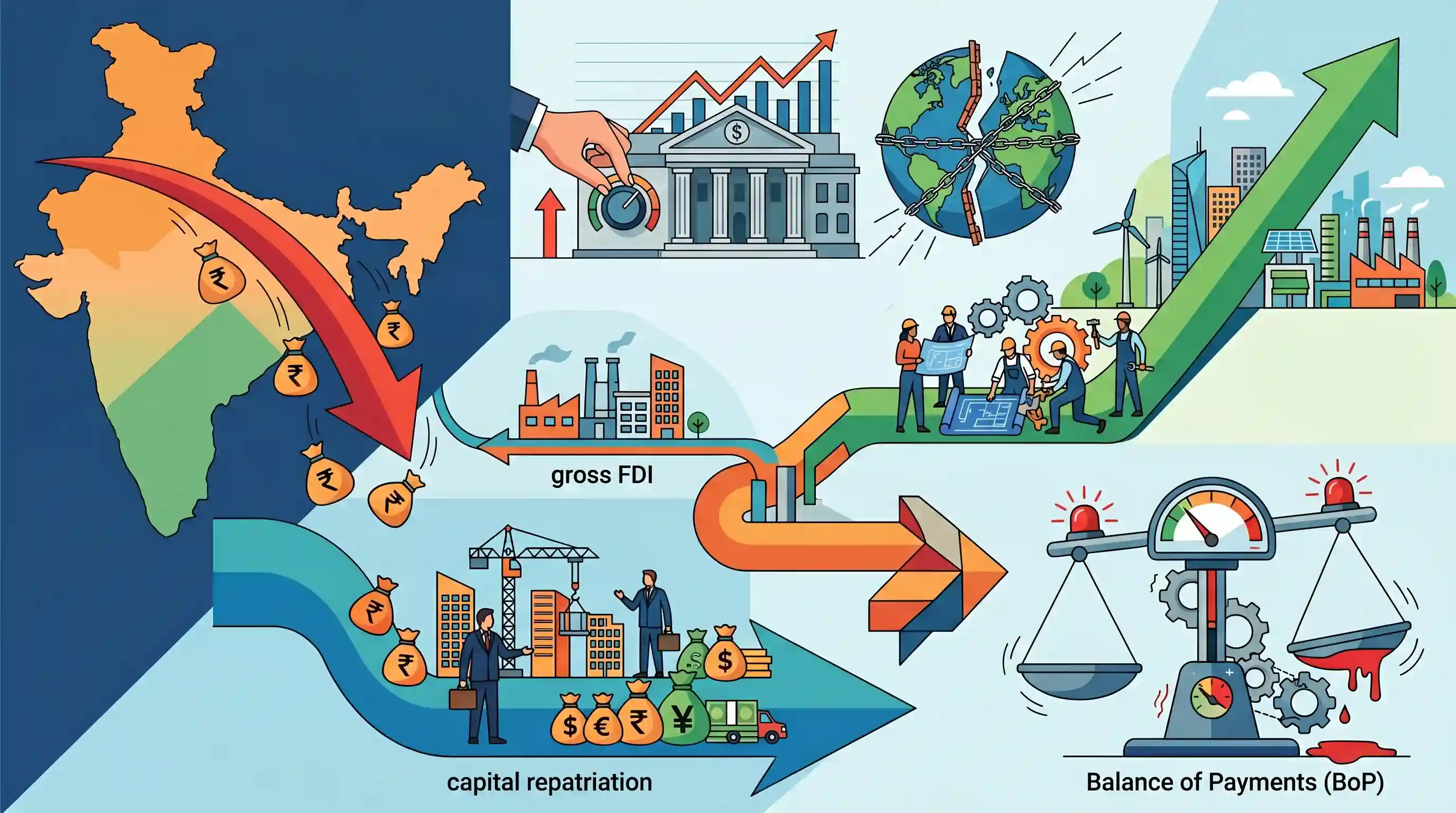
Net Foreign Direct Investment (FDI) inflows into India have plummeted recently, driven by a simultaneous drop in gross FDI and an increase in capital repatriation by foreign investors. The decline reflects both global macroeconomic challenges—such as tightened monetary policies in developed nations and geopolitical fragmentation—and domestic factors requiring policy attention. This trend places pressure on the capital account of India's Balance of Payments, underscoring the necessity of deeper structural reforms to revive long-term, non-debt creating foreign investments.
Key Points
- Net FDI into India has seen a sharp decline due to a combination of moderating gross inflows and increasing repatriation or disinvestment by foreign entities.
- Global macroeconomic headwinds, including high interest rates in advanced economies (like the US) and geopolitical uncertainties, have dampened cross-border investments globally.
- Increased repatriation of dividends and capital by multinational corporations has widened the gap between gross and net FDI.
- The slump in long-term, non-debt creating capital flows highlights the need for structural reforms, improved ease of doing business, and regulatory stability to attract sustained investment.
Important Terms
Foreign Direct Investment (FDI)

Investment made by a foreign entity into a domestic company's physical assets or management to establish a lasting interest and significant control.
UPSC context
GS-III (Economy); crucial for understanding non-debt capital inflows and external sector stability.
Net FDI
The difference between gross FDI inflows and outward flows, including capital repatriation by foreign firms and overseas direct investment (ODI) by domestic entities.
UPSC context
GS-III (Economy); measures actual capital retention and investor confidence within the domestic economy.
Balance of Payments (BoP)
A systematic record of all economic transactions—including trade, services, and capital transfers—between a country's residents and the rest of the world.
UPSC context
GS-III (External Sector); fundamental for analyzing macroeconomic stability and foreign exchange reserve management.
Capital Repatriation
The process of foreign investors sending profits, dividends, or liquidated capital back to their home country, thereby reducing the host nation's net investment.
UPSC context
GS-III (Economy); key factor affecting the capital account and evaluating the long-term impact of foreign investment.
US Federal Reserve
The central bank of the United States whose monetary policy—specifically interest rate hikes—can trigger capital outflows from emerging markets like India.
UPSC context
GS-III (External Sector); tests the global spillover effects of developed-nation policies on India's financial stability.
UNCTAD
The UN body that analyzes global trade and investment, famously publishing the annual 'World Investment Report' to track international FDI trends.
UPSC context
GS-II (International Institutions); acts as the authoritative international source for trade and investment data.
Make in India
A 2014 flagship initiative aimed at transforming India into a global manufacturing hub by streamlining regulations and attracting large-scale foreign investment.
UPSC context
GS-III (Industrial Policy); essential for discussing sectoral reforms and efforts to boost manufacturing-led growth.
Reserve Bank of India (RBI)
India's central bank and regulator responsible for monitoring FDI, managing foreign exchange reserves, and maintaining the Balance of Payments data.
UPSC context
GS-III (Economy); central authority for monetary policy and external sector regulation in India.
Prelims Trap
"Capital and dividend repatriation by foreign MNCs directly reduces India's Gross FDI inflows."
Repatriation affects Net FDI, not Gross FDI. Gross FDI only tracks incoming investments. Furthermore, dividend repatriation is recorded in the Current Account, while capital repatriation hits the Capital Account.
Static Concepts Connected
How are FDI and its associated repatriations classified in the Balance of Payments (BoP)?
- Capital Account (FDI): Inward and outward foreign direct investments are recorded here as they involve cross-border asset ownership and long-term capital creation.
- Current Account (Dividends): The repatriation of profits, dividends, and interest generated by these investments is recorded under the Primary Income section of the Current Account.
- Capital Account (Repatriation): When a foreign entity liquidates its physical/business assets in India and takes the principal back, it is recorded as an outflow here.
What is the difference between debt and non-debt creating capital flows?
- Non-debt creating flows: Investments like FDI and FPI (equity) do not create a fixed repayment obligation for the host country, thereby preserving sovereign credit health.
- Debt creating flows: External Commercial Borrowings (ECBs), NRI deposits, and foreign purchases of government/corporate bonds create strict repayment and interest obligations.
Cross-Topic Patterns
US Fed tightening + Capital Flight
High interest rates in advanced economies trigger 'flight to safety', not only pulling FPIs out of emerging markets but also delaying capital-intensive greenfield FDI commitments.
PLI Schemes vs. Actual FDI Realization
Despite substantial Production Linked Incentive (PLI) subsidies aimed at shifting global supply chains, the gap between signed MoUs and actual non-debt creating FDI inflows highlights persistent domestic regulatory friction.

Expect a multi-statement Prelims question testing the calculation of Net FDI and the exact BoP classification of dividend repatriations.
Linked PYQs · 4
Linked PYQs · 4
- 2020PrelimsGS1
With reference to Foreign Direct Investment in India, which one of the following is considered its major characteristic?
- 2016MainsGS3
Justify the need for FDI for the development of the Indian economy. Why there is gap between MOUs signed and actual FDIs? Suggest remedial steps to be taken for increasing actual FDIs in India.
- 2021PrelimsGS1
Consider the following : 1. Foreign currency convertible bonds 2. Foreign institutional investment with certain conditions 3. Global depository receipts 4. Non-resident external deposits Which of the above can be included in Foreign Direct Investments?
- 2018MainsGS3
How would the recent phenomena of protectionism and currency manipulations in world trade affect macroeconomic stability of India?
