FDI Inflows and Outflows Trends in India
Source:The Hindu ↗
Why It Matters
Fluctuations in Net FDI directly impact India's Balance of Payments, capital account stability, and foreign exchange reserves, making it essential for understanding macroeconomic indicators and external sector management.
Summary
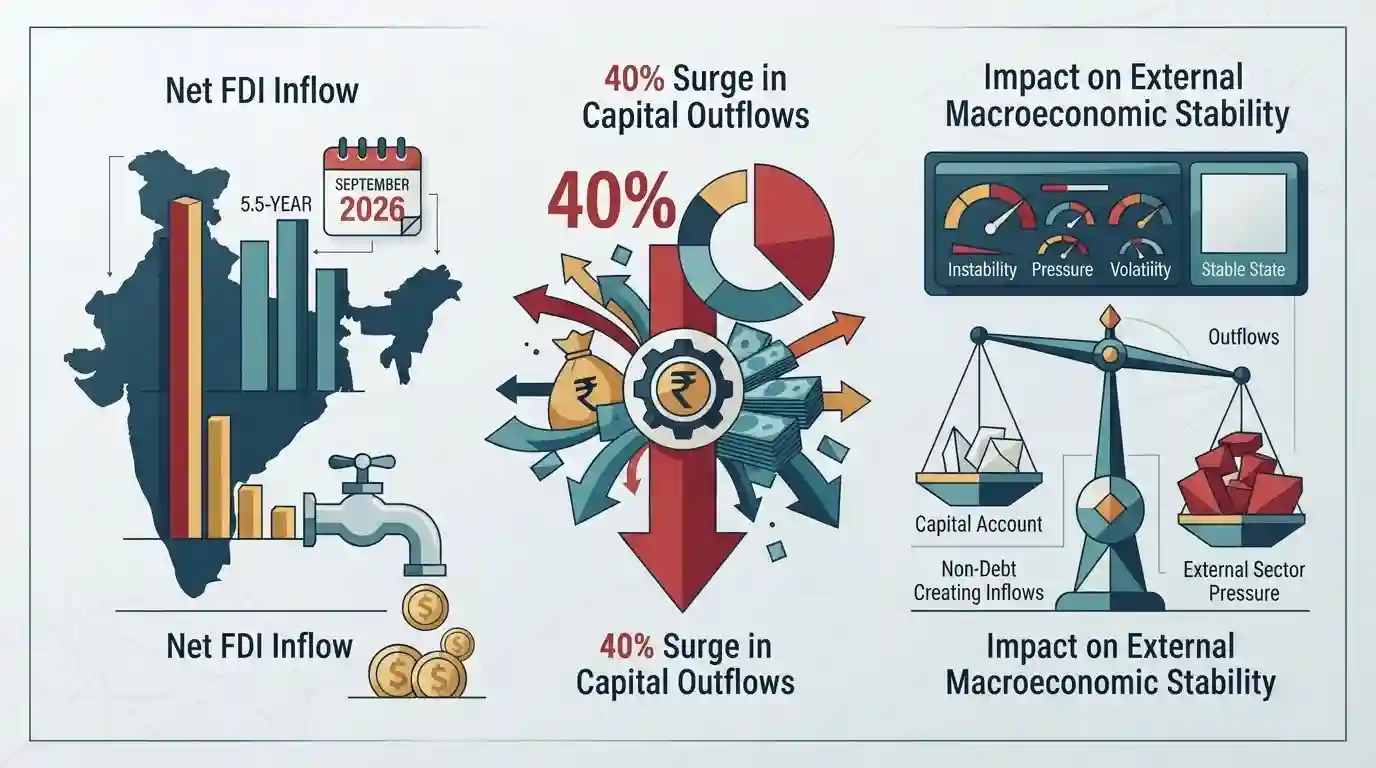
Net Foreign Direct Investment (FDI) in India fell to a more than 5.5-year low in September 2026, primarily due to a 40% surge in capital outflows. This decline highlights challenges in maintaining stable non-debt creating capital inflows, affecting the capital account and overall external macroeconomic stability.
Key Points
- Net Foreign Direct Investment (FDI) in India dropped to a multi-year low of over 5.5 years in September 2026.
- The sharp contraction was driven by a 40% jump in capital outflows compared to previous periods.
- This trend impacts India's capital account balance and reflects shifting global investor sentiments, domestic macroeconomic conditions, and repatriation pressures.
- Understanding FDI dynamics is critical for analyzing non-debt creating capital flows, external sector stability, and economic growth.
Important Terms
Foreign Direct Investment (FDI)

An investment made by a company or individual in one country in business interests in another country, establishing a lasting interest and significant management control.
UPSC context
UPSC GS Paper III (Indian Economy - External Sector & Capital Account). Tests understanding of non-debt capital flows, inflows/outflows, and macroeconomic stability.
Capital Account
The section of India's Balance of Payments that records all international capital transactions, including foreign direct investment, portfolio investment, and external loans.
UPSC context
UPSC GS Paper III (Indian Economy - Balance of Payments). Important for questions on external sector stability, financial flows, and forex reserves.
Reserve Bank of India (RBI)
India's central banking institution that regulates monetary policy, the banking system, and foreign exchange under FEMA to ensure external macroeconomic stability.
UPSC context
UPSC GS Paper III (Indian Economy). Tests role of central banks in managing forex, currency convertibility, and capital flow volatility.
Static Concepts Connected
What is the difference between FDI and FPI in India's Balance of Payments?
- FDI Nature:: Involves lasting interest, managerial control, and long-term capital commitment in productive enterprises.
- FPI Nature:: Highly volatile, short-term capital investment in financial assets like equities and bonds without managerial control.
- BoP Classification:: Classified under the Capital Account as non-debt creating foreign capital inflows.
Cross-Topic Patterns
FDI Outflows vs. Forex Reserves & Rupee Stability
A widening current account deficit combined with dropping net FDI creates severe downward pressure on RBI's foreign exchange reserves and the rupee.

Net FDI decline driven by rising outflows is a prime candidate for a BoP structural statement question.
Linked PYQs · 3
Linked PYQs · 3
- 2016MainsGS3
Justify the need for FDI for the development of the Indian economy. Why there is gap between MOUs signed and actual FDIs? Suggest remedial steps to be taken for increasing actual FDIs in India.
- 2020PrelimsGS1
With reference to Foreign Direct Investment in India, which one of the following is considered its major characteristic?
- 2013PrelimsGS1
Which of the following constitute Capital Account? 1. Foreign Loans 2. Foreign Direct Investment 3. Private Remittances 4. Portfolio Investment Select the correct answer using the codes given below.
