Economic Impact of Youth Protests in Nepal
Source:The Hindu ↗
Why It Matters
Nepal's political instability and economic crises directly affect India's security, border management, and 'Neighborhood First' policy. Additionally, massive youth-led anti-graft movements demonstrate the growing role of civic unrest and non-state actors in shaping South Asian geopolitics, which is relevant to governance topics.
Summary
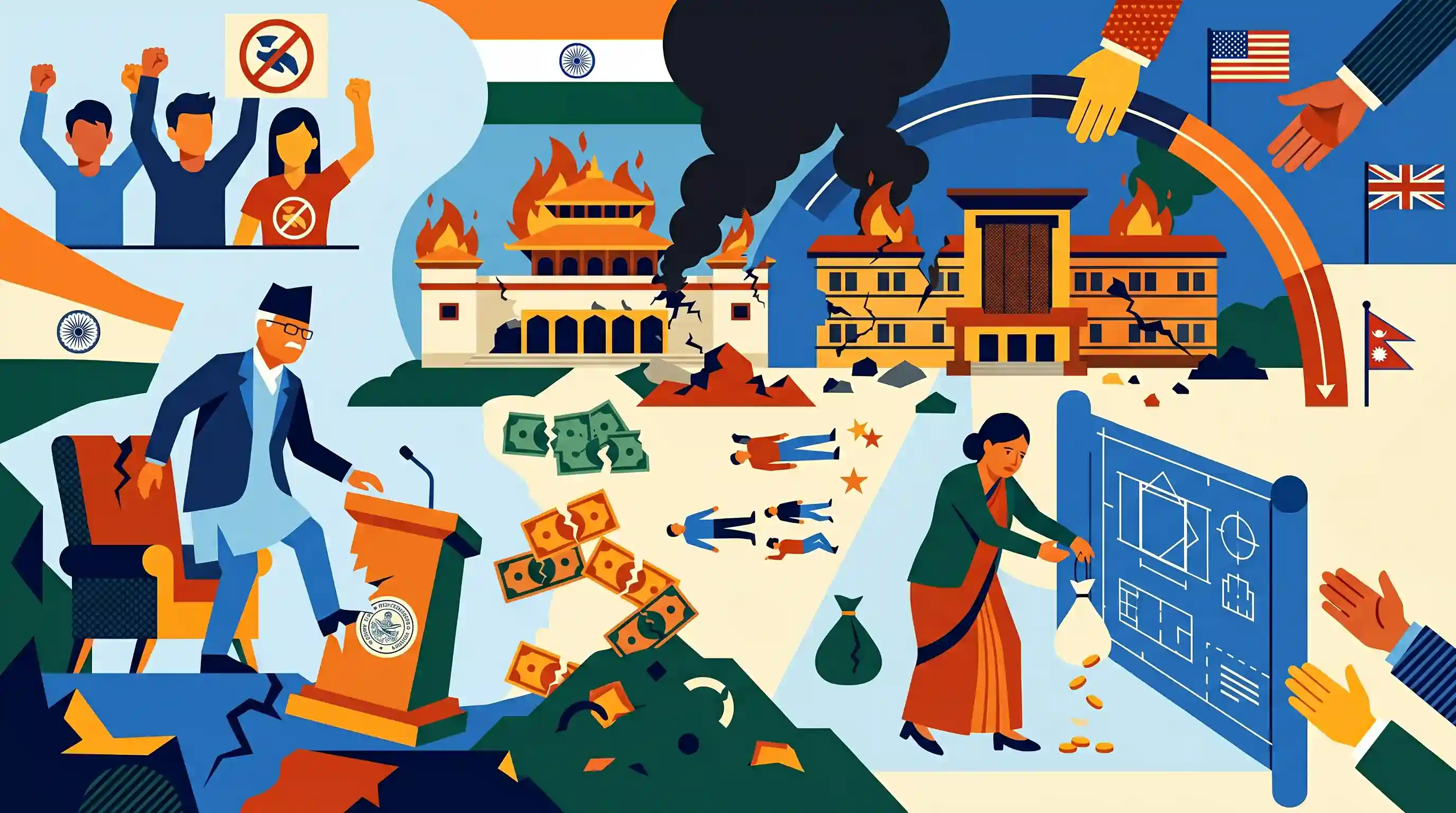
Nepal is reeling from significant economic and infrastructural losses following Gen-Z led anti-graft protests in September that forced Prime Minister K.P. Sharma Oli to resign. The unrest caused $586 million in economic damages, claimed 77 lives, and left crucial institutions like the Parliament House and Supreme Court destroyed. Interim PM Sushila Karki is currently struggling to fund the $252 million reconstruction effort, having collected less than $1 million so far ahead of the March 2026 parliamentary elections.
Key Points
- Youth-led anti-corruption protests caused PM K.P. Sharma Oli to resign and inflicted an estimated $586 million hit on Nepal's $42 billion economy.
- The violence resulted in 77 deaths, over 2,000 injuries, and the torching of major public buildings including the Supreme Court, Parliament House, and Singha Durbar.
- Reconstruction is estimated to cost over $252 million, but the official state fund has only managed to raise less than $1 million, posing a massive resource challenge.
- An interim government headed by former Chief Justice Sushila Karki is managing the crisis, with new parliamentary elections scheduled for March 5, 2026.
Important Terms
India-Nepal Relations

The diplomatic and strategic relationship between India and its northern neighbor, influenced by shared cultural history, an open border, and regional security concerns in the Himalayas.
UPSC context
GS Paper II: International Relations. Tests the impact of neighborhood political instability on India's strategic interests and regional stability.
Gen-Z Protests
A youth-led social movement in Nepal (September 2025) that utilized social media to organize mass protests against systemic corruption, nepotism, and governance failures.
UPSC context
GS Paper II: Role of Civil Society. Tests the influence of digital activism and non-state actors on democratic accountability.
Interim Government
A temporary administrative authority formed to manage state affairs and conduct fair elections following the resignation of Prime Minister K.P. Sharma Oli's government.
UPSC context
GS Paper II: Polity/Governance. Tests knowledge of constitutional transitions and administrative continuity during political crises in neighboring democracies.
Sushila Karki
A prominent Nepalese jurist who served as the first female Chief Justice and the first female (interim) Prime Minister during Nepal’s 2025-2026 political transition.
UPSC context
GS Paper II/IV: Leadership/Judiciary. Tests the role of judicial integrity and female leadership in navigating constitutional crises.
Anti-Graft Movement
A public movement targeting systemic corruption and the mismanagement of public funds, demanding institutional accountability and transparency in the executive and legislative branches.
UPSC context
GS Paper II/IV: Governance/Ethics. Tests public demand for accountability and the impact of corruption on national development.
Supreme Court of Nepal
The highest judicial authority in Nepal; its building was significantly damaged during the 2025 unrest, highlighting the vulnerability of democratic institutions during civil conflict.
UPSC context
GS Paper II: Comparative Constitutions. Tests the role and protection of the judiciary during periods of mass civil unrest.
Ministry of Urban Development (Nepal)
The Nepalese government department responsible for infrastructure and physical planning, currently overseeing the $252 million reconstruction of public buildings destroyed in protests.
UPSC context
GS Paper III: Infrastructure. Tests state administrative roles in post-crisis reconstruction and the fiscal challenges of rebuilding critical infrastructure.
Static Concepts Connected
What drives Nepal's macroeconomy and its structural dependence on India?
- Trade and Transit: India is Nepal's largest trading partner. As a landlocked country, Nepal relies heavily on Indian ports like Kolkata and Visakhapatnam for third-country trade.
- Remittance Economy: Remittances form nearly a quarter of Nepal's GDP, with a massive portion generated by Nepali citizens working freely in India under the 1950 Peace and Friendship Treaty.
- Currency Peg: The Nepalese Rupee is formally pegged to the Indian Rupee, anchoring Nepal's inflation and providing macroeconomic stability amidst severe domestic political volatility.
What is the role of civil society and non-state actors in governance?
- Watchdog Function: Civil society organizations and youth movements mobilize public opinion to expose political corruption and demand accountability when formal institutions become compromised.
- Extra-institutional Pressure: Mass citizen protests can force legitimate constitutional transitions, though unstructured movements risk devolving into violent destruction of vital democratic infrastructure, as seen in Kathmandu.
Cross-Topic Patterns
Contagion of South Asian youth uprisings
Nepal's anti-graft unrest mirrors the student-led ouster of Bangladesh's PM and Sri Lanka's Aragalaya movement, highlighting a regional pattern of Gen-Z toppling established regimes over governance failures.
Neighborhood instability and border security
An open border with a politically volatile Nepal heightens India's internal security risks, potentially increasing cross-border smuggling, unauthorized migration, and stalling critical bilateral hydropower projects.

Expect a GS-2 Mains question in 2026 analyzing the socio-economic triggers of recent youth-led regime changes across South Asia.
Linked PYQs · 2
Linked PYQs · 2
- 2012MainsGS2
Discuss the contentious issues that have caused the prolonged constitutional logjam in Nepal.
- 2025MainsGS2
Civil Society Organizations are often perceived as being anti-State actors than non-State actors. Do you agree? Justify.
