Nepal Army Imposes Curfews Amid Gen Z Political Unrest
Source:The Hindu ↗
Why It Matters
Nepal's political instability and constitutional breakdown directly impact India's border security and regional diplomacy under the 'Neighbourhood First' policy. The crisis also serves as a critical case study on the role of unorganized youth movements (civil society), systemic corruption, and the fragility of democratic institutions in South Asia.
Summary
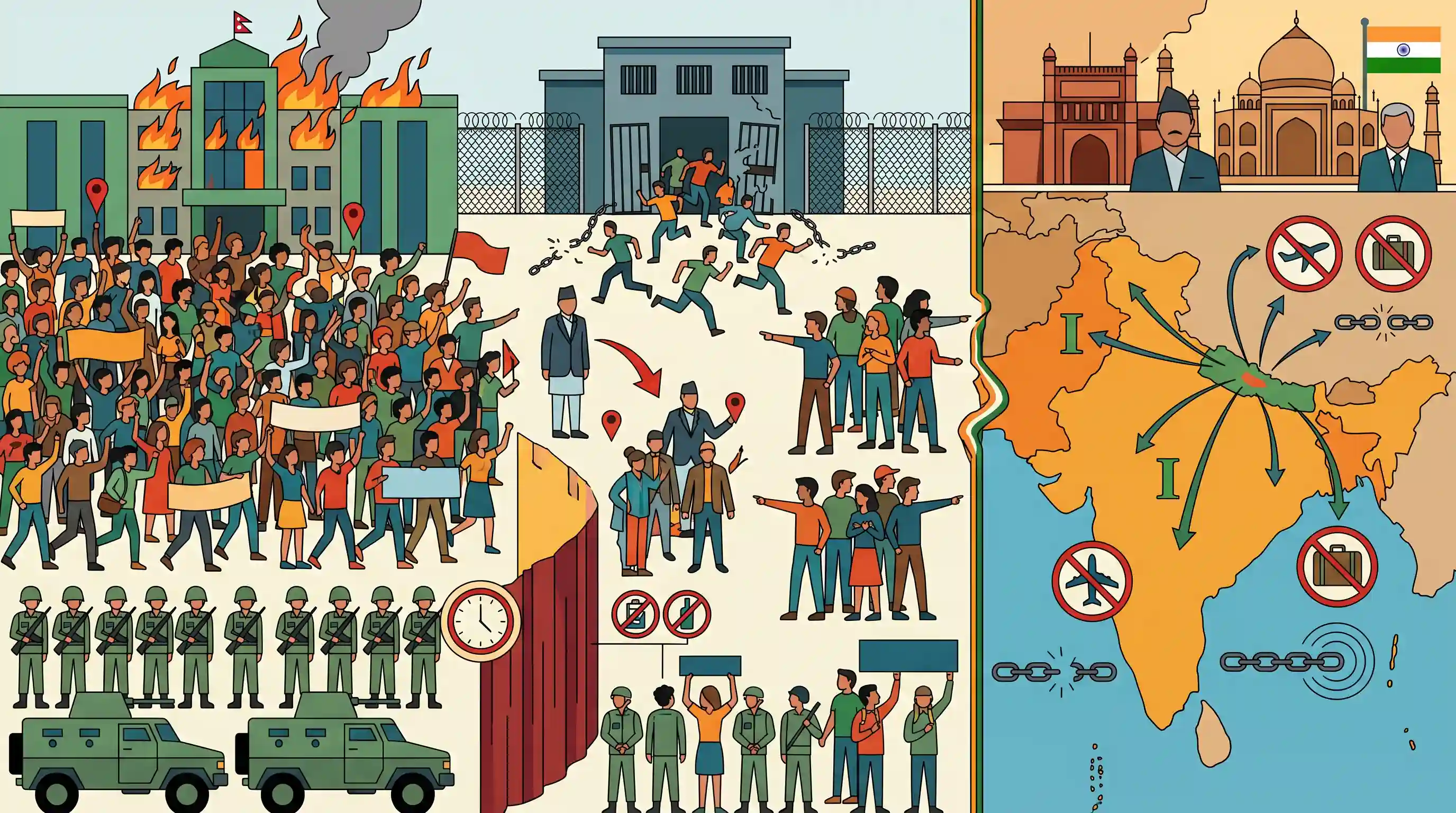
Massive Gen-Z-led protests against systemic corruption and misgovernance have plunged Nepal into a severe political crisis. The escalating violence, which has claimed at least 30 lives, forced the resignation of Prime Minister K.P. Sharma Oli. With demonstrators torching key government institutions and thousands of inmates escaping in coordinated jailbreaks, the Nepal Army has taken charge of national security and enforced curfews. Protesters now face internal divisions over forming an interim administration. The breakdown of constitutional machinery in a bordering nation has prompted India to issue travel advisories, highlighting broader geopolitical and security concerns for the region.
Key Points
- Massive Gen-Z-led protests against corruption and misgovernance escalated into violence, leading to the resignation of Prime Minister K.P. Sharma Oli.
- Following the deaths of at least 30 people in police firing, the Nepal Army assumed security control and enforced curfews across affected areas.
- Demonstrators targeted and torched major institutional symbols, including the Supreme Court, Parliament, and the Singha Durbar complex.
- The chaos triggered massive prison breaks, with over 5,000 inmates escaping, including high-profile political figures like Rabi Lamichhane and Top Bahadur Rayamajhi.
- Protesters remain internally divided over the leadership of a potential interim administration, debating between former Chief Justice Sushila Karki and Kathmandu Mayor Balendra Shah.
- India's Ministry of External Affairs (MEA) issued a travel advisory, underscoring the regional implications of Nepal's internal instability.
Important Terms
Nepal Army

The unified military force of Nepal responsible for territorial integrity. It acts as a stabilizing institution during political crises, often taking charge of internal security and disaster management under constitutional mandates.
UPSC context
GS-II and GS-III; tests understanding of the military’s role in neighboring democracies and impact on regional security stability.
Rastriya Swatantra Party (RSP)
A centrist, youth-led political party in Nepal founded in 2022. It represents a generational shift, focusing on anti-corruption, meritocracy, and challenging the dominance of traditional political elites.
UPSC context
GS-II (International Relations); relevant for analyzing evolving democratic patterns and youth-driven political movements in India’s neighborhood.
Ministry of External Affairs (MEA)
The Indian government department responsible for the conduct of foreign relations. It manages bilateral ties, issues travel advisories, and ensures the safety of the Indian diaspora during regional crises.
UPSC context
GS-II; tests knowledge of India’s institutional framework for neighborhood policy and diplomatic crisis management.
Parliament of Nepal
The federal legislature of Nepal, which transitioned from a monarchy to a republic. It is the primary law-making body whose functioning is vital for maintaining constitutional order and democratic stability.
UPSC context
GS-II; important for comparative constitutional studies and understanding democratic resilience in the South Asian region.
Supreme Court of Nepal
The highest court in Nepal’s judicial system, responsible for interpreting the constitution and protecting fundamental rights. It serves as a critical arbiter during political and constitutional crises.
UPSC context
GS-II; focuses on the role of the judiciary in preserving democratic machinery in neighboring states.
Tribhuvan International Airport
Nepal's primary international gateway located in Kathmandu. It is strategically significant for regional connectivity, tourism, and coordinating international aid or evacuations during periods of national unrest.
UPSC context
GS-III; relates to infrastructure security and logistical challenges during regional humanitarian or political crises.
Prelims Trap
The Indo-Nepal border is fenced and heavily guarded by the Border Security Force (BSF) to prevent illegal migration.
The 1,751 km Indo-Nepal border is uniquely open and porous, allowing free movement. It is guarded by the Sashastra Seema Bal (SSB), not the BSF.
Static Concepts Connected
What are the core provisions of the 1950 Indo-Nepal Treaty of Peace and Friendship?
- National Treatment: Grants reciprocal rights to citizens in each other's territory concerning residence, property ownership, employment, and trade.
- Open Border: Establishes visa-free, passport-free movement of people across the shared border, fostering deep cultural and economic ties.
- Security Consultation: Obligates both nations to consult each other on any serious friction or misunderstanding with any neighboring state.
How is the Indo-Nepal border managed and what are the primary security challenges?
- Guarding Force: Guarded by the Sashastra Seema Bal (SSB), which functions under the MHA as a border guarding force emphasizing intelligence and community relations.
- Porous Nature: The 1,751 km open border spans five Indian states (UP, Bihar, Uttarakhand, Sikkim, West Bengal), making traditional fencing practically impossible.
- Security Threats: The open boundary facilitates human trafficking, smuggling of Fake Indian Currency Notes (FICN), drug transit, and cross-border movement of criminals.
Cross-Topic Patterns
Neighborhood Instability + Border Security
Political crises in open-border states like Nepal directly elevate GS3 internal security challenges, testing SSB deployment and counter-infiltration protocols against escaped criminals.
Civil Society + Democratic Breakdown
The shift from formal opposition to youth-led mass protests causing government collapse reflects a growing regional trend of non-state actors overriding failing constitutional machinery.

GS3 Mains 2026 will likely test the internal security threats posed by regime instability in open-border neighbors like Nepal and Myanmar.
Linked PYQs · 3
Linked PYQs · 3
- 2012MainsGS2
Discuss the contentious issues that have caused the prolonged constitutional logjam in Nepal.
- 2025MainsGS2
Civil Society Organizations are often perceived as being anti-State actors than non-State actors. Do you agree? Justify.
- 2022MainsGS2
India is an age-old friend of Sri Lanka.’ Discuss India's role in the recent crisis in Sri Lanka in the light of the preceding statement.
