Anti Establishment Protests Trigger Constitutional Crisis in Nepal
Source:The Hindu ↗
Why It Matters
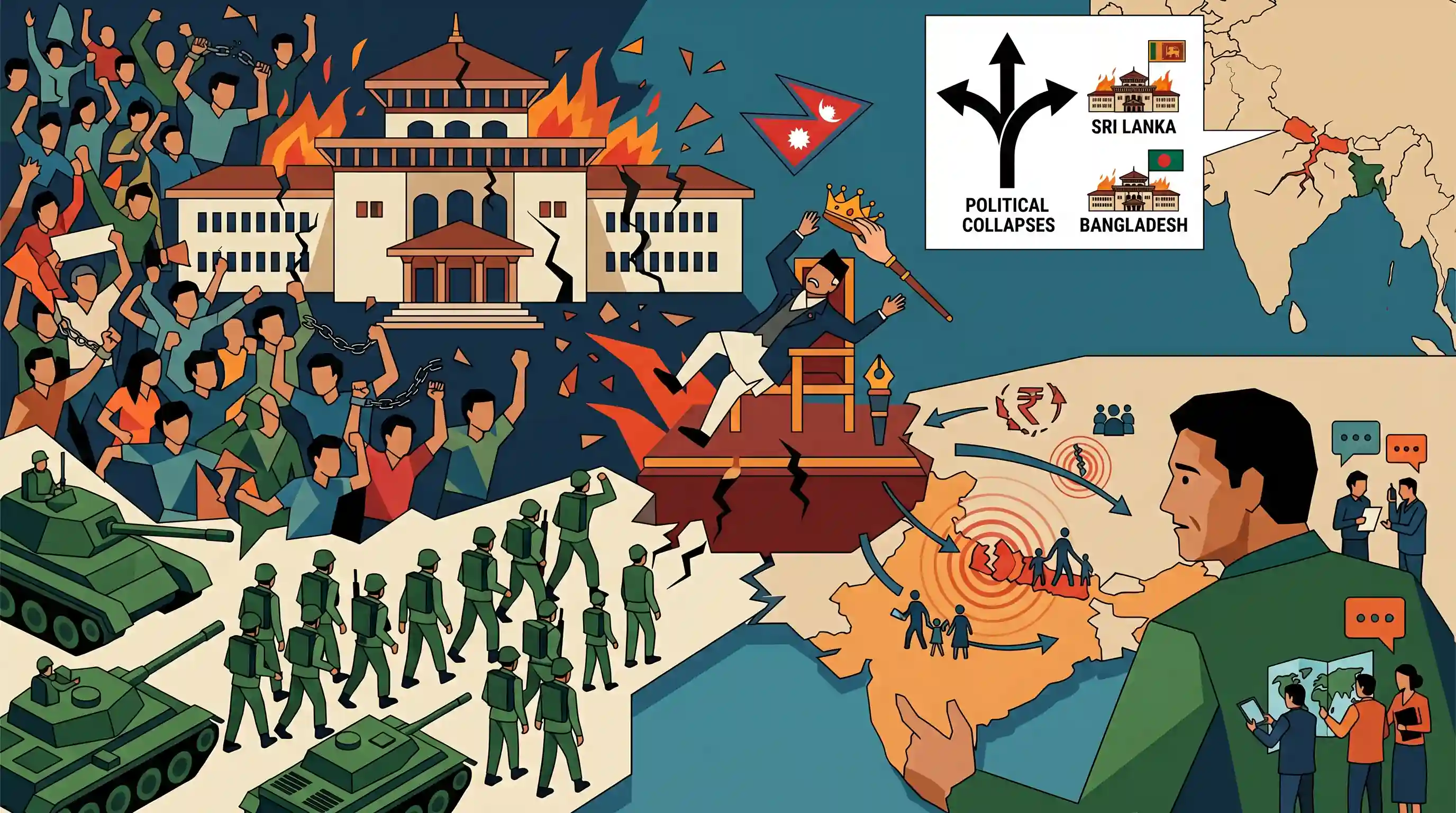
Instability in a key neighboring country like Nepal has immediate ramifications for India's border security and regional diplomacy under the 'Neighborhood First' policy. The recurring pattern of mass public uprisings toppling governments in South Asia—following Sri Lanka and Bangladesh—presents complex foreign policy challenges for India regarding how to engage with new, anti-establishment regimes and ensure regional stability.
Summary
Massive youth-led protests have engulfed Nepal, leading to the resignation of Prime Minister K.P. Sharma Oli amid severe violence and arson targeting major state institutions like Parliament and the Supreme Court. Driven by deep-seated anger over political corruption and the traditional elite, the unrest has created a constitutional vacuum, prompting the Nepal Army to intervene to restore order. Observers warn that Nepal could be experiencing a 'Sri Lanka' or 'Bangladesh' style political collapse, a development that carries significant security and diplomatic implications for the South Asian region, especially India.
Key Points
- Youth and Gen Z-led protests against political corruption and elitism have plunged Nepal into chaos, culminating in violent attacks on key state institutions including Parliament and the Supreme Court.
- The intense unrest forced Prime Minister K.P. Sharma Oli to resign, creating a constitutional and administrative vacuum in the country.
- The Nepal Army, under the command of Gen. Ashok Raj Sigdel, has been forced to step in to manage the breakdown of law and order.
- The crisis is being widely compared to recent sudden regime collapses in Sri Lanka and Bangladesh, highlighting a volatile regional trend of anti-incumbency uprisings.
- Newer political figures and entities, such as Kathmandu Mayor Balendra Shah and RSP chief Ravi Lamichhane, represent the anti-establishment sentiment fueling the current crisis.
Important Terms
Rastriya Swatantra Party (RSP)

A centrist, populist political party in Nepal that rose to power in 2026, winning a near-supermajority by campaigning on anti-corruption, meritocracy, and youth-centric reforms.
UPSC context
GS II: International Relations/Bilateral Relations. Analyzes political shifts in neighboring nations and their impact on India’s strategic interests.
Nepal Army
Nepal’s primary land warfare force, which intervened during the 2025-26 crisis as a 'stabilizer' to maintain order, protect state institutions, and mediate between protesters and the government.
UPSC context
GS II: Role of military in democracy. Tests understanding of civil-military relations in the context of fragile South Asian polities.
Gen Z Movement (Nepal)
A digitally driven youth uprising (2025–26) triggered by a social media ban and systemic corruption, resulting in the ousting of PM Oli and the rise of new political forces.
UPSC context
GS II: Civil Society & Pressure Groups. Explores how technology-driven youth movements reshape governance and challenge traditional political elites.
Neighborhood First Policy
India's diplomatic strategy prioritizing political, economic, and security ties with immediate neighbors like Nepal, which is currently tested by South Asian political instability.
UPSC context
GS II: Indian Foreign Policy. Crucial for assessing India’s regional leadership and crisis management in the neighborhood.
Constitutional Vacuum
A state of governance where constitutional processes are stalled, such as the period following PM Oli’s resignation and the appointment of an interim PM outside standard procedures.
UPSC context
GS II: Comparative Constitutions. Tests the ability to analyze legal crises and transitions during political breakdown in democratic systems.
Prelims Trap
The Indo-Nepal border is secured by the Border Security Force (BSF) and the Indian Army.
The 1,751 km open border with Nepal is exclusively guarded by the Sashastra Seema Bal (SSB), not the BSF or the Indian Army.
Static Concepts Connected
How is the Indo-Nepal border managed and what are the security challenges?
- Guarding Force: Guarded by the Sashastra Seema Bal (SSB) under the administrative control of the Ministry of Home Affairs.
- Treaty Basis: Governed by the 1950 Indo-Nepal Treaty of Peace and Friendship, which allows for a porous border and free movement of people.
- Security Threats: Vulnerable to fake currency (FICN) smuggling, human trafficking, and use as a transit route by third-country operatives.
What are High Impact Community Development Projects (HICDPs)?
- Focus Areas: Grassroots Indian grant assistance targeting local infrastructure like schools, hospitals, and drinking water facilities.
- Implementation: Executed directly through local bodies and municipalities rather than central federal governments, ensuring faster delivery.
- Strategic Value: Builds direct public goodwill and sustains development partnerships, bypassing high-level political instability in the partner country.
Cross-Topic Patterns
Demographic Dividend vs. Disaster
Protests in Nepal, Bangladesh, and Sri Lanka illustrate how severe economic stagnation and elite corruption can morph a 'youth bulge' into a systemic destabilizer and security threat.
Porous Borders & Internal Security
Constitutional collapse in Nepal directly heightens India's internal security risks. Governance vacuums allow transnational syndicates to exploit the 1,751 km open border for smuggling and infiltration.

South Asian regime collapses and open border security challenges (SSB mandate) are highly likely to merge in a 2026 Mains IR/Security combo.
Linked PYQs · 2
Linked PYQs · 2
- 2022MainsGS2
India is an age-old friend of Sri Lanka.’ Discuss India's role in the recent crisis in Sri Lanka in the light of the preceding statement.
- 2025MainsGS2
Civil Society Organizations are often perceived as being anti-State actors than non-State actors. Do you agree? Justify.
