Nepal Political Crisis and Interim Leadership Transition
Source:The Hindu ↗
Why It Matters
Nepal\'s political instability directly affects India\'s border security and regional influence under its \'Neighbourhood First\' policy. Furthermore, the success of youth-led anti-corruption movements and the historic appointment of a female Prime Minister provide significant case studies on democratic accountability, civic unrest, and political empowerment in South Asia.
Summary
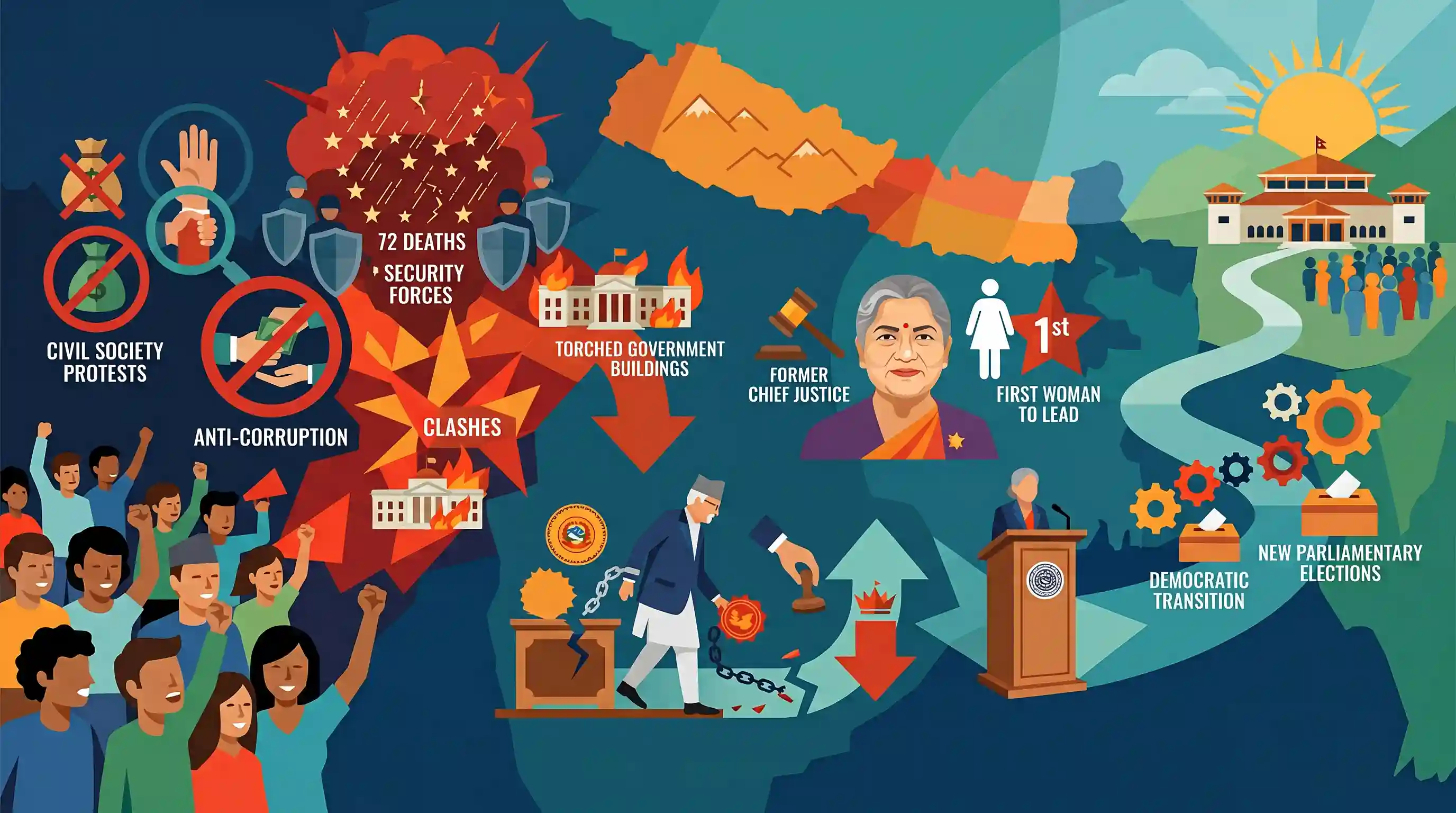
The death toll in Nepal\'s recent anti-corruption, youth-led protests has risen to 72 following intense clashes with security forces. Amid the escalating crisis—which saw key government buildings torched—Prime Minister K.P. Sharma Oli resigned. Former Chief Justice Sushila Karki has been appointed as the interim Prime Minister, becoming the first woman to lead the country. She is tasked with guiding the nation through the democratic transition to new parliamentary elections.
Key Points
- Youth-led anti-corruption protests in Nepal have escalated violently, resulting in at least 72 deaths and significant damage to government infrastructure.
- Protesters torched critical institutions, including the Supreme Court, parliament, and police outposts.
- The severe political crisis forced the resignation of Prime Minister K.P. Sharma Oli.
- Former Chief Justice Sushila Karki has been appointed as interim Prime Minister, making history as Nepal\'s first female leader.
- The interim administration is tasked with restoring stability and organizing fresh parliamentary elections by March.
Important Terms
India-Nepal Relations

Unique bilateral ties marked by open borders and the 1950 Treaty of Peace and Friendship. They are foundational to India's 'Neighborhood First' policy and regional security.
UPSC context
GS Paper II: International Relations. Tests understanding of strategic neighborhood dynamics and civilizational links.
Democratic Transition
The process of shifting from political instability or autocracy to established democratic governance. In Nepal, this involves moving toward inclusive federalism and stable parliamentary rule.
UPSC context
GS Paper II: Polity/Governance. Evaluates institutional stability and democratic evolution in neighboring nations.
Supreme Court of Nepal
The apex judicial body in Nepal. It plays a critical role in interpreting the constitution and has historically intervened during parliamentary dissolutions and political deadlocks.
UPSC context
GS Paper II: Separation of Powers. Relevant for comparing judicial activism and constitutional oversight across South Asia.
Interim Government
A temporary administration established to bridge a leadership vacuum. It is typically tasked with maintaining law and order and conducting free and fair elections.
UPSC context
GS Paper II: Polity. Relates to constitutional mechanisms for governance during crises and political transitions.
Parliament of Nepal
The bicameral legislature (Sanghiya Sansad) of Nepal, consisting of the House of Representatives and the National Assembly. It is the core institution of democratic representation.
UPSC context
GS Paper II: Comparison of Constitutional Schemes. Tests knowledge of parliamentary structures in India’s immediate neighborhood.
Civil Society Protests
Organized non-state movements demanding accountability and reform. Nepal's youth-led 'Gen Z' movement exemplifies the power of digital-age activism in forcing regime change.
UPSC context
GS Paper II: Pressure Groups/Role of Civil Society. Focuses on citizen participation in governance and accountability.
Prelims Trap
Sushila Karki became the first female President of Nepal following the protests.
Bidhya Devi Bhandari was Nepal's first female President (Head of State). Sushila Karki is the first female Prime Minister (Head of Government). UPSC often swaps these executive titles to confuse aspirants.
Static Concepts Connected
How is the India-Nepal border managed and what are its vulnerabilities?
- Open border: Regulated by the 1950 Treaty of Peace and Friendship, it allows free movement of citizens without visas, fostering deep cultural and economic ties.
- Guarding force: The Sashastra Seema Bal (SSB) is the designated Central Armed Police Force responsible for guarding the 1,751 km border.
- Security vulnerabilities: The porous nature makes it highly susceptible to human trafficking, smuggling of contraband, fake currency (FICN), and unauthorized infiltration.
What are the core functions of Civil Society in ensuring democratic accountability?
- Watchdog role: Acting as an independent observer to monitor state institutions, expose corruption, and prevent the abuse of political power.
- Public mobilization: Mobilizing citizens to demand transparency, participate in policy-making, and push for democratic reforms or transitions during institutional decay.
- Democratic empowerment: Fostering civic education and empowering marginalized groups to participate effectively in the democratic and electoral processes.
Cross-Topic Patterns
Nepal crisis & India's border security
Political violence in Nepal historically triggers migration and security spillovers across the porous 1,751-km open border, heightening the role of the Sashastra Seema Bal (SSB).
Youth-led movements & democratic accountability
Similar to recent events in Bangladesh and Sri Lanka, youth-led anti-corruption protests in Nepal highlight the rising influence of unorganized civil society in enforcing political accountability in South Asia.

Expect a GS-2 Mains question linking youth protests and political instability in South Asia (Nepal, Bangladesh) to India's regional security.
Linked PYQs · 4
Linked PYQs · 4
- 2012MainsGS2
Discuss the contentious issues that have caused the prolonged constitutional logjam in Nepal.
- 2022MainsGS2
India is an age-old friend of Sri Lanka.’ Discuss India's role in the recent crisis in Sri Lanka in the light of the preceding statement.
- 2025MainsGS2
Civil Society Organizations are often perceived as being anti-State actors than non-State actors. Do you agree? Justify.
- 2024MainsGS1
Distinguish between gender equality, gender equity and women's empowerment. Why is it important to take gender concerns into account in programme design and implementation?
