Nepal Prime Minister Resigns Amid Youth Led Protests
Source:Indian Express ↗
Why It Matters
Political instability in Nepal, a country with which India shares an open border and deep civilizational ties, has direct security and strategic implications for New Delhi. The rise of youth-led anti-establishment protests mirrors similar movements in the region (e.g., Bangladesh), necessitating a recalibration of India's 'Neighborhood First' policy to engage effectively with emerging civil society forces rather than just traditional political elites.
Summary
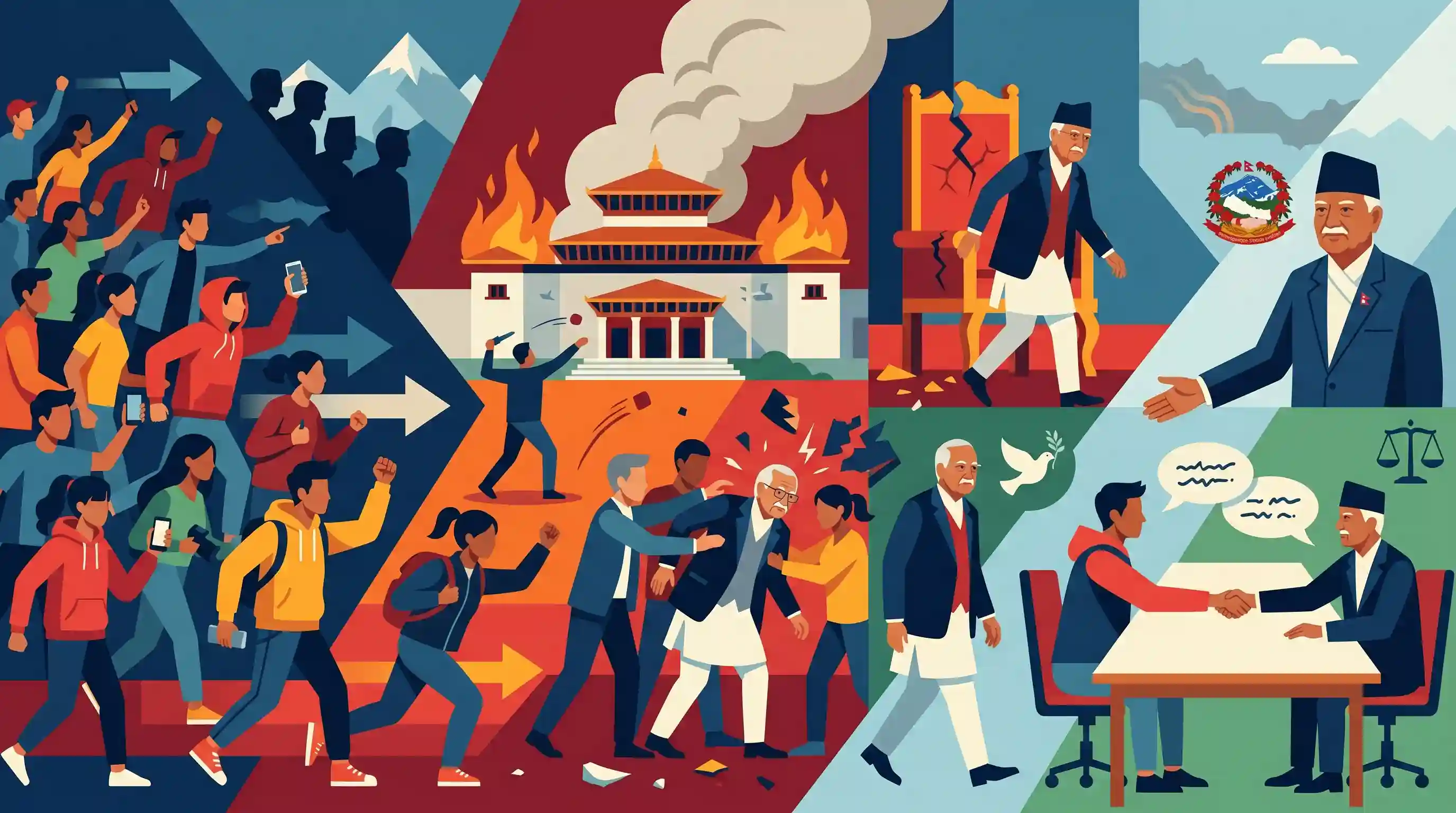
Following widespread, youth-led "Gen Z" protests that spiraled into extreme violence, KP Sharma Oli has resigned as the Prime Minister of Nepal. The political crisis reached a boiling point when protesters set the Parliament building on fire and assaulted a former prime minister, protesting against the entrenched political elite. In response to the collapse of the so-called 'Oli-garchy', President Ram Chandra Paudel has stepped in, offering to initiate dialogue with the demonstrators to restore democratic order and stability. This event marks another significant episode of political instability in India's immediate neighborhood driven by civil society and youth uprisings.
Key Points
- Nepal's Prime Minister KP Sharma Oli resigned after massive youth-led protests escalated across the country.
- The protests turned intensely violent, resulting in demonstrators setting the Parliament on fire and physically assaulting a former prime minister.
- President Ram Chandra Paudel has offered to hold dialogue with the protesters to de-escalate the constitutional and political crisis.
- The unrest highlights deep-seated public anger against entrenched political elites (referred to as the fall of 'Oli-garchy') and reflects a broader regional trend of youth-driven democratic uprisings.
Important Terms
Federal Parliament of Nepal

The bicameral supreme legislature of Nepal consisting of the House of Representatives (Lower House) and the National Assembly (Upper House), established under the 2015 Constitution.
UPSC context
GS Paper II: Comparative Constitutions. Crucial for understanding legislative structures and stability in India's immediate neighborhood.
Neighborhood First Policy
India's core foreign policy prioritizing diplomatic, economic, and security engagement with immediate neighbors to ensure regional stability, connectivity, and prosperity while countering external strategic influences.
UPSC context
GS Paper II: Bilateral Relations. Tests knowledge of India’s strategic doctrine and challenges in maintaining regional leadership during neighborly crises.
Gen Z Protests
Digitally-orchestrated, youth-led uprisings (e.g., Nepal 2025, Bangladesh 2024) driven by frustration over corruption, nepotism, and censorship, utilizing social media to demand systemic political accountability.
UPSC context
GS Paper II/III: Civil Society Role/Internal Security. Examines how demographic shifts and technology influence governance and regional political stability.
President of Nepal
The ceremonial head of state and 'guardian of the constitution' who performs functions like appointing the Prime Minister and dissolving parliament based on executive recommendation.
UPSC context
GS Paper II: Polity. Relevant for comparing the role of the President/Head of State in parliamentary democracies during political transitions.
Constitutional Crisis
A severe governance breakdown where constitutional provisions fail to resolve political stalemates, often requiring extraordinary measures or interim administrations to prevent total state collapse.
UPSC context
GS Paper II: Governance. Tests ability to analyze institutional failures and the legal frameworks used to restore democratic order.
Prelims Trap
The 1,751 km India-Nepal open border is actively guarded by the Border Security Force (BSF).
UPSC often mixes up CAPF jurisdictions. The Sashastra Seema Bal (SSB), not the BSF, is the designated border guarding force for the India-Nepal border.
Static Concepts Connected
How does the India-Nepal open border impact India's internal security?
- Smuggling Hub: The porous nature acts as a major conduit for Fake Indian Currency Notes (FICN), narcotics, and arms smuggling.
- Safe Havens: Unregulated movement is frequently exploited by anti-India insurgent groups and foreign intelligence operatives for safe transit and logistical support.
- Human Trafficking: The open boundary facilitates cross-border human trafficking networks that target vulnerable populations from impoverished rural areas in both nations.
What are the key pillars of the 1950 India-Nepal Treaty of Peace and Friendship?
- National Treatment: Grants reciprocal national treatment to citizens of both countries regarding residence, property ownership, trade, and movement.
- Open Border: Establishes the framework for a visa-free regime, allowing the unimpeded transit of people and goods across the international boundary.
- Security Consultation: Mandates that both governments consult each other on matters of serious friction or misunderstanding likely to breach friendly relations.
Cross-Topic Patterns
South Asian Gen-Z vs Digital Censorship
Like Bangladesh (2024) and Sri Lanka (2022), blanket internet/social media bans triggered extreme protests in Nepal, linking fundamental digital rights (Polity) directly to regional instability (IR).
Remittance Trap and State Failure
Nepal's 30% GDP reliance on remittances masked structural failures like 20% youth unemployment. This demonstrates how heavy external economic dependency often catalyzes severe internal political collapse.

Mains 2026 will likely feature a comparative question on the socio-economic triggers of regime collapse in Sri Lanka, Bangladesh and Nepal.
Linked PYQs · 2
Linked PYQs · 2
- 2012MainsGS2
Discuss the contentious issues that have caused the prolonged constitutional logjam in Nepal.
- 2025MainsGS2
Civil Society Organizations are often perceived as being anti-State actors than non-State actors. Do you agree? Justify.
