Nepal Prime Minister visits India for bilateral talks
Source:The Hindu ↗
Why It Matters
Bilateral visits involving neighboring countries are critical for India's strategic foreign policy, security, connectivity, and regional stability in South Asia.
Summary
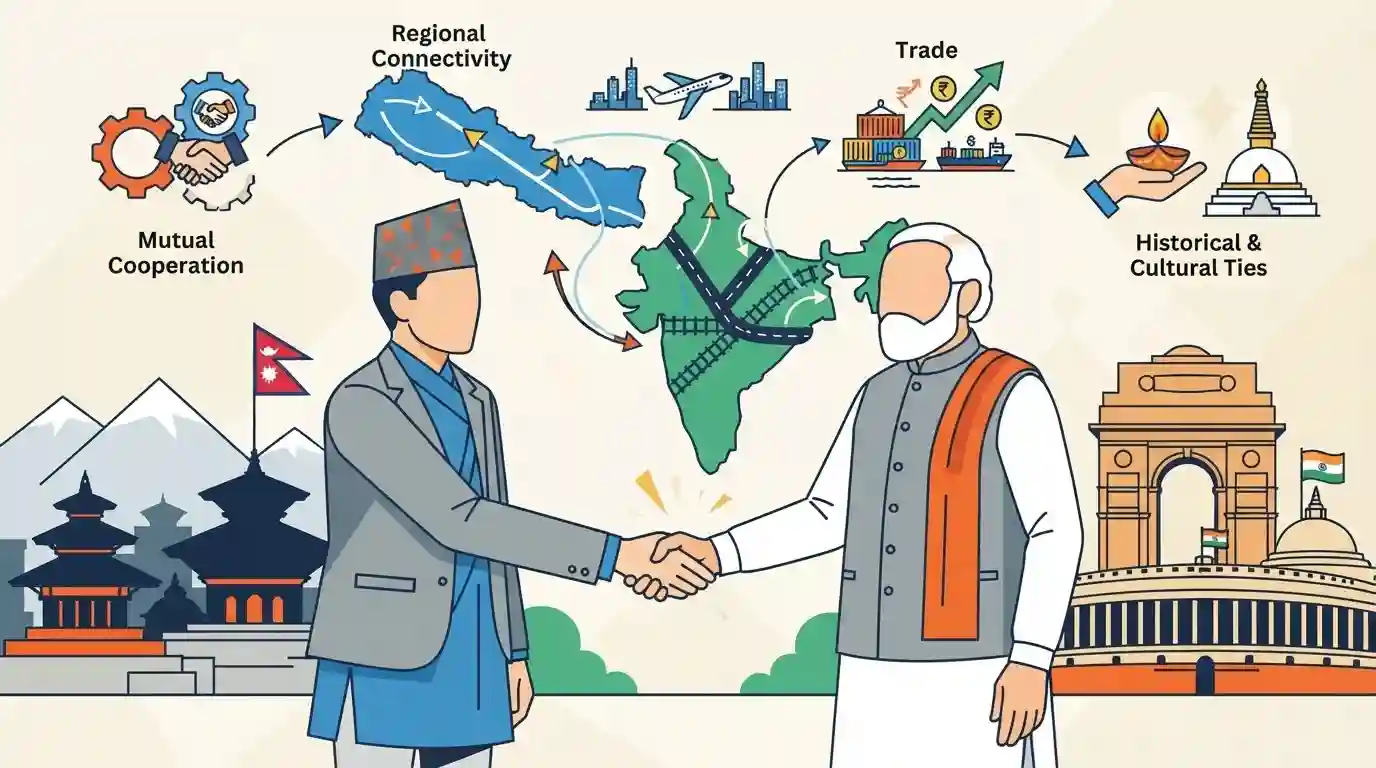
Nepal Prime Minister Balendra Shah arrived in New Delhi for his first official visit to India, marking a significant milestone in bilateral diplomatic engagement. The high-level visit emphasizes mutual cooperation, regional connectivity, trade, and the longstanding historical and cultural ties between the two neighboring countries.
Key Points
- Nepal Prime Minister Balendra Shah arrived in New Delhi for his first official visit to India.
- The visit highlights ongoing diplomatic engagements and bilateral relations between India and Nepal under the 'Neighborhood First' policy.
- Discussions are expected to focus on regional connectivity, trade, border cooperation, and economic partnerships.
Important Terms
Government of India

The executive authority of India, responsible for formulation and execution of domestic and foreign policy, including maintaining strategic bilateral relations with neighboring countries like Nepal under India's 'Neighborhood First' policy.
UPSC context
UPSC Prelims/Mains GS Paper II: India and its Neighborhood - Bilateral relations, diplomatic engagement, and strategic policy framework.
Government of Nepal
The central governing body of Nepal, responsible for conducting foreign relations, trade negotiations, and infrastructure cooperation with key regional partners such as India.
UPSC context
UPSC Mains GS Paper II: Bilateral, regional and global groupings involving India and affecting India's strategic interests.
Prelims Trap
The Prime Minister of Nepal holds absolute authority to unilaterally ratify long-term bilateral water or boundary treaties during official state visits.
Aspirants often confuse executive authority in Nepal's constitutional framework; while the PM holds executive power, key treaties require parliamentary ratification or broader consensus due to coalition dynamics.
Static Concepts Connected
What are the core foundational treaties and transit agreements governing India-Nepal bilateral relations?
- Treaty of Peace:: Signed in 1950, it forms the basis of special ties, allowing free movement of citizens and reciprocal treatment in economic matters.
- Transit Treaty:: Updated periodically, it provides landlocked Nepal access to third-country trade through Indian ports like Kolkata and Visakhapatnam.
Cross-Topic Patterns
Nepal bilateral visits + transboundary river treaties
Bilateral water-sharing pacts like Mahakali and Pancheshwar intersect directly with climate resilience financing and sub-regional energy grids in South Asia.

Expect a statement-based question pairing India's Neighborhood First policy with specific river-valley or transit projects in Nepal.
Linked PYQs · 2
Linked PYQs · 2
- 2026PrelimsGS1
Consider the following statements about river bridges connecting India with neighbouring countries : 1. 'Maitri Setu', built over Feni river, connects Ramgarh in India with Sabroom in Bangladesh. 2. Jhulaghat suspension bridge connects India with Myanmar. 3. Mechi bridge and its approaches connect Panitanki Bypass in India with Kakarvitta in Nepal. Which of the statements given above is/are correct ?
- 2012MainsGS2
Discuss the contentious issues that have caused the prolonged constitutional logjam in Nepal.
