India Nepal Bilateral Relations Energy Trade and Connectivity
Source:Indian Express ↗
Why It Matters
This development is crucial for understanding India's neighborhood first policy, economic diplomacy, and cross-border energy integration in South Asia.
Summary
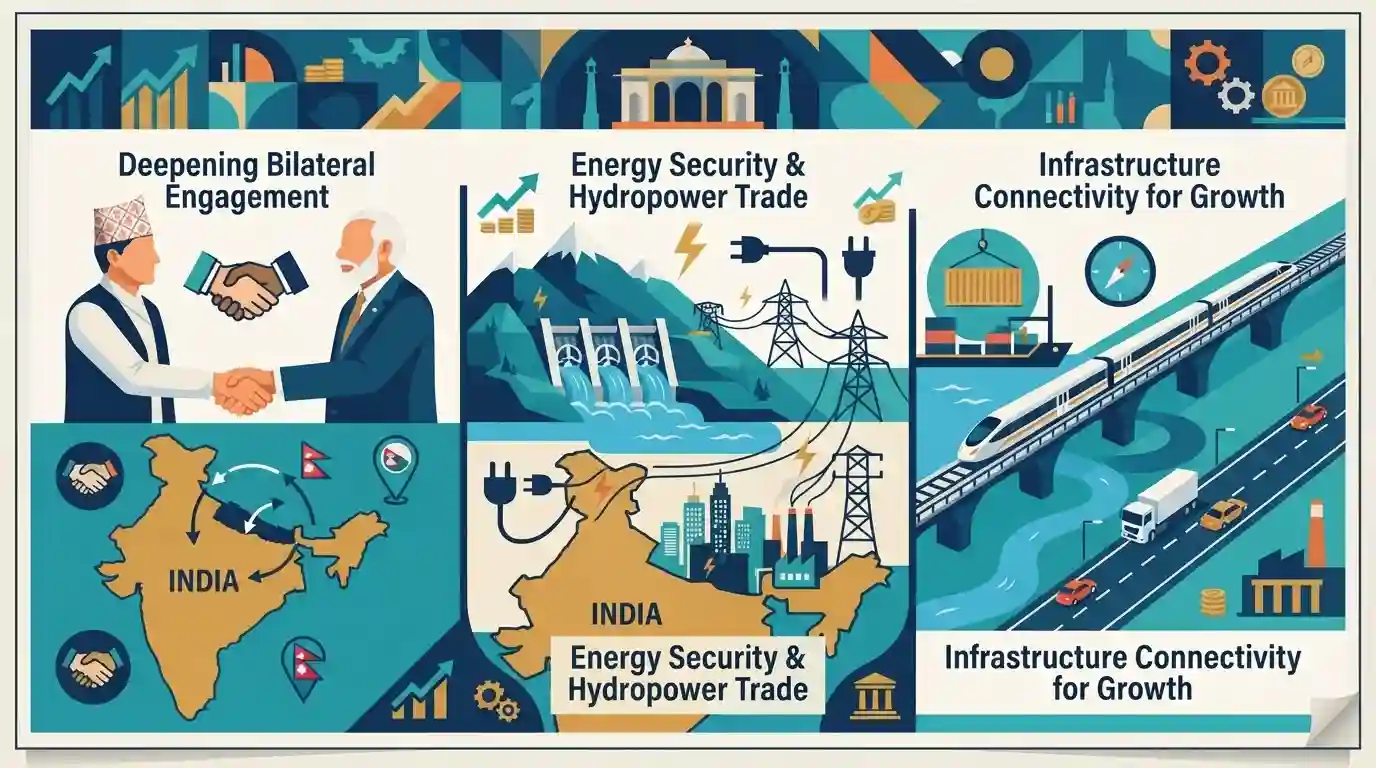
Nepal Prime Minister Balen Shah's visit to India highlights deepening bilateral engagement, focusing heavily on cross-border energy cooperation, hydropower trade, and infrastructure connectivity to foster mutual economic growth and regional stability.
Key Points
- Nepal Prime Minister Balen Shah undertook a visit to India focusing on strengthening bilateral relations, energy cooperation, and trade.
- The visit underscores the strategic significance of cross-border grid connectivity and hydropower trade between India and Nepal.
- Both nations discussed enhancing economic integration, transit facilities, and collaborative ventures in infrastructure development.
Important Terms
Cross-Border Energy Cooperation

A bilateral framework governing the export of massive amounts of clean energy from Nepal to India, aiming to import up to 10,000 MW over a decade.
UPSC context
UPSC GS Paper II (International Relations - India & Neighborhood) and GS Paper III (Energy Security). Tests India's grid integration and regional hydro-diplomacy.
Pancheshwar Multipurpose Project
A stalled joint hydropower and multi-purpose dam project on the Mahakali River along the India-Nepal border, grounded in the 1996 Mahakali Treaty.
UPSC context
UPSC GS Paper II (Bilateral Relations, Water Diplomacy) and GS Paper III (Infrastructure/Energy). Evaluates bilateral bottleneck resolution and transboundary water management.
Power Trade Agreement (PTA)
The institutional framework established in 2014 to facilitate power exchange, grid interconnections, and commercial electricity trade between India and Nepal.
UPSC context
UPSC GS Paper II (India's Neighborhood Policy) and GS Paper III (Power Sector Governance). Focuses on regional economic integration and market access.
Static Concepts Connected
What are the key institutional mechanisms and hydro projects under India-Nepal energy cooperation?
- Institutional Setup: Institutional Framework includes the bilateral Joint Working Group (JWG) on Power Sector Cooperation and the Joint Vision Statement on Power Sector Cooperation.
- Hydro Ventures: Major Hydro Projects involve Indian PSUs like SJVN and NHPC developing Arun-III, Lower Arun, West Seti, and Seti River-6 projects.
- Transmission Lines: Grid Connectivity features operational corridors like the 400kV Dhalkebar-Muzaffarpur transmission line and upcoming links like Butwal-Gorakhpur.
Cross-Topic Patterns
Hydropower + BRI Counter-Strategy
India's hydropower investments in Nepal directly counter Beijing's BRI footprint in the Himalayas, blending energy security with regional geostrategic containment.
Energy Security + Neighbourhood First Policy
Cross-border power grids create interdependent economic corridors, transforming traditional territorial diplomacy into resource-anchored regional integration under SAGAR.

Expect a statement-based prelims question on the 10,000 MW power pact, Dhalkebar-Muzaffarpur line, and Indian PSUs in Nepal's hydropower.
Linked PYQs · 2
Linked PYQs · 2
- 2025MainsGS2
"Energy security constitutes the dominant kingpin of India's foreign policy, and is linked with India's overarching influence in Middle Eastern countries.” How would you integrate energy security with India's foreign policy trajectories in the coming years?
- 2024MainsGS2
Discuss the geopolitical and geostrategic importance of Maldives for India with a focus on global trade and energy flows. Further also discuss how this relationship affects India's maritime security and regional stability amidst international competition ?
