Nepal Observes National Day of Mourning Following Gen Z Protests
Source:The Hindu ↗
Why It Matters
Political stability in Nepal is of vital strategic and security interest to India due to the shared open border and deep cultural ties. The involvement of the youth in toppling the government highlights shifting demographic demands, economic distress, and democratic challenges in India's immediate neighborhood, all of which impact India's Neighbourhood First policy.
Summary
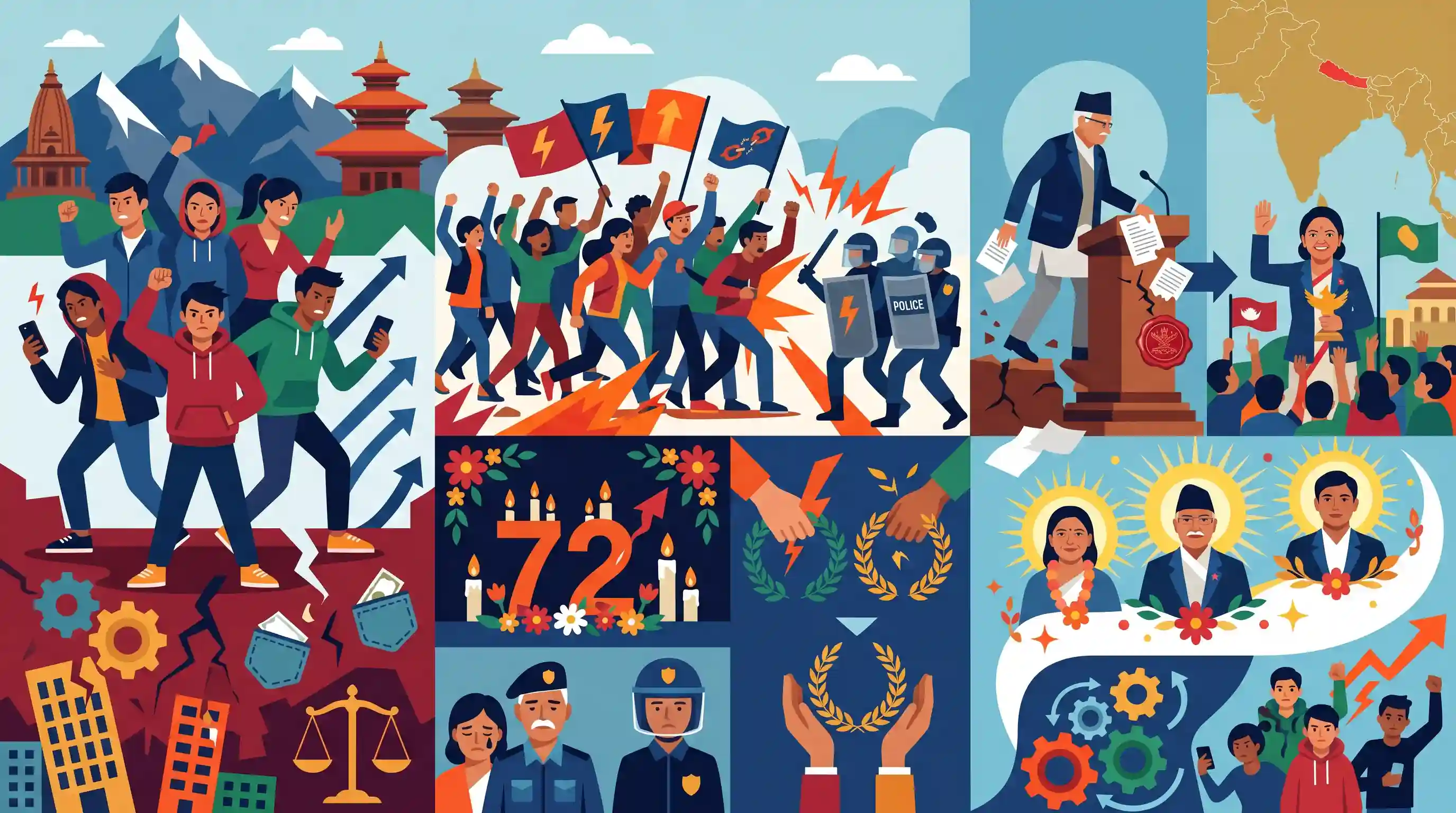
Nepal observed a national day of mourning to honor 72 people, including three policemen, who were killed in recent Gen Z-led protests. The intense anti-government demonstrations forced the resignation of former Prime Minister K.P. Sharma Oli, resulting in a change of government. The newly appointed Prime Minister, Sushila Karki, announced that the deceased would be officially recognized as "martyrs." The protests reflect deep-seated frustrations among the nation's youth regarding persistent political instability and underlying economic difficulties.
Key Points
- Nepal observed a national day of mourning to honor 72 individuals killed during recent Gen Z-led protests.
- The anti-government demonstrations, organized by the youth, forced the resignation of Prime Minister K.P. Sharma Oli and toppled his government.
- Current Prime Minister Sushila Karki announced that those killed in the clashes would be officially recognized as "martyrs".
- The widespread unrest highlights the growing frustration among Nepal's younger generation over prolonged political instability and severe economic difficulties.
Important Terms
India-Nepal Treaty of Peace and Friendship (1950)

The foundational 1950 agreement between India and Nepal establishing 'special relations,' allowing open borders and reciprocal rights for citizens regarding residence, property, and employment.
UPSC context
GS Paper II (International Relations). Crucial for understanding bilateral friction and the 'Neighbourhood First' policy.
Sushila Karki
A prominent Nepalese jurist who served as the first female Chief Justice (2016) and subsequently as Interim Prime Minister (2025) following nationwide youth-led protests.
UPSC context
GS Paper II (Regional Politics). Important for studying South Asian democratic transitions and women in leadership.
Buffer State
A strategic term for a small, neutral country located between two larger, rival powers (India and China), serving to minimize direct friction.
UPSC context
GS Paper II (Strategic Geography). Essential for analyzing Nepal's 'equidistance' foreign policy.
Youth Bulge
A demographic phenomenon where a large percentage of the population consists of young adults, often driving social change and political movements when economic opportunities are scarce.
UPSC context
GS Paper I (Social Issues). Tests understanding of demographic dividends versus social unrest risks.
Roti-Beti ka Rishta
A traditional phrase (meaning 'relationship of food and marriage') describing the deep cultural and familial ties between the people of India and Nepal.
UPSC context
GS Paper II (International Relations). Highlights the soft-power and people-to-people dimension of diplomacy.
Political Instability
A chronic governance challenge in Nepal characterized by frequent changes in government (over 25 PMs since 1990) and delayed constitutional implementation.
UPSC context
GS Paper II (Neighborhood Relations). Tests awareness of regional threats to Indian security and development projects.
Prelims Trap
"Nepal is the only neighboring country with which India shares an open, visa-free border."
India also shares an open, visa-free border with Bhutan (under the 1949 Treaty of Friendship, updated in 2007), making Nepal one of two such neighbors, not the exclusive one.
Static Concepts Connected
What turns a demographic dividend into a demographic disaster?
- Jobless Growth: Failure to create enough formal jobs to absorb the expanding working-age population.
- Skill Deficit: Poor education and inadequate vocational training rendering the youth unemployable in modern economic sectors.
- Civic Unrest: Frustration from economic stagnation channeling young, unemployed populations into massive political instability and civil unrest.
How is the porous Indo-Nepal border managed by India?
- Nodal Guarding Agency: The Sashastra Seema Bal (SSB) is the primary Central Armed Police Force deployed to guard the Indo-Nepal and Indo-Bhutan borders.
- Treaty Basis: The 1950 Indo-Nepal Treaty of Peace and Friendship underpins the open border, allowing free movement of citizens without passports or visas.
- Security Vulnerabilities: The open nature makes it highly vulnerable to smuggling, human trafficking, counterfeit currency networks, and infiltration by third-country terrorists.
Cross-Topic Patterns
South Asian Gen Z political upheavals
Recent youth-led protests forcing regime changes in Sri Lanka, Bangladesh, and now Nepal highlight a regional pattern where economic mismanagement triggers massive political instability.
Open borders and internal security spillovers
Civil unrest in Kathmandu directly impacts India's internal security, as the 1,751-km porous border makes border states vulnerable to sudden migration surges and infiltration during political chaos.

Mains 2026 may feature a comparative GS2 question on "youth-led regime changes in South Asia," linking unemployment to regional security.
Linked PYQs · 1
Linked PYQs · 1
- 2012MainsGS2
Discuss the contentious issues that have caused the prolonged constitutional logjam in Nepal.
