Demographic Dividend Failures in Developing Nations
Source:Indian Express ↗
Why It Matters
It provides essential regional case studies demonstrating that a favorable demographic structure alone does not guarantee economic success. It is highly relevant for GS2 (Human Resources) and GS3 (Employment) answers to illustrate the consequences of failing to skill youth and create adequate jobs.
Summary
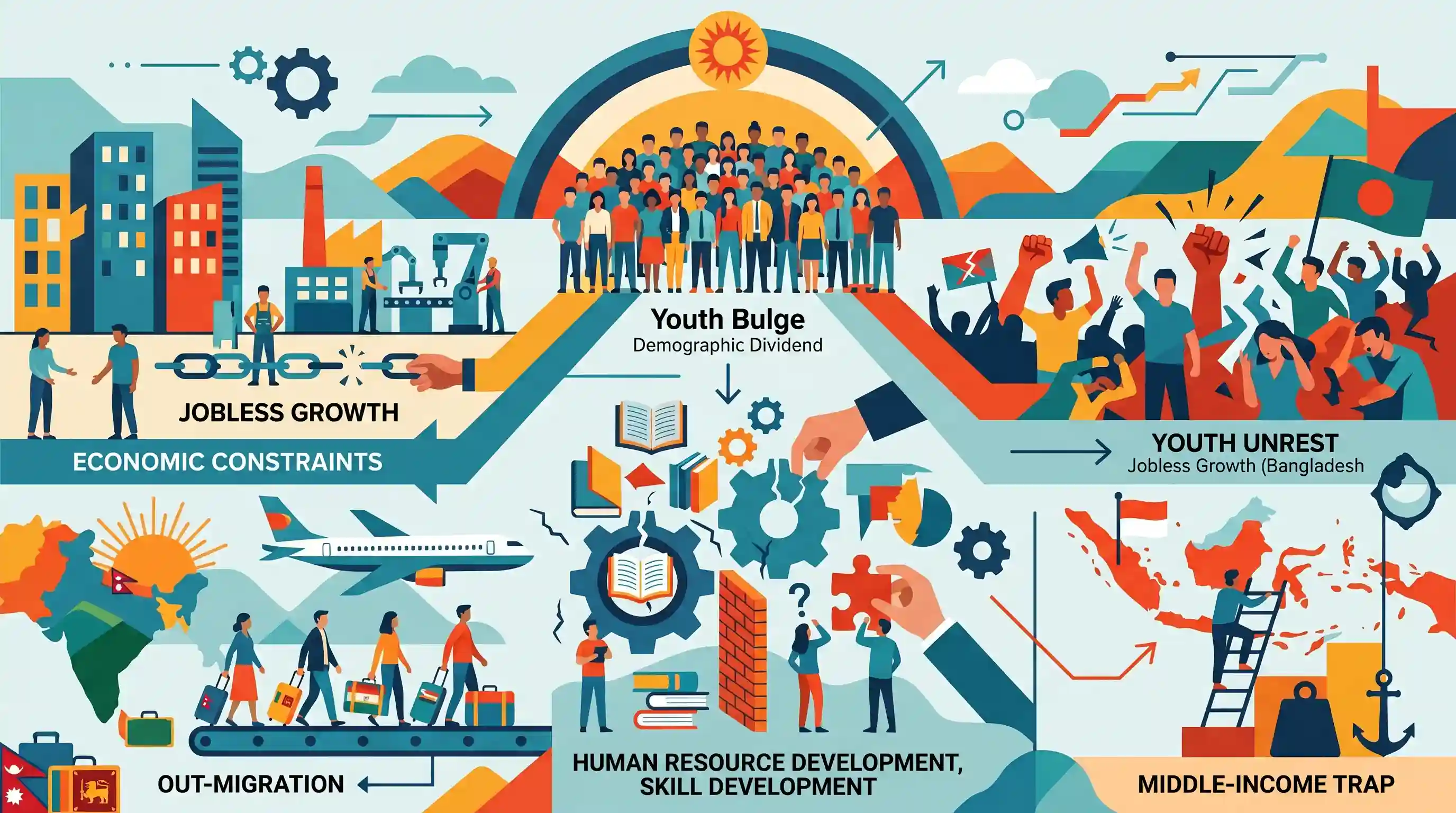
The article highlights how the anticipated "demographic dividend" is failing to materialize in regional economies such as Nepal, Indonesia, Bangladesh, and Sri Lanka. Despite having large working-age populations, these nations struggle with structural economic flaws, political instability, and a severe lack of adequate job creation. Phenomena like massive out-migration in Nepal and Sri Lanka, youth unrest driven by jobless growth in Bangladesh, and Indonesia's struggle to escape the middle-income trap demonstrate that a youth bulge can quickly become a demographic burden. These examples underscore the critical necessity of investing in education, skilling, and domestic employment opportunities to truly capitalize on a favorable demographic structure.
Key Points
- A demographic dividend is not an automatic driver of economic growth; it requires concurrent job creation, skill development, and robust economic policies to harness the youth bulge.
- In Nepal and Sri Lanka, severe economic distress and lack of domestic opportunities have resulted in massive labor emigration and brain drain, eroding their demographic advantage.
- Bangladesh illustrates the pitfalls of jobless growth and sector over-reliance, where an inability to create sufficient quality employment has fueled significant youth unrest.
- Indonesia faces the pressing challenge of upgrading skills and generating high-productivity jobs to avoid the middle-income trap before its population begins to age.
- For India, these regional case studies serve as a stark cautionary tale emphasizing the urgent need to bridge the employability gap and prevent a demographic disaster.
Prelims Trap
A high working-age population automatically ensures a demographic dividend.
Aspirants confuse the demographic 'window' (a population age structure) with the 'dividend' (an economic result). The dividend requires active policy intervention.
Static Concepts Connected
What is the Middle-Income Trap in development economics?
- Definition: A situation where a developing country attains a certain income (due to given advantages) and gets stuck, unable to transition to high-income status.
- Causes: Often triggered by rising wages that eliminate competitive edges in low-skill manufacturing, while lacking the institutional capability to compete in high-value innovation.
- Prevention: Requires massive investment in human capital, structural economic transformation, and technological infusion to boost overall labor productivity.
What specific conditions convert a demographic dividend into a demographic burden?
- Jobless Growth: Economic growth driven by capital-intensive sectors rather than labor-intensive manufacturing leads to high GDP but no new jobs for the youth bulge.
- Employability Gap: When the education system produces graduates whose skills do not match modern industry requirements, creating structural unemployment.
- Brain Drain: Lack of domestic opportunities forces skilled human capital to emigrate, eroding the nation's productive base while leaving behind an aging demographic.
Cross-Topic Patterns
Demography dictates regional security
Economic distress and youth unrest in Bangladesh and Sri Lanka directly complicate India's border management, refugee influx challenges, and 'Neighborhood First' policy objectives.
Premature deindustrialization + Demography
Skipping the manufacturing phase to become service-led economies restricts mass low-skilled employment, directly causing jobless growth and an unutilized demographic window.

Mains GS1/GS3 2026 will likely fuse South Asian 'jobless growth' with India's own middle-income trap and deindustrialization risks.
Linked PYQs · 4
Linked PYQs · 4
- 2014MainsGS3
While we flaunt India's demographic dividend, we ignore the dropping rates of employability. What are we missing while doing so? Where will the jobs that India desperately needs come from? Explain.
- 2016MainsGS2
Demographic Dividend in India will remain only theoretical unless our manpower becomes more educated, aware, skilled and creative." What measures have been taken by the government to enhance the capacity of our population to be more productive and employable?
- 2023MainsGS2
Skill development programmes have succeeded in increasing human resources supply to various sectors. In the context of the statement analyse the linkages between education, skill and employment.
- 2015MainsGS3
The nature of economic growth in India in recent times is often described as jobless growth. Do you agree with this view ? Give arguments in favour of your answer.
