India Nepal Cross Border Power Trade and Energy Cooperation
Source:The Hindu ↗
Why It Matters
This development illustrates India's growing role as a net power exporter in South Asia and reinforces its 'Neighbourhood First' policy through strategic energy cooperation.
Summary
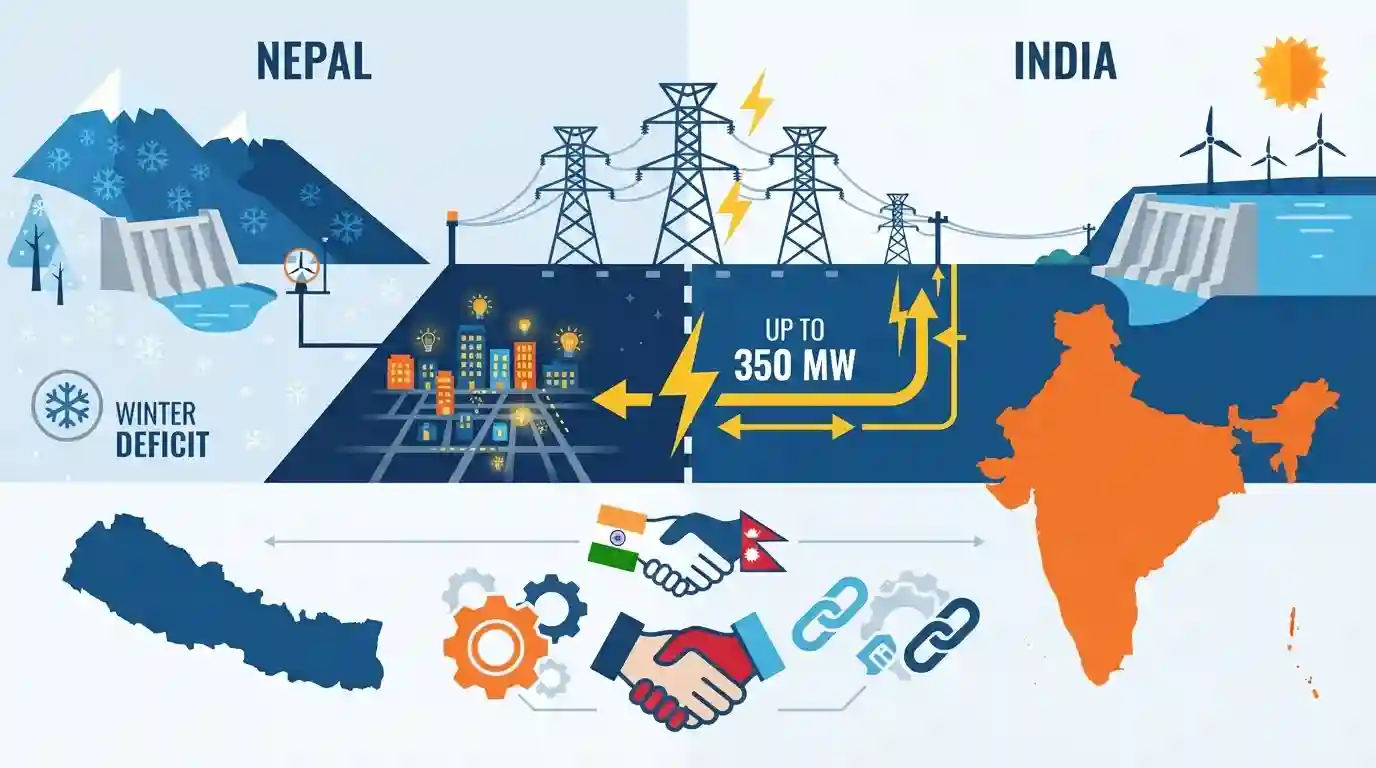
India has granted approval to Nepal to import up to 350 MW of electricity from the Indian power market during the winter season. This is intended to help Nepal tide over seasonal deficits in hydropower generation caused by lower water levels in rivers during colder months. The move underscores robust bilateral cooperation and cross-border energy connectivity between the two nations.
Key Points
- India has approved Nepal's request to import up to 350 MW of power from the Indian power market during the winter months.
- This energy arrangement helps Nepal manage severe seasonal power deficits when domestic run-of-river hydropower generation drops due to reduced water flow.
- It highlights deepening bilateral economic and energy integration under the framework of cross-border power grid connectivity between India and Nepal.
Important Terms
Central Electricity Authority of India

The statutory body under India's Ministry of Power responsible for formulating power policy, planning, and granting regulatory approvals for cross-border electricity trade.
UPSC context
GS Paper II (International Relations - India-Nepal Bilateral Relations) & GS Paper III (Infrastructure - Energy Sector). Tests technical regulatory frameworks for cross-border energy cooperation.
Nepal Electricity Authority
Nepal's state-owned power utility entity responsible for the generation, transmission, and distribution of electricity throughout the country.
UPSC context
GS Paper II (Bilateral Relations, Economic Ties) and GS Paper III (Energy Security). Tests cooperation mechanisms and regional grid integration in South Asia.
Prelims Trap
Nepal relies entirely on Indian electricity imports year-round due to structural domestic generation deficits.
Aspirants might confuse this seasonal winter import arrangement with Nepal being permanently power-deficient; Nepal actually exports surplus wet-season power to India under reciprocal arrangements.
Static Concepts Connected
What are the key institutional mechanisms and corridors governing India-Nepal energy cooperation?
- 25-Year Agreement: Long-Term Pact: A 25-year power trade agreement aims to scale bilateral electricity trade up to 10,000 MW.
- Key Corridor: Transmission Corridor: The Dhalkebar-Muzaffarpur high-capacity 400 kV cross-border transmission line serves as the primary arterial network.
- CBTE Guidelines: Regulatory Framework: Governed by India's Guidelines for Cross-Border Trade of Electricity (CBTE), permitting access to Indian power exchanges.
Cross-Topic Patterns
Cross-Border Energy Grid + Regional Diplomacy
India's emergence as a net power exporter in South Asia alters regional geopolitics, countering Chinese infrastructure dominance through connectivity and energy security interdependence.
Power Trade + Cross-Border Electricity Regulations
Bilateral power agreements operate under India's specific CBTE regulations, connecting regional diplomacy with international trade law and domestic open-access market rules.

India-Nepal 10,000 MW power pact & cross-border grid integration (Dhalkebar-Muzaffarpur) prime candidates for a multi-statement prelims Q.
Linked PYQs · 3
Linked PYQs · 3
- 2026PrelimsGS1
Consider the following statements about river bridges connecting India with neighbouring countries : 1. 'Maitri Setu', built over Feni river, connects Ramgarh in India with Sabroom in Bangladesh. 2. Jhulaghat suspension bridge connects India with Myanmar. 3. Mechi bridge and its approaches connect Panitanki Bypass in India with Kakarvitta in Nepal. Which of the statements given above is/are correct ?
- 2026PrelimsGS1
Match List I with List II and select the answer using the code given below the Lists : List I (Project Supported by India) A. Mangdechhu Hydroelectric Project B. Restoration of Stor Palace C. District Hospital at Dickoya D. Institute of Security and Law Enforcement Studies List II (Country) 1. Maldives 2. Afghanistan 3. Bhutan 4. Sri Lanka Code :
- 2020PrelimsGS1
Consider the following statements: 1. The value of Indo-Sri Lanka trade has consistently increased in the last decade. 2. "Textile and textile articles" constitute an important item of trade between India and Bangladesh. 3. In the last five years, Nepal has been the largest trading partner of India in South Asia. Which of the statements given above is/are correct?
