Nepal Monsoon Floods Destroy Vital Cross-Border Bridge
Source:The Hindu ↗
Why It Matters
The event serves as a stark case study on how climate-induced disasters in the Himalayas can disrupt strategic supply chains and geopolitical trade routes, emphasizing the need for disaster-resilient infrastructure.
Summary
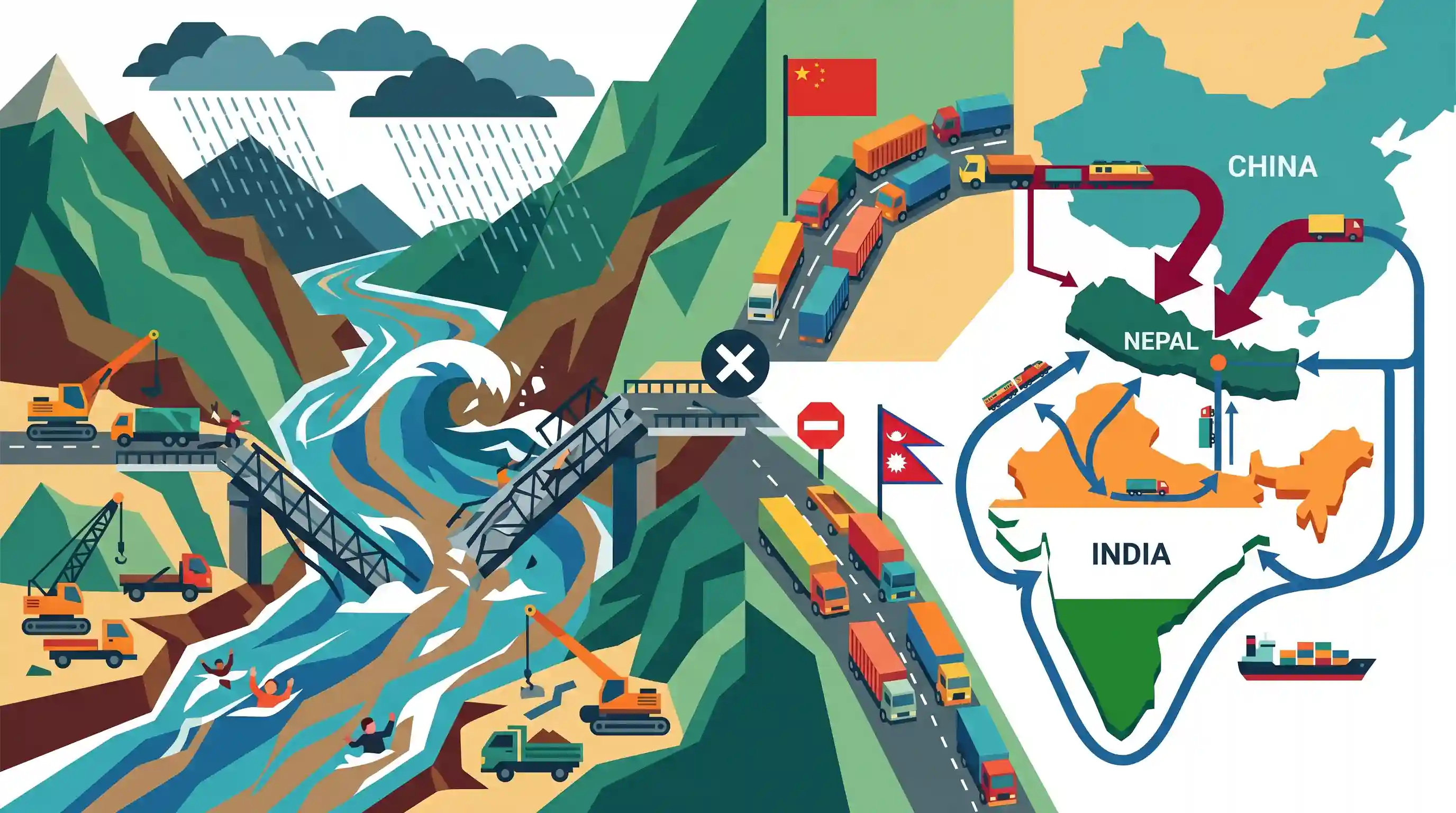
Devastating monsoon floods in Nepal have swept away the Friendship Bridge at Rasuwagadi, a critical border crossing over the Bhotekoshi River that connects Nepal to China. The disaster claimed at least nine lives and left 19 missing, including nationals from both countries working on a Chinese-funded infrastructure project. Beyond the human toll, the destruction of the bridge has completely halted direct bilateral trade on this route. Consequently, traders are forced to rely on a much longer alternative supply chain, shipping goods from China via India and then transporting them overland into Nepal. This event highlights the vulnerability of cross-border mountain infrastructure to climate-induced disasters and illustrates the complex transit dependencies among Himalayan neighbors.
Key Points
- Monsoon floods in Nepal destroyed the Friendship Bridge over the Bhotekoshi River, a vital transit link to China.
- The disaster resulted in at least 9 deaths and 19 missing individuals, including workers on a Chinese-assisted construction project.
- Direct border trade between Nepal and China on this route has been completely halted due to the destruction of the bridge.
- The disruption forces goods to be routed via a longer path from China to India, and then overland into Nepal.
- The incident underscores the extreme vulnerability of strategic infrastructure in the ecologically fragile Himalayan region.
Important Terms
Nepali Army

Nepal's primary security force for large-scale SAR and coordinating multinational humanitarian assistance during disasters, utilizing specialized air and land rescue assets.
UPSC context
GS III (Disaster Management). Tests institutional frameworks for disaster response and military-civilian coordination in emergencies.
Armed Police Force (APF)
A paramilitary organization in Nepal with a specific legal mandate for search and rescue operations, operating specialized disaster management divisions across the country.
UPSC context
GS III (Disaster Management). Relevant for understanding specialized paramilitary mandates in regional disaster mitigation.
Nepal Police
The civil law enforcement agency acting as the first responder during disasters, responsible for immediate rescue, data collection, and local site security.
UPSC context
GS III (Disaster Management). Highlights the importance of local civilian agencies in the 'first hour' of crisis response.
Friendship Bridge (Rasuwagadi)
A critical 114-meter-long bridge connecting Rasuwagadi, Nepal, to Kerung, China; it is a primary trade route and focal point of China-Nepal connectivity projects.
UPSC context
GS II (Neighborhood Relations). Essential for analyzing China’s influence in Nepal and shifts in Himalayan transit dependencies.
Bhotekoshi River
A trans-boundary river flowing from Tibet into Nepal, known for extreme topography and high vulnerability to climate-induced flash floods and glacial lake outbursts.
UPSC context
GS I (Physical Geography). Focuses on mountain hazards and the impact of climate change on trans-boundary water systems.
Trans-Himalayan Multi-Dimensional Connectivity Network
An ambitious connectivity framework under China's Belt and Road Initiative aiming to link Nepal to China via rail, roads, and energy transmission lines.
UPSC context
GS II (International Relations). Crucial for evaluating geopolitical competition between India and China in Nepal.
Prelims Trap
The Bhotekoshi River originates in the high altitudes of Nepal.
Bhotekoshi is an antecedent river originating in Tibet (China) and flowing south into Nepal. Antecedent rivers pre-date the Himalayan uplift.
Static Concepts Connected
What characterizes antecedent river systems in the Himalayas?
- Pre-date uplift: These river systems established their drainage patterns long before the Himalayan mountain building process began.
- Deep gorges: They maintain their original course by aggressively down-cutting the rising terrain, forming deep V-shaped valleys and gorges.
- Major examples: Key Himalayan examples include the Indus, Sutlej, Brahmaputra, and the Kosi river systems (which includes Bhotekoshi).
What are the transit rights of landlocked states under international law?
- Right of access: UNCLOS Article 125 grants landlocked states the right of access to and from the sea.
- Bilateral agreements: Terms and modalities for exercising freedom of transit must be negotiated through bilateral agreements with transit states (e.g., India-Nepal Treaty of Transit).
- Sovereign protection: Transit states have the right to take measures ensuring their legitimate interests aren't infringed by these transit rights.
Cross-Topic Patterns
BRI's Himalayan geographical constraints
Frequent climate disasters repeatedly disrupt trans-Himalayan BRI projects, naturally reinforcing India's structural and geographical advantage as Nepal's most reliable overland transit hub.
Border infrastructure and CDRI
The destruction of the Friendship Bridge exemplifies GS3 Disaster Management themes, specifically highlighting the core mandate of the India-led Coalition for Disaster Resilient Infrastructure (CDRI).

Expect a prelims mapping question on antecedent trans-boundary Himalayan rivers (like Kosi/Bhotekoshi) paired with GLOF concepts.
Linked PYQs · 3
Linked PYQs · 3
- 2019MainsGS1
How can the mountain ecosystem be restored from the negative impact of development initiatives and tourism?
- 2016MainsGS1
The Himalayas are highly prone to landslides. Discuss the causes and suggest suitable measures of mitigation.
- 2019MainsGS3
Vulnerability is an essential element for defining disaster impacts and its threat to people. How and in what ways can vulnerability to disasters be characterized? Discuss different types of vulnerability with reference to disasters.
