Nepal Floods: Nagpur Pilgrims Evacuated Safely to Maharashtra
Source:The Hindu ↗
Why It Matters
This event highlights the increasing frequency of climate-induced flash floods in the fragile Himalayan ecosystem (e.g., the Bhotekoshi flood) and underscores the vital importance of transboundary disaster management, bilateral infrastructure support (like Bailey bridges), and proactive state-level administrative coordination to ensure the safety of citizens stranded abroad.
Summary
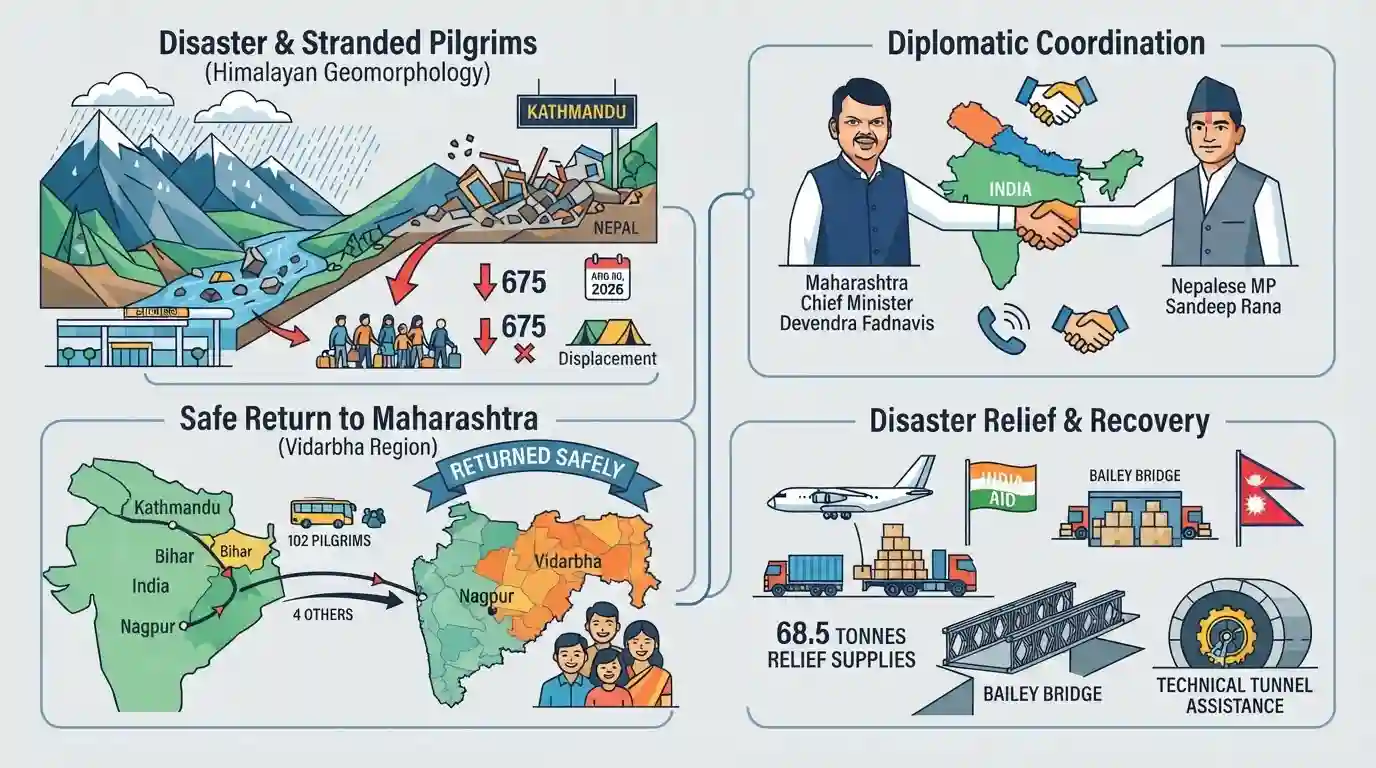
On August 30, 2026, 102 pilgrims from Nagpur and 4 others from Vidarbha returned safely to Maharashtra after being stranded in Kathmandu due to catastrophic flash floods on the Nepal-Tibet border. The disaster killed at least 675 people and displaced thousands. Maharashtra Chief Minister Devendra Fadnavis, in coordination with Nepalese MP Sandeep Rana, facilitated their safe evacuation via Bihar. Meanwhile, India supported Nepal's recovery with 68.5 tonnes of relief supplies, a Bailey bridge, and technical tunnel engineering assistance.
Key Points
- A total of 102 pilgrims from Nagpur and 4 others from different parts of the Vidarbha region (Wardha and Hinganghat) returned home safely after being stranded in Kathmandu due to severe flash floods.
- The devastating floods along the Nepal-Tibet border (including the Bhotekoshi river flood) claimed at least 675 lives and left nearly 2,400 missing in Nepal.
- The pilgrims had traveled to Nepal on August 19, 2026, to visit the Pashupatinath temple and other religious sites.
- Maharashtra Chief Minister Devendra Fadnavis coordinated the rescue operations and remained in constant communication with Nepal's Member of Parliament, Sandeep Rana, to ensure safe transit.
- The safe evacuation route involved traveling by bus from Kathmandu to Janakpur (near the Bihar border), then to Danapur and Patna, before taking a train back to Nagpur.
- India played a significant role in disaster relief, delivering 68.5 tonnes of humanitarian aid, deploying technical tunnel expertise, and constructing a temporary Bailey bridge to assist flood-hit regions in Nepal.
Important Terms
Bilateral Disaster Assistance Cooperation

A joint framework where two sovereign nations collaborate to manage, mitigate, and recover from natural disasters, involving the deployment of relief materials, rescue operations, and technical engineering support.
UPSC context
MPSC GS Paper II (IR) & Paper III (Disaster Management). Tests transboundary disaster response and neighborhood diplomacy frameworks.
Maharashtra Chief Minister's Office (CMO)
The administrative secretariat providing administrative and policy support to the Chief Minister of Maharashtra, facilitating inter-state coordination, policy implementation, and crisis management decisions.
UPSC context
MPSC GS Paper II (Polity and Governance). Tests the state executive structure, administrative machinery, and disaster response coordination.
Indian Railways
The state-owned national railway system of India, managed by the Ministry of Railways, serving as the primary infrastructure for mass passenger transport and heavy freight logistics.
UPSC context
MPSC GS Paper I (Geography) & Paper IV (Economy & Infrastructure). Tests transportation networks and critical transit systems of India.
Pashupatinath Temple
A revered, ancient Hindu temple complex in Kathmandu, Nepal, dedicated to Lord Shiva, located on the Bagmati River and designated as a UNESCO World Heritage Site.
UPSC context
MPSC GS Paper I (History & Culture) & Paper II (Bilateral Relations). Tests ancient temple architecture and India-Nepal cultural ties.
Prelims Trap
The Governor of the state acts as the ex-officio Chairperson of the State Disaster Management Authority (SDMA).
Under Section 14 of the Disaster Management Act 2005, the Chief Minister is the ex-officio Chairperson, not the Governor.
Static Concepts Connected
What are the defining characteristics of the Pranhita River system in Maharashtra?
- Confluence formation: Formed by the merger of the Wardha and Wainganga rivers on the Vidarbha border.
- Geographical boundary: Its entire 113 km course acts as the natural boundary between Maharashtra and Telangana.
- Discharge destination: It is the largest tributary of the Godavari River by water volume, draining at Kaleshwaram.
What differentiates GLOFs from LLOFs in disaster management?
- GLOF mechanism: Occurs when unstable moraines or glacial ice damming a lake fail, releasing water abruptly.
- LLOF mechanism: Triggered when landslide or rockfall debris blocks a river channel, forming a temporary, fragile dam.
Cross-Topic Patterns
Disaster diplomacy + Neighborhood First
India's rapid deployment of relief aid and Bailey bridges to Nepal during crises showcases how subnational state rescues align with bilateral soft-power diplomacy.
Himalayan hydrology + Bihar plains
Flash floods in transboundary rivers like the Bhote Koshi directly escalate flood vulnerability downstream in Bihar's Koshi river basin.

MPSC likely to combine Maharashtra's drainage systems (Pranhita formation) with disaster management structures under the DM Act 2005.
Linked PYQs · 2
Linked PYQs · 2
- 2023MPSC_PRELIMSGS1
Observe the following statements : A. There is loss of bio-diversity due to dumping of toxic waste into soil. B. Deforestation is responsible for frequent floods in river. C. Fransisco Mendez was known as 'Amazon Gandhi' due to his work in energy field.
- 2024MPSC_PRELIMSGS1
Which type of drainage pattern is found in Maharashtra ? (a) Dendritic (b) Parallel (c) Indefinite (d) Trellis Answer options :
