Hydropower Vulnerability to Himalayan Flash Floods in Nepal
Source:The Hindu ↗
ఇది ఎందుకు ముఖ్యం
It directly addresses the intersection of renewable energy expansion (hydropower) and climate change-induced disasters in the fragile Himalayan ecosystem, a critical theme for GS3 (Environment/Disaster Management) and GS1 (Geography).
సారాంశం
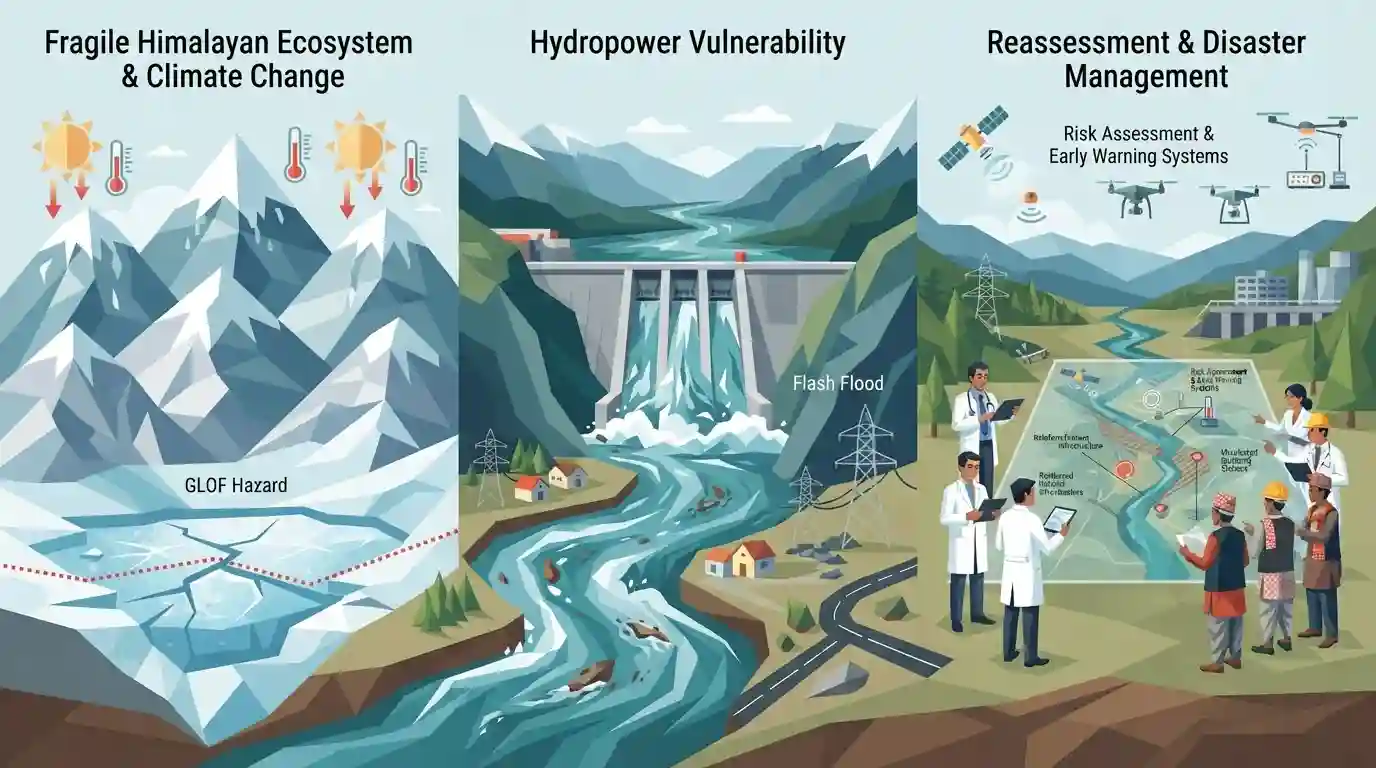
The article discusses how recent flash floods in Nepal have shattered assumptions about hydropower being a completely clean, risk-free, and easy source of energy. It highlights the vulnerability of the fragile Himalayan ecosystem to climate change, extreme weather, and GLOFs, emphasizing the need for a comprehensive reassessment of hydropower development in the region.
ముఖ్య అంశాలు
- Recent flash floods in Nepal have exposed the severe vulnerabilities of hydropower projects in the fragile Himalayan ecosystem.
- The illusion of clean, easy, and risk-free hydropower is challenged by climate change impacts, Glacial Lake Outburst Floods (GLOFs), and erratic extreme weather events.
- Run-of-the-river and large dam projects alike face high risks of siltation, structural damage, and disruption to energy security and cross-border power trade.
- There is an urgent need to reassess developmental models in high-altitude mountain ecosystems, balancing renewable energy goals with ecological carrying capacities.
ప్రిలిమ్స్ ఉచ్చు
Run-of-the-river hydropower projects are completely risk-free and environmentally benign alternatives to large storage dams in the Himalayas.
Aspirants often assume 'run-of-the-river' hydroelectric projects are entirely ecologically benign and immune to large-scale disasters, whereas they remain highly vulnerable to siltation, flash floods, and GLOFs.
అనుసంధానమైన స్థిర భావనలు
What are the primary causes and disaster management strategies for Glacial Lake Outburst Floods (GLOFs)?
- Primary Causes:: Triggered by rapid glacier melting, earthquakes, or heavy rainfall breaching weak moraine dams.
- NDMA Guidelines:: NDMA guidelines emphasize hazard zonation mapping, automated early warning systems, and lowering lake water levels via siphon or artificial channels.
అంతర-అంశ నమూనాలు
Hydropower Vulnerability + India-Nepal Energy Diplomacy
Himalayan infrastructure development intersects with transboundary river management and bilateral energy trade agreements between India and its northern neighbors.
EIA Reform + Climate Change Adaptation Models
Fragile mountain ecosystems require EIAs that incorporate dynamic climate risks like GLOFs rather than static baseline studies.

Himalayan hydropower vulnerabilities + GLOF risks + transboundary river management likely to feature in Mains GS-3 (Disaster/Environment).
అనుసంధాన PYQలు · 2
అనుసంధాన PYQలు · 2
- 2017MainsGS3
'Climate change' is a global problem. How India will be affected by climate change? How Himalayan and coastal states of India will be affected by climate change?
- 2016MainsGS1
The Himalayas are highly prone to landslides. Discuss the causes and suggest suitable measures of mitigation.
