Uttar Pradesh Disaster Management and Cross Border Floods
Source:The Hindu ↗
Why It Matters
Highlights the state-level response to international disasters, the operational role of the SDRF, and the geographical vulnerability of Uttar Pradesh to floods caused by rivers originating in Nepal. Essential for understanding UP's disaster management protocols and cross-border cooperation.
Summary
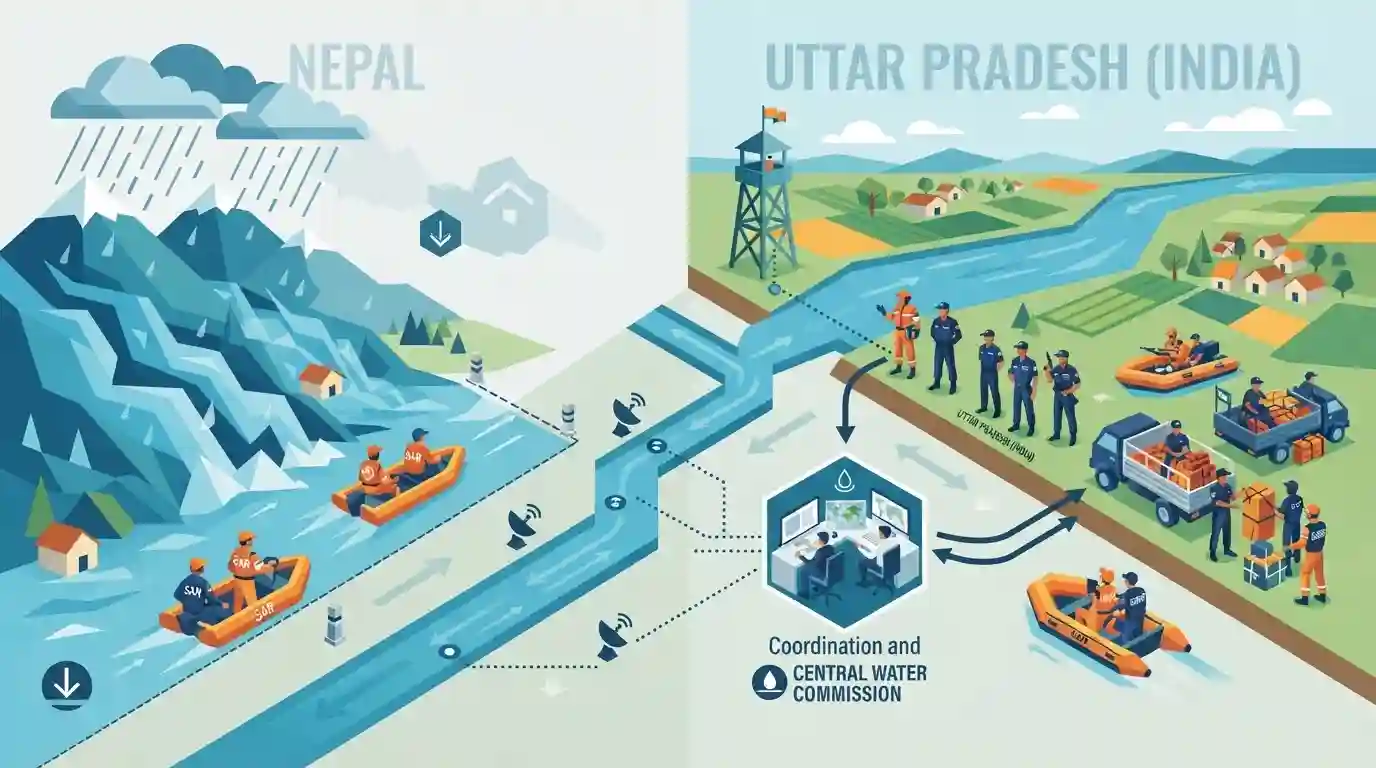
Following severe flash floods in Nepal, the Uttar Pradesh government has heightened vigilance in border districts and deployed SDRF and PAC personnel to assist in cross-border rescue operations. State authorities are closely monitoring rivers originating from Nepal and coordinating with the Central Water Commission to manage any downstream flood threats in UP.
Key Points
- The Uttar Pradesh government has put districts bordering Nepal on high alert following devastating flash floods in the neighboring country.
- Chief Minister Yogi Adityanath ordered the deployment of a State Disaster Response Force (SDRF) platoon and personnel from the 26th Battalion of PAC to assist in relief and rescue operations in Nepal.
- Authorities are continuously monitoring the water levels of rivers originating in Nepal that flow into Uttar Pradesh to mitigate potential flood risks downstream.
- The state's Relief Commissioner is coordinating with Nepalese authorities and the Central Water Commission to analyze rainfall and river discharge data.
Important Terms
State Disaster Response Force (SDRF)

A specialized state-level force formed in 2016 in Uttar Pradesh to execute rapid relief and rescue operations during natural and man-made disasters, such as floods and earthquakes, using advanced equipment.
UPSC context
Relevant for UPPSC GS Paper 3 and GS Paper 5 (Disaster Management), testing knowledge of UP's specific emergency response frameworks.
Provincial Armed Constabulary (PAC)
An armed police force in Uttar Pradesh. Its specialized flood relief companies and platoons operate motorboats and assist the SDRF in emergency rescue and civilian evacuations during severe floods.
UPSC context
Tests knowledge in UPPSC GS Paper 5 (State Security and Disaster Management) regarding the utilization of armed police in civil defense.
Central Water Commission (CWC)
A premier technical organization under the Ministry of Jal Shakti. It monitors transboundary river water levels and issues crucial flood forecasts to states like UP during cross-border events.
UPSC context
Crucial for UPPSC GS Paper 3 (Disaster Management) and GS Paper 2 (International Relations) regarding cross-border water management with Nepal.
Relief Commissioner's Office
The primary nodal agency in Uttar Pradesh responsible for coordinating disaster response, distributing transparent relief, managing rehabilitation, and communicating early weather warnings to vulnerable state districts.
UPSC context
Key for UPPSC GS Paper 5 (State Administration) and GS Paper 3, highlighting UP's administrative machinery for crisis mitigation.
Prelims Trap
Uttar Pradesh shares its international border with Nepal across 8 districts.
UP shares its 599 km international border with exactly 7 districts, not 8. These are Pilibhit, Lakhimpur Kheri, Bahraich, Shravasti, Balrampur, Siddharthnagar, and Maharajganj.
Static Concepts Connected
Which major trans-boundary rivers originate in Nepal and frequently flood Uttar Pradesh?
- Rapti River: Originates near Rukumkot, Nepal. Often called the 'Sorrow of Gorakhpur' due to recurrent, devastating flash floods in the eastern UP plains.
- Ghaghara River: A major left-bank tributary of the Ganga, bringing massive water discharge from the Himalayas into UP, significantly impacting the Terai belt.
- Gandak River: Monitored by the CWC, this river forms a critical boundary between UP and Bihar, carrying heavy monsoon discharge from Nepal.
How is the State Disaster Response Fund (SDRF) structured and financed?
- Statutory Origin: It was constituted under Section 48 (1) (a) of the National Disaster Management Act, 2005.
- Funding Ratio: The Centre contributes 75% for general category states (like UP) and 90% for special category states/UTs.
- Nodal Ministry: The Ministry of Home Affairs is the nodal ministry for overseeing disaster response and SDRF allocations.
Cross-Topic Patterns
Terai Topography & Flood Vulnerability
The steep gradient of Nepal's Himalayas causes rivers to rapidly lose velocity entering the UP Terai. This sudden transition deposits heavy silt, shifting river courses and causing severe flash floods.
Cross-border Sub-national Diplomacy
UP's direct deployment of SDRF and PAC to Nepal highlights the growing role of border states (para-diplomacy) in managing localized trans-boundary crises and India's 'Neighborhood First' policy.

Expect a multi-statement question mapping UP's 7 Nepal-bordering districts alongside trans-boundary rivers (like Rapti) and SDRF funding.
Linked PYQs · 2
Linked PYQs · 2
- 2025UPPSC_PRELIMSGS1
Which of the following districts of Uttar Pradesh shares its boundary with only one other district of Uttar Pradesh ? 1. Lalitpur 2. Saharanpur 3. Sonbhadra Select the correct answer from the code given below :
- 2018UPPSC_PRELIMSGS1
Which of the following rivers of Uttar Pradesh has been declared a 'Biological Disaster' due to environmental pollution?
