Nepal Eases Indian Currency Rules for Travel and Trade
Source:Indian Express ↗
આ શા માટે મહત્વનું છે
This move directly impacts India-Nepal people-to-people relations, tourism, and border trade, addressing a significant currency transaction bottleneck that persisted since India's 2016 demonetisation. It is highly relevant for GS-2 (Neighborhood Relations) and GS-3 (External Sector/Economy and Border Management).
સારાંશ
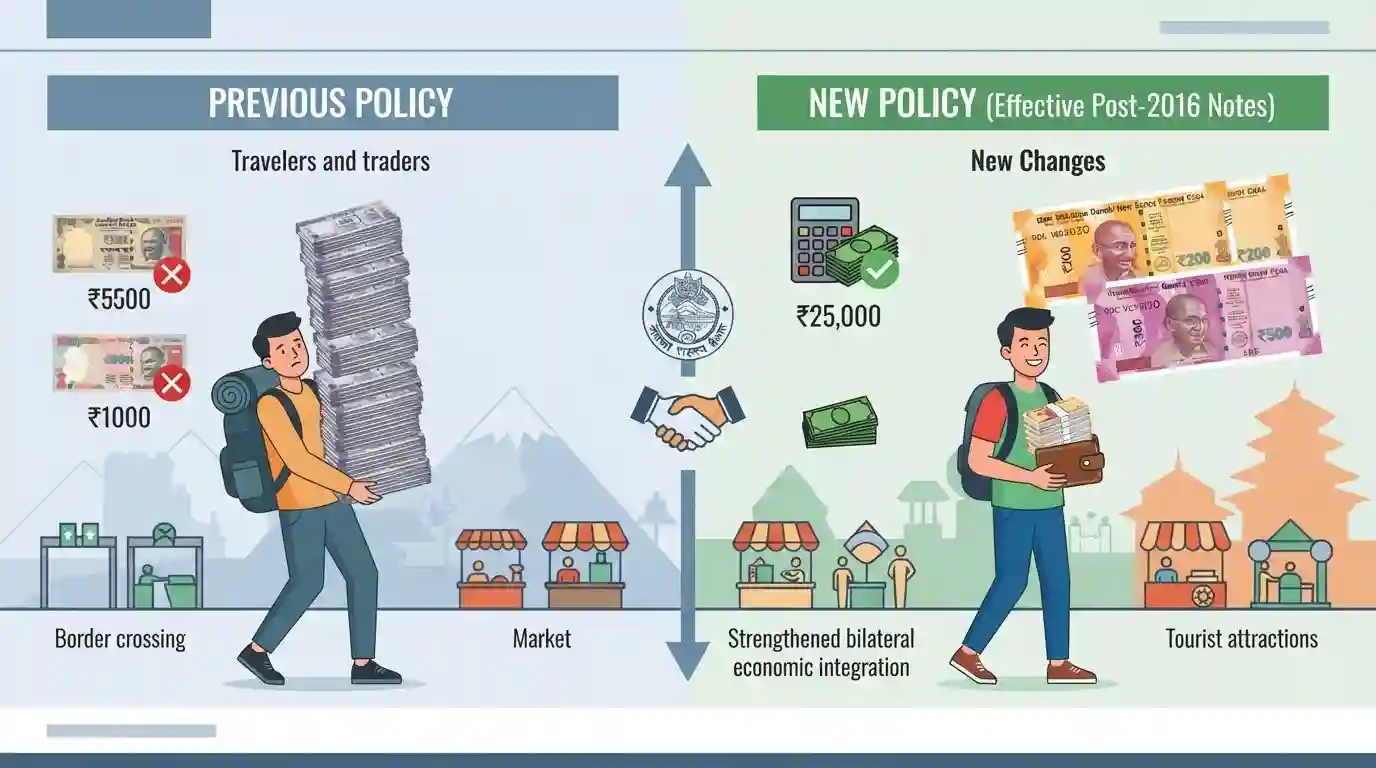
Nepal's central bank, the Nepal Rastra Bank, has eased its currency restrictions to allow Indian travellers and Nepalese citizens to carry and possess Indian currency notes of ₹200 and ₹500 denominations, up to a limit of ₹25,000 per person. This relaxation applies exclusively to Mahatma Gandhi New Series notes issued post-demonetisation (on or after November 9, 2016), while older pre-demonetisation ₹500 and ₹1,000 notes remain completely prohibited. This policy shift resolves a long-standing practical challenge for Indian tourists and border traders, eliminating the need to carry bulky volumes of ₹100 notes, and is set to strengthen bilateral economic integration and tourism.
મુખ્ય મુદ્દા
- Nepal has eased restrictions on Indian currency, permitting Indian travellers to carry ₹200 and ₹500 denomination notes.
- The allowance is capped at a maximum limit of ₹25,000 per person, and applies only to notes issued on or after November 9, 2016 (post-demonetisation series).
- Indian currency notes of ₹500 and ₹1,000 denominations issued prior to November 9, 2016, remain strictly banned and illegal in Nepal.
- Nepalese citizens cannot bring Indian currency into Nepal from countries other than India, nor can they carry Indian currency to any third country.
- This regulatory relief is expected to significantly boost tourism, support cross-border traders, and resolve a persistent practical hurdle for Indian visitors who previously had to carry large volumes of ₹100 notes.
મહત્વપૂર્ણ શબ્દો
Foreign Exchange Management Act (FEMA)

A 1999 Indian legislation regulating foreign exchange transactions, aimed at facilitating external trade, payments, and promoting the orderly development and maintenance of India's foreign exchange market.
UPSC context
GS Paper III (Indian Economy); tests knowledge of external sector regulations, capital flows, and trade facilitation policies.
India-Nepal Treaty of Peace and Friendship
A foundational 1950 bilateral treaty between India and Nepal that established an open border, mutual security cooperation, and reciprocal rights for residency, property, and employment.
UPSC context
GS Paper II (Bilateral Relations/Neighborhood); critical for analyzing strategic security, open-border dynamics, and regional diplomacy.
Nepal Rastra Bank
The central bank of Nepal, responsible for monetary stability, regulating financial institutions, and managing foreign currency rules, including bilateral currency integration with India.
UPSC context
GS Paper II (Bilateral Relations); relevant to financial cooperation, trade barriers, and neighborly tourism initiatives in South Asia.
Reserve Bank of India
India’s central bank, established in 1935, which regulates the nation's monetary policy, banking sector, and governs cross-border currency flows under the Foreign Exchange Management Act.
UPSC context
GS Paper III (Indian Economy); core to monetary policy, financial system stability, and foreign exchange regulations.
પ્રિલિમ્સ ટ્રેપ
All Indian currency notes of ₹200 and ₹500 denominations, including older pre-demonetisation series, are now legal to carry into Nepal up to ₹25,000.
Only the post-demonetisation (Mahatma Gandhi New Series, issued on or after November 9, 2016) ₹200 and ₹500 notes are permitted. Older series remain strictly banned.
સંલગ્ન સ્થિર ખ્યાલો
How does the currency pegging mechanism work between India and Nepal?
- Fixed exchange rate: The Nepalese Rupee (NPR) is officially pegged to the Indian Rupee (INR) at a fixed rate of 1.60 NPR to 1 INR since 1993.
- Monetary stability: The peg anchors Nepal's domestic price levels and inflation to India's monetary performance, reflecting their highly integrated bilateral trade.
- Reserve management: Nepal Rastra Bank maintains the peg by backing the currency with substantial Indian Rupee and foreign exchange reserves.
What are the FEMA rules governing currency carriage to Nepal and Bhutan?
- Denomination thresholds: There is no value limit on carrying Indian currency notes up to ₹100 denomination to Nepal and Bhutan.
- Higher denomination cap: Carrying post-demonetisation Indian currency notes of ₹200 and ₹500 denominations is strictly capped at ₹25,000 per person.
- Security exclusions: To prevent money laundering, citizens of Pakistan and Bangladesh are entirely barred from carrying high-denomination Indian notes (above ₹100).
આંતર-વિષય પેટર્ન
Currency integration + Neighborhood First
Easing currency friction underpins India's soft power, directly promoting cross-border tourism and economic integration with landlocked neighbors like Nepal.
Economic regulations + National security
FEMA exemptions that specifically exclude nationals of certain neighboring countries showcase how monetary policy acts as a security firewall against illicit cross-border flows.

RBI's FEMA currency export rules, including special bilateral limits and third-country security exclusions, are highly probable for Prelims 2026.
સંલગ્ન PYQ · 2
સંલગ્ન PYQ · 2
- 2018PrelimsGS1
Which one of the following statements correctly describes the meaning of legal tender money?
- 2020MainsGS3
For effective border area management, discuss the steps required to be taken to deny local support to militants and also suggest ways to manage favourable perception among locals.
