Mountain Ecosystems Bear Disproportionate Climate Crisis Burdens
Source:Indian Express ↗
ఇది ఎందుకు ముఖ్యం
This article provides crucial context on climate justice, mountain ecosystem vulnerability, and transboundary disaster management between India and its neighbors, directly aligning with GS3 syllabus topics on environment and disaster management.
సారాంశం
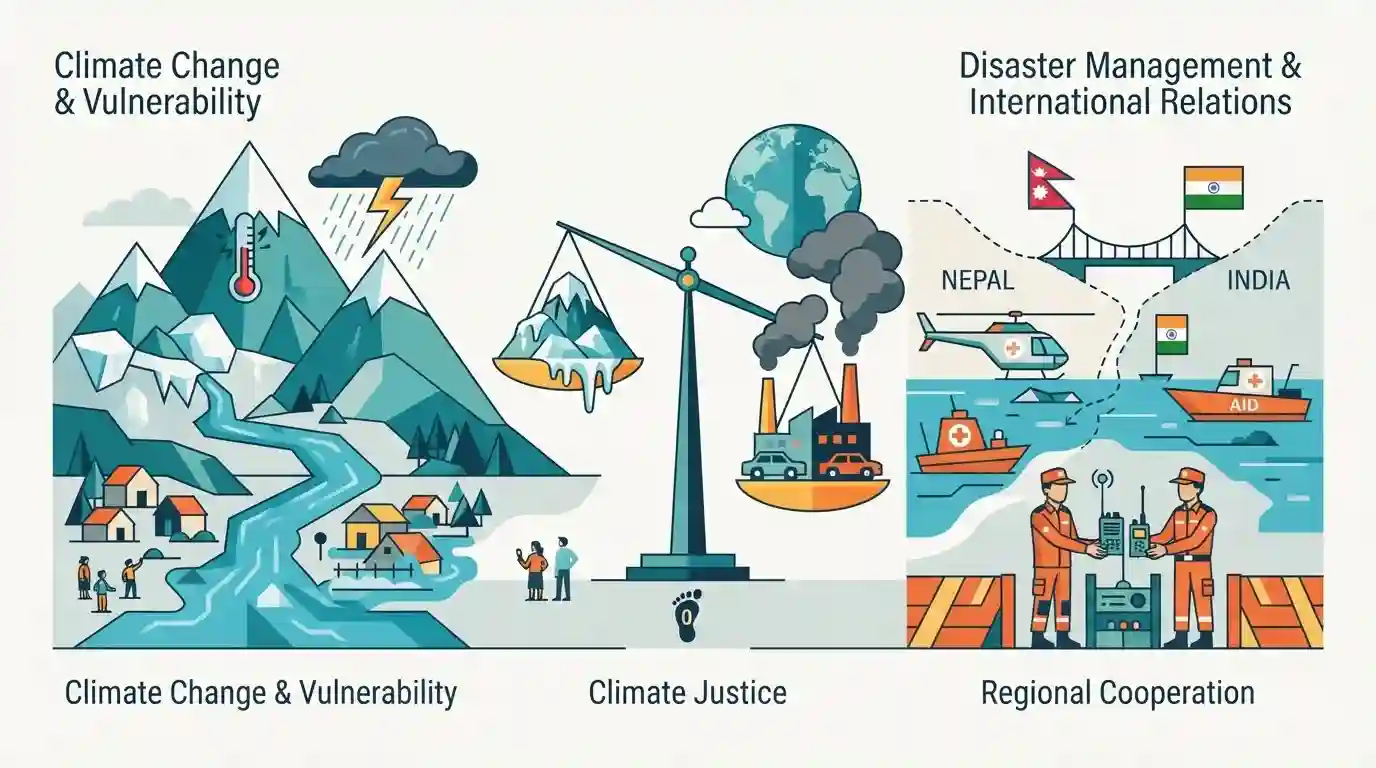
The article highlights how mountain ecosystems like Nepal bear the heaviest brunt of climate change—experiencing extreme weather, flash floods, and glacial melts—despite having contributed virtually nothing to global carbon emissions. It calls for enhanced regional cooperation between South Asian neighbors like India and Nepal for transboundary disaster resilience and urges global climate justice.
ముఖ్య అంశాలు
- Nepal contributes negligibly to global greenhouse gas emissions yet suffers disproportionately from climate-induced disasters like catastrophic floods and glacial lake outburst floods (GLOFs).
- The fragile ecology of the Hindu Kush Himalaya region makes it a climate hotspot, experiencing warming well above global averages.
- Transboundary disaster management and early warning systems between India and Nepal are critical to mitigating downstream and upstream flood risks.
- Global climate justice demands financial and technical support from historical polluters and developed nations to vulnerable mountain nations like Nepal.
ముఖ్యమైన పదాలు
Paris Agreement

A legally binding international treaty adopted at COP21 in 2015 under the UNFCCC, aiming to limit global temperature rise to well below 2°C, preferably 1.5°C, above pre-industrial levels through national climate pledges (NDCs).
UPSC context
Crucial for UPSC GS Paper III (Environment & Ecology); frequently tested for its mechanisms like NDCs, global stocktake, and mitigation goals.
Sendai Framework for Disaster Risk Reduction
A 15-year global framework adopted in 2015 to prevent new and reduce existing disaster risks, emphasizing multi-hazard approaches, resilience building, and risk governance.
UPSC context
Important for UPSC GS Paper III (Disaster Management); tested on global targets and proactive strategies for reducing disaster vulnerability.
UNFCCC
An international environmental treaty adopted at the 1992 Rio Earth Summit to stabilize greenhouse gas concentrations in the atmosphere and prevent dangerous anthropogenic interference with the climate system.
UPSC context
Core static-cum-current topic for UPSC GS Paper III (Environment & Ecology); tests framework conventions, CBDR-RC principle, and COP processes.
IPCC
The UN body established in 1988 by WMO and UNEP to provide objective, scientific assessments on climate change, its natural and political impacts, and future risks.
UPSC context
Important for UPSC GS Paper III (Environment & Ecology); reports form the scientific backbone for global climate negotiations and answer writing.
అనుసంధానమైన స్థిర భావనలు
What are the primary drivers and institutional frameworks governing Glacial Lake Outburst Floods (GLOFs) and transboundary disaster management in the Himalayas?
- Glacial Retreat: Accelerated melting of Himalayan glaciers creates unstable moraine-dammed lakes prone to sudden catastrophic outbursts.
- Sendai Framework: The Sendai Framework for Disaster Risk Reduction emphasizes multi-hazard early warning systems and disaster risk reduction investments.
- Bilateral Mechanisms: Joint India-Nepal bilateral mechanisms exist for flood forecasting, data sharing, and water resource management along common rivers.
అంతర-అంశ నమూనాలు
Transboundary water governance and disaster resilience
Transboundary river management between India and Nepal intersects with regional power projects, flood forecasting, and ecological security in the Gangetic plains.
Climate justice and loss-and-damage architecture
Mountain regions like the Hindu Kush Himalayas link climate adaptation funding debates under UNFCCC with indigenous community resilience frameworks.

Hindu Kush Himalayan warming rates + transboundary early warning systems will likely be tested via a multi-statement assertion question.
అనుసంధాన PYQలు · 2
అనుసంధాన PYQలు · 2
- 2024MainsGS3
What is disaster resilience? How is it determined? Describe various elements of a resilience framework. Also mention the global targets of Sendai Framework for Disaster Risk Reduction (2015–2030).
- 2019MainsGS3
Vulnerability is an essential element for defining disaster impacts and its threat to people. How and in what ways can vulnerability to disasters be characterized? Discuss different types of vulnerability with reference to disasters.
