Himalayan Climate Crisis and Transboundary Water Cooperation
Source:Indian Express ↗
কেন এটি গুরুত্বপূর্ণ
It highlights the critical intersection of climate justice, transboundary disaster management, and regional cooperation in the fragile Himalayan ecosystem, which is central to GS Paper 3 (Disaster Management and Environment) and GS Paper 2 (Bilateral Relations).
সারসংক্ষেপ
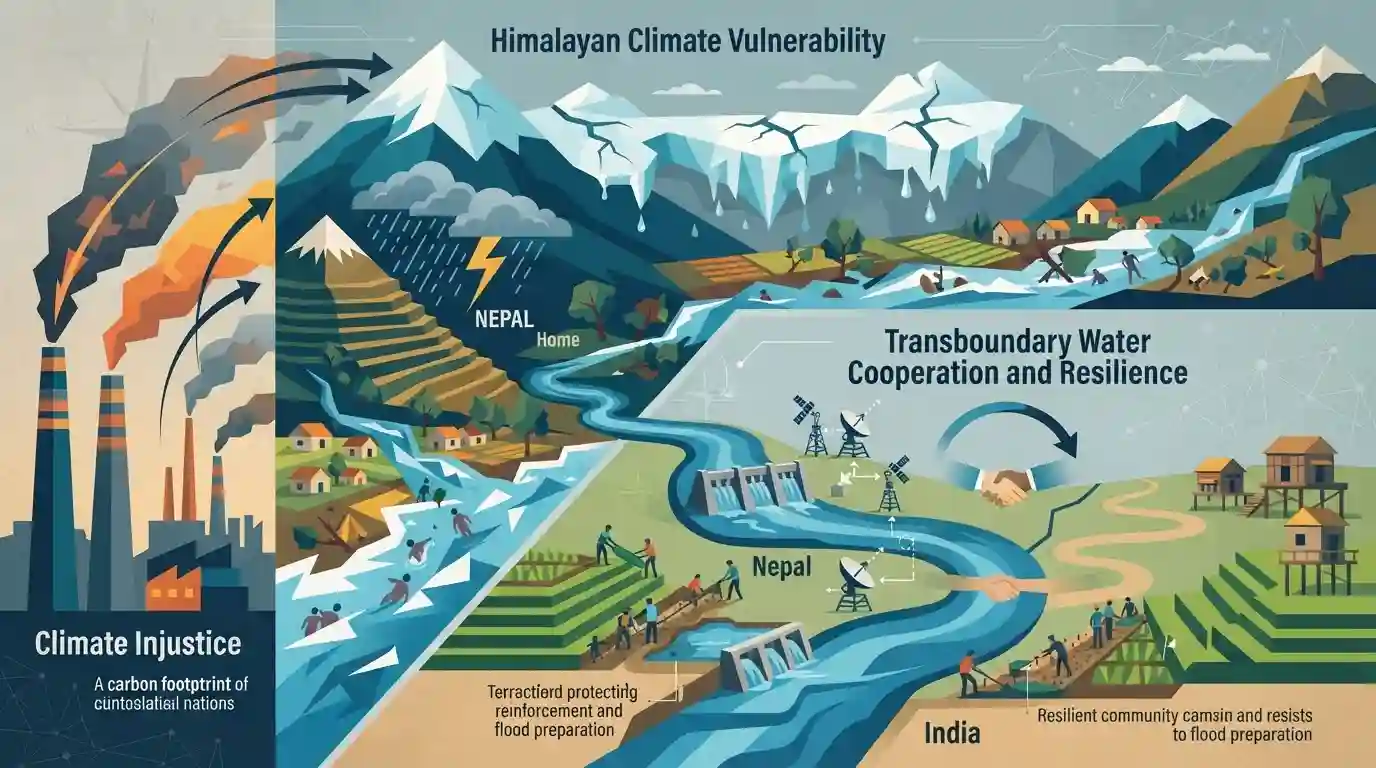
The article explores the climate vulnerability of the Himalayan region, focusing on Nepal's experience with devastating floods and extreme weather events. It highlights the injustice of the global climate crisis—where nations with negligible historical emissions bear the brunt of climate-induced disasters—and emphasizes the critical need for transboundary water cooperation and regional resilience frameworks between upstream and downstream nations like Nepal and India.
মূল বিষয়
- The climate crisis in the Himalayas illustrates extreme transboundary vulnerabilities, where mountainous nations like Nepal suffer severe climate impacts (floods, glacial lake outburst floods) despite contributing minimally to global greenhouse gas emissions.
- Transboundary river basins require robust regional cooperation, joint early-warning systems, and data-sharing mechanisms between upstream and downstream countries (such as Nepal and India) to mitigate disaster risks.
- Global climate equity discussions must account for climate-vulnerable developing economies that face disproportionate infrastructure destruction and livelihood loss due to ecological crises they did not create.
প্রিলিমস ফাঁদ
Transboundary water cooperation in the Himalayas is restricted to water-sharing and irrigation treaties between riparian states.
Aspirants often assume downstream nations like India are solely 'upstream-vulnerable' or that transboundary water management is limited to irrigation treaties, missing the critical disaster-mitigation and GLOF data-sharing dimension.
সংযুক্ত স্থির ধারণা
What are the primary institutional mechanisms for managing transboundary river waters and flood forecasting between India and Nepal?
- Bilateral Treaties:: Bilateral treaties like the 1996 Mahakali Treaty and the Kosi/Gandak Agreements govern water resource development and flood control structures.
- Joint Committees:: Joint committees such as the India-Nepal Joint Committee on Water Resources (JCWR) address flood management, inundation, and project execution.
- Data Sharing:: Real-time data sharing on hydrological and meteorological parameters aids in flood forecasting for downstream plains in Bihar and Uttar Pradesh.
আন্তঃবিষয় প্যাটার্ন
Transboundary Rivers & Bilateral Water Diplomacy
Transboundary disaster management intersects with bilateral water treaties, requiring joint institutional frameworks that balance ecological security with hydro-diplomacy in shared river basins.
Climate Equity & Loss and Damage Mechanisms
Developing mountain economies face severe infrastructure losses despite minimal emissions, intensifying demands for loss and damage funds at UNFCCC COPs.

Himalayan transboundary vulnerabilities and GLOF risks will likely feature in a multi-statement environment or disaster management question.
সংযুক্ত PYQ · 3
সংযুক্ত PYQ · 3
- 2024MainsGS3
Flooding in urban areas is an emerging climate-induced disaster. Discuss the causes of this disaster. Mention the features of two such major floods in the last two decades in India. Describe the policies and frameworks in India that aim at tackling such floods.
- 2016MainsGS3
Rehabilitation of human settlements is one of the important environmental impacts which always attracts controversy while planning major projects. Discuss the measures to be adopted to mitigate the impact of the recent incidents of cloudbursts in many places of Uttarakhand.
- 2019MainsGS3
Vulnerability is an essential element for defining disaster impacts and its threat to people. How and in what ways can vulnerability to disasters be characterized? Discuss different types of vulnerability with reference to disasters.
