Himalayan Transboundary Floods and Trilateral Climate Cooperation
Source:Indian Express ↗
हे का महत्त्वाचे आहे
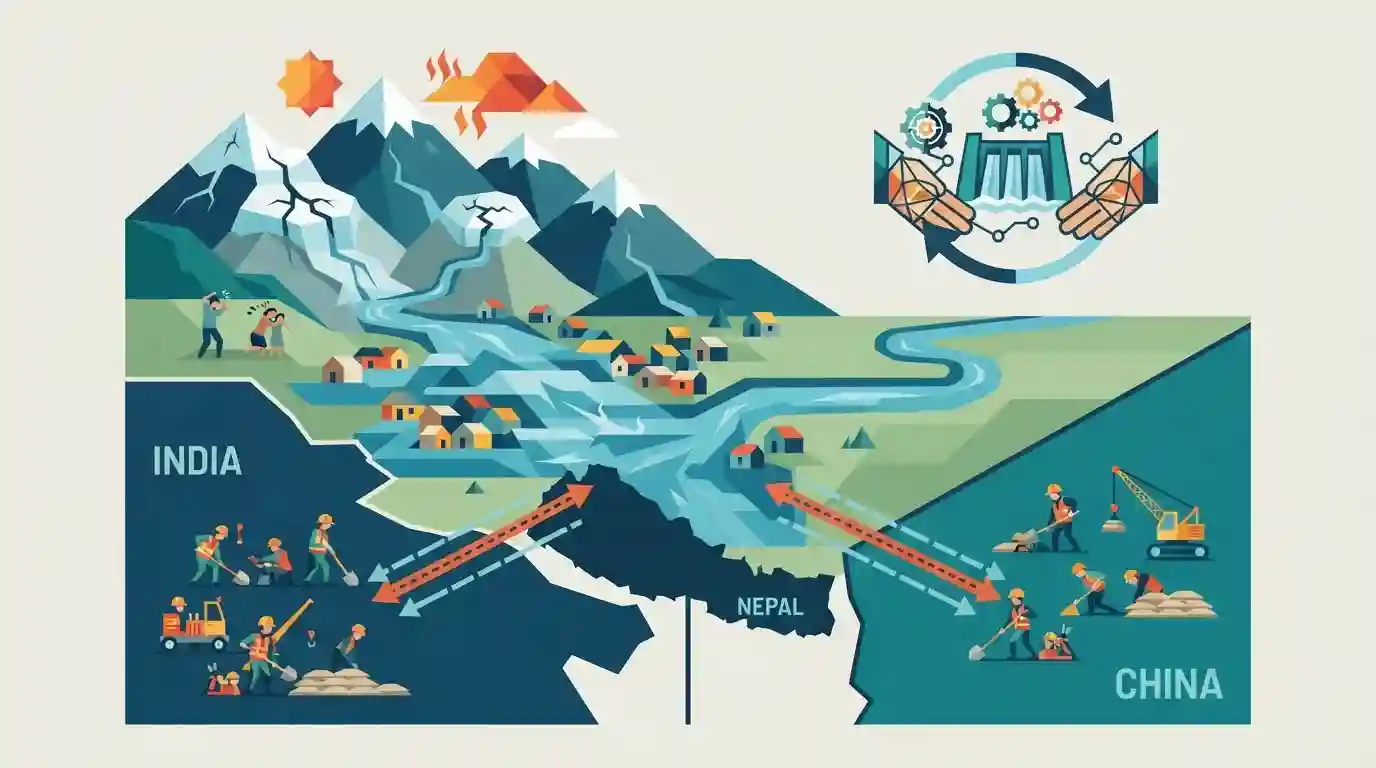
It underscores the intersection of climate change, disaster management, and geopolitics in the ecologically sensitive Himalayan region, highlighting why traditional bilateral frameworks must evolve into trilateral mechanisms for ecological security.
सारांश
The article discusses the mounting climate crisis in the Himalayas, highlighting how intensifying floods and glacial hazards in Nepal require urgent collaborative transboundary management between India and China to mitigate disaster risks and protect vulnerable populations.
मुख्य मुद्दे
- Climate change-induced melting of Himalayan glaciers has drastically increased the frequency and severity of transboundary floods and glacial lake outburst floods (GLOFs) affecting Nepal, India, and China.
- Ecological vulnerabilities in the Himalayan region transcend national boundaries, making unilateral disaster management and data sharing inadequate.
- There is an urgent need for trilateral cooperation between India, China, and Nepal to share hydrological data, implement joint early-warning systems, and coordinate climate resilience strategies.
- Geopolitical competition between India and China should not preclude collaborative ecological stewardship of the fragile Himalayan ecosystem.
महत्त्वाच्या संज्ञा
Hindu Kush Himalayas (HKH)

A mountainous region spanning Afghanistan, Pakistan, India, Nepal, Bhutan, Bangladesh, Myanmar, and China, containing massive ice reserves that are rapidly melting due to climate change.
UPSC context
UPSC Paper III: Environment, Ecology, and Climate Change — tests understanding of regional climate vulnerabilities, transboundary river basins, and ecological security.
Glacial Lake Outburst Flood (GLOF)
Catastrophic floods caused by the sudden failure of natural dams holding back glacial meltwaters, posing severe threats to downstream nations like Nepal and India.
UPSC context
UPSC Paper III: Disaster Management — tests causes, impact, and mitigation strategies for climate-induced natural disasters in mountain ecosystems.
Transboundary Environmental Cooperation
Environmental management and data sharing mechanisms that span international borders, critical for mitigating upstream hazards like flash floods that impact downstream sovereign states.
UPSC context
UPSC Paper II: International Relations — tests bilateral and regional diplomacy, resource sharing, and cooperative security frameworks in South Asia.
संबंधित स्थिर संकल्पना
What are the key drivers and mechanisms of Glacial Lake Outburst Floods (GLOFs) in the Himalayas?
- Lake Formation: Rapid melting of glaciers forms unstable moraine-dammed lakes that can breach suddenly due to seismic activity, avalanches, or excessive meltwater influx.
- Cascading Impact: Cascading down valleys, GLOFs unleash catastrophic downstream flooding, destroying infrastructure, displacing communities, and altering river morphology across national borders.
- Data Deficit: Transboundary early warning requires real-time hydrological data sharing between upper riparians (China) and lower riparians (India, Nepal) which is often constrained by geopolitical friction.
आंतर-विषय नमुने
Himalayan Hydro-diplomacy & Regional Security
Transboundary river governance in South Asia intersects directly with hydro-diplomacy, regional data-sharing protocols, and strategic security in borderlands.

Expect statements combining GLOF mechanics, cryosphere observation gaps, and limits of bilateral data-sharing in the Himalayas.
संबंधित PYQ · 2
संबंधित PYQ · 2
- 2017MainsGS3
'Climate change' is a global problem. How India will be affected by climate change? How Himalayan and coastal states of India will be affected by climate change?
- 2024MainsGS3
Flooding in urban areas is an emerging climate-induced disaster. Discuss the causes of this disaster. Mention the features of two such major floods in the last two decades in India. Describe the policies and frameworks in India that aim at tackling such floods.
