Hindu Kush Himalayan Ecosystem Vulnerability and Disaster Risks
Source:The Hindu ↗
Why It Matters
The article underscores the vulnerability of the Hindu Kush Himalayan ecosystem, which directly impacts South Asia's climate, river systems, and millions of lives, aligning directly with UPSC syllabus requirements on environmental degradation and disaster management.
Summary
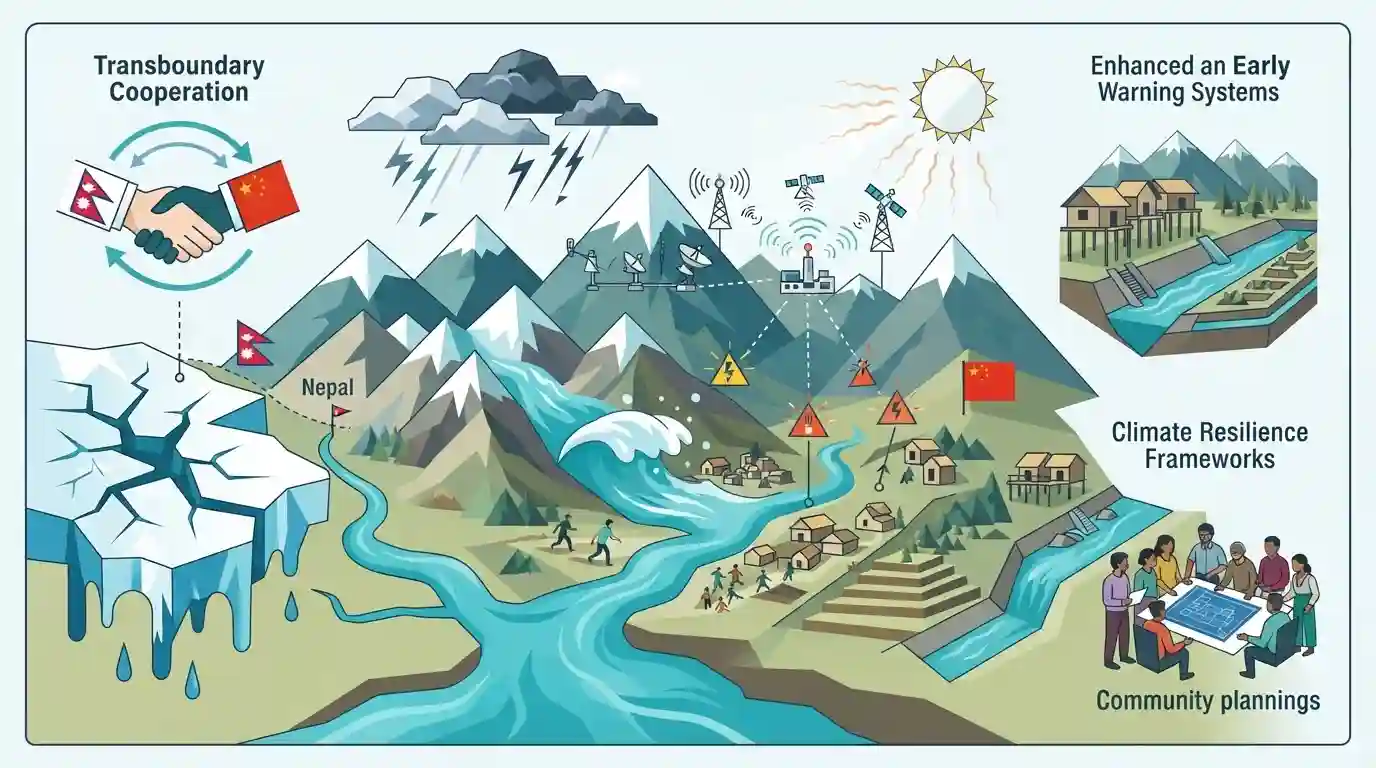
The flash flood disaster across Nepal and China has brought renewed global attention to the vulnerability of the Hindu Kush Himalaya region. U.N. climate officials stressed that mounting climate pressures in high-mountain areas demand urgent transboundary cooperation, enhanced early warning systems, and stronger climate resilience frameworks.
Key Points
- The flash flood disaster involving Nepal and China highlights the severe fragility and vulnerability of the Hindu Kush Himalayas to climate change.
- The U.N. climate chief emphasized that climate impacts in mountain ecosystems are accelerating rapidly, threatening lives, livelihoods, and transboundary water security.
- Experts call for enhanced early warning systems, cross-border data sharing, and robust climate adaptation frameworks tailored for fragile high-altitude regions.
Important Terms
Hindu Kush Himalayas

A vast mountain system in Asia spanning eight countries, acting as a major water tower for nearly two billion people and facing accelerated glacial melting due to climate change.
UPSC context
Important for UPSC CSE GS Paper I (Geography - Physical Geography and Mountain Systems) and GS Paper III (Environment, Climate Change, and Disaster Management).
Flash Flood
Sudden and destructive floods caused by overflowing water bodies or glacial collapses, increasingly common in fragile high-altitude mountain ecosystems.
UPSC context
Crucial for UPSC CSE GS Paper III under Disaster Management (causes, early warning systems, and mitigation strategies for extreme weather events).
Glacial Lake Outburst Floods
Floods triggered by the sudden release of water from glacial lakes, often caused by ice avalanches, structural failures, or melting permafrost.
UPSC context
Relevant for UPSC CSE GS Paper III (Environment and Ecology - climate change impacts on cryosphere and high-risk Himalayan hazards).
Transboundary Cooperation
Collaborative management and data sharing across national borders to address regional ecological and environmental crises.
UPSC context
Important for UPSC CSE GS Paper II (International Relations - bilateral and regional cooperation) and GS Paper III (Environment and Disaster Management).
Prelims Trap
transboundary water security and climate frameworks in the Himalayas involve only downstream bilateral agreements
Aspirants often assume transboundary river and glacial hazards are exclusively bilateral treaties between India and downstream nations, ignoring that China acts as the upper riparian for critical Himalayan basins impacting South Asia.
Static Concepts Connected
What are the key ecological and hydrological characteristics of the Hindu Kush Himalaya (HKH) region?
- Third Pole: Often termed the Third Pole, it holds the largest ice mass outside polar regions, feeding major Asian river systems.
- Accelerated Warming: Experience warming rates significantly higher than the global average, accelerating glacial retreat and permafrost thaw.
- Cascading Hazards: Prone to cascading hazards like GLOFs (Glacial Lake Outburst Floods) and debris-flow flash floods across international borders.
Cross-Topic Patterns
Himalayan Disasters + Transboundary Water Diplomacy
Transboundary river basins require moving from fragmented flood management to integrated regional agreements, mirroring basin-scale diplomacy challenges seen across Brahmaputra and Indus river systems.
Hydropower Expansion + Ecologically Fragile Mountain Geographies
Rapid infrastructure push in young, unstable mountain terrain exposes the trade-off between green energy transition and climate resilience in fragile ecosystems.

HKH region vulnerability, Third Pole warming rates, and transboundary early warning systems will likely feature in a multi-statement environment question.
Linked PYQs · 3
Linked PYQs · 3
- 2017MainsGS3
'Climate change' is a global problem. How India will be affected by climate change? How Himalayan and coastal states of India will be affected by climate change?
- 2020MainsGS3
Discuss the recent measures initiated in disaster management by the Government of India departing from the earlier reactive approach.
- 2024MainsGS3
Flooding in urban areas is an emerging climate-induced disaster. Discuss the causes of this disaster. Mention the features of two such major floods in the last two decades in India. Describe the policies and frameworks in India that aim at tackling such floods.
