Nepal Bans Major Social Media Platforms Over Compliance
Source:Indian Express ↗
Why It Matters
The event is highly relevant to India's own ongoing efforts to regulate Big Tech and social media intermediaries (such as the IT Rules 2021). It highlights the delicate balance democracies must strike between ensuring digital platform accountability and protecting citizens' fundamental rights to free speech and dissent.
Summary
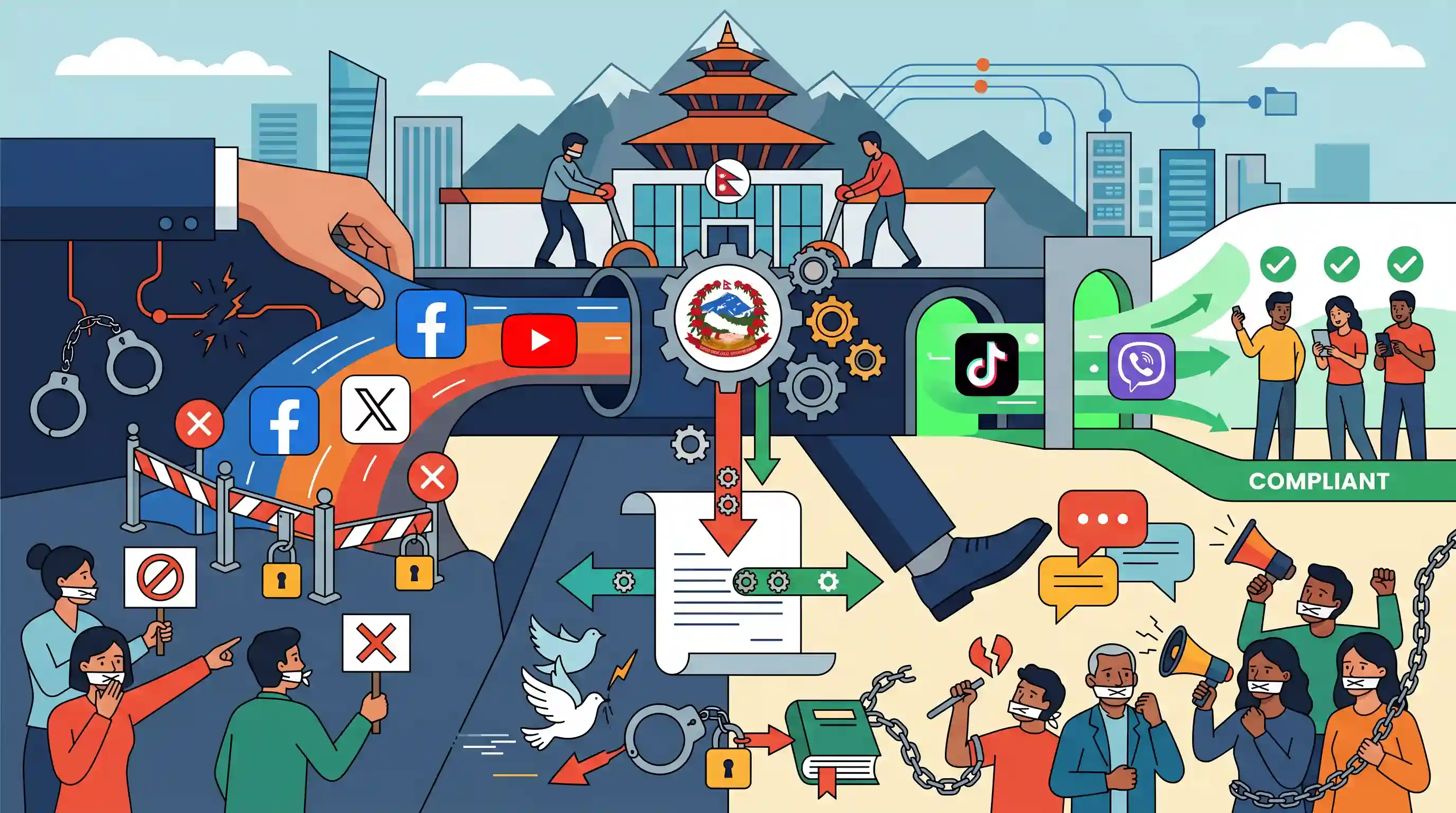
Nepal's government has banned approximately two dozen social media platforms, including Facebook, X, and YouTube, after the companies failed to comply with regulations requiring them to officially register and establish a local contact point in the country. Compliant platforms like TikTok and Viber have been spared. The move coincides with a proposed parliamentary bill aimed at making digital platforms accountable and well-managed. However, human rights groups have strongly criticized the tighter regulations, raising concerns that the measures will be weaponized to censor online dissent, punish protests, and infringe upon citizens' fundamental right to freedom of expression.
Key Points
- Nepal has blocked around two dozen major social media platforms, including Facebook, X, and YouTube, for failing to officially register and appoint a local liaison in the country.
- Platforms that complied with the government directives, such as TikTok and Viber, continue to operate normally.
- A proposed bill in Nepal's parliament seeks to mandate that digital platforms be "properly managed, responsible and accountable."
- Rights groups warn the proposed law threatens freedom of expression and could be misused to censor online dissent, while the government maintains it is necessary for monitoring and accountability.
Important Terms
Digital Sovereignty

A state's authority to govern digital infrastructure, data, and communication networks within its borders, ensuring independence from external influence or control by foreign technology entities.
UPSC context
GS Papers 2 & 3: Critical for discussions on data protection, internal security, and regulation of global 'Big Tech' intermediaries.
Freedom of Speech and Expression
A fundamental right (Article 19 in India) permitting individuals to express opinions freely. It is subject to 'reasonable restrictions' like public order, sovereignty, and security.
UPSC context
GS Paper 2: Tests the constitutional balance between individual liberties and the state's power to regulate digital dissent.
Intermediary Accountability
The legal responsibility of digital platforms to comply with local regulations, establish grievance mechanisms, and remove unlawful content while maintaining 'due diligence' to keep legal protections.
UPSC context
GS Paper 3: Core to the IT Act and Intermediary Guidelines; tests knowledge of platform-state legal relationships.
Social Media Management Directive 2023 (Nepal)
A regulatory framework requiring social media platforms to register with the government, establish local liaison offices, and appoint resident grievance and compliance officers.
UPSC context
GS Paper 2: International Relations/Governance; used as a comparative case study for digital regulation in South Asia.
Safe Harbor Provision
A legal protection (e.g., Section 79 of India's IT Act) that shields online platforms from liability for user-generated content, provided they follow government-mandated due diligence.
UPSC context
GS Paper 3: IT Law; tests the evolution of legal immunity for tech platforms in the face of rising misinformation.
Grievance Redressal Mechanism
A mandatory administrative system for platforms to receive, process, and resolve user complaints or government takedown orders within a specified legal timeframe.
UPSC context
GS Paper 2: Governance/E-governance; tests the practical application of accountability in digital services.
Prelims Trap
Failure to appoint a local compliance officer under IT Rules automatically results in a platform's ban.
Non-compliance revokes 'safe harbour' immunity (Section 79), making companies legally liable for third-party content. It does not automatically trigger an outright ban under Section 69A.
Static Concepts Connected
What are the core compliance mandates for Significant Social Media Intermediaries (SSMIs) in India?
- Local Officers: Must appoint a Chief Compliance Officer, a Nodal Contact Person, and a Resident Grievance Officer, all of whom must reside in India.
- Physical Address: Mandatory requirement to publish a physical contact address located within India on their website or app.
- Traceability mandate: Messaging intermediaries must enable the identification of the 'first originator' of flagged information, raising privacy vs. security debates.
What is the "Safe Harbour" protection under Section 79 of the IT Act, 2000?
- Intermediary Immunity: Protects digital intermediaries from legal liability for any third-party data, information, or communication hosted on their platforms.
- Conditional Protection: Immunity applies only if they observe due diligence and act merely as a neutral conduit without modifying the transmitted information.
- Loss of Shield: Protection is forfeited if the platform actively aids/abets an unlawful act or disobeys government takedown notices.
Cross-Topic Patterns
Digital Sovereignty vs. Article 19
Like Nepal, India balances platform regulation (IT Rules) with free speech. Supreme Court rulings routinely test digital state control against 'reasonable restrictions' under Article 19(2).
Tech spheres of influence in South Asia
Nepal banning Western platforms while retaining TikTok highlights how digital regulation policies often reflect broader geopolitical alignments and the emerging 'splinternet' in South Asia.

Expect a GS2 Mains question linking digital sovereignty, IT Rules 2021 compliance, and Article 19 free speech implications.
Linked PYQs · 3
Linked PYQs · 3
- 2024MainsGS3
Social media and encrypting messaging services pose a serious security challenge. What measures have been adopted at various levels to address the security implications of social media? Also suggest any other remedies to address the problem.
- 2013MainsGS3
What are social networking sites and what security implications do these sites present ?
- 2014MainsGS2
What do you understand by the concept "freedom of speech and expression"? Does it cover hate speech also ? Why do the films in India stand on a slightly different plane from other forms of expression ? Discuss.
