Maharashtra School Education Adoption of CBSE Curriculum
Source:livemint ↗
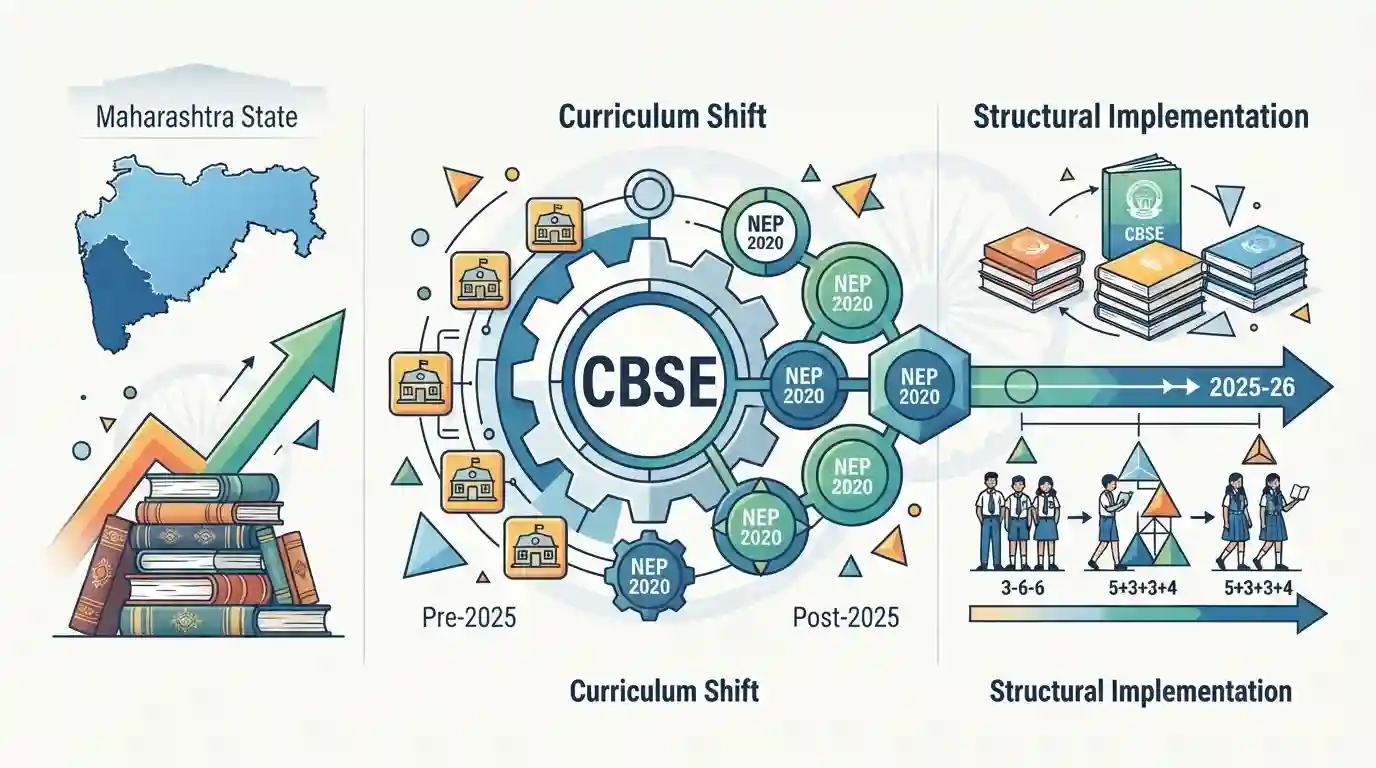
Why It Matters
Crucial for understanding how states are implementing the National Education Policy (NEP) 2020 at the ground level, reflecting shifts in school education curriculum standards.
Summary
Maharashtra announced the adoption of the CBSE curriculum from the 2025-26 academic session in alignment with the National Education Policy (NEP) 2020, bringing major structural changes to school education books, classes, and standards in the state.
Key Points
- Maharashtra is adopting the Central Board of Secondary Education (CBSE) curriculum starting from the 2025-26 academic session in alignment with the National Education Policy (NEP) 2020.
- The move aims to standardize learning outcomes, modernize curriculum structure, and streamline educational frameworks across selected schools in the state.
- It marks a significant transition in school education policy and administrative coordination between state boards and national educational standards in Maharashtra.
Important Terms
National Education Policy (NEP) 2020

India's comprehensive framework for educational reform approved in 2020, aiming to transform school and higher education by focusing on foundational literacy, flexibility, critical thinking, and competency-based learning.
UPSC context
MPSC/UPSC General Studies Paper II (Governance, Social Justice, Education Policy). Tests knowledge of national development goals and educational restructuring.
CBSE
A national-level board of education in India under the Union Ministry of Education that conducts standardized public examinations for Classes 10 and 12 and provides a uniform national curriculum.
UPSC context
MPSC General Studies Paper II / Maharashtra Governance. Tests awareness of administrative standardization in school education.
Maharashtra State Government
The sub-national executive and legislative administration of Maharashtra, responsible for policy-making, budgetary allocations, and the execution of state schemes including school education reforms.
UPSC context
MPSC General Studies Paper I & II (Maharashtra State Administration and Governance). Tests understanding of state-level policy execution.
Prelims Trap
Maharashtra is completely replacing its State Board with CBSE for all schools across the state from 2025-26.
Aspirants often confuse state-level adoption of CBSE guidelines for selected schools as a total abolition of the Maharashtra State Board of Secondary and Higher Secondary Education, which is incorrect.
Static Concepts Connected
What are the key constitutional provisions regarding Education in India?
- Original Status: Education was originally a state subject under List II of the Seventh Schedule.
- 42nd Amendment: The 42nd Constitutional Amendment Act of 1976 transferred education to the Concurrent List (List III).
- Concurrent Status: Ensures both Parliament and State Legislatures can make laws on education, while central legislation prevails in case of repugnancy.
Cross-Topic Patterns
NEP 2020 & Centre-State Educational Jurisdiction
State-level adoption of national curriculum frameworks interacts with constitutional provisions on education under the Concurrent List (Seventh Schedule).
Cooperative Federalism in School Education
The shift from state board curricula to CBSE standards impacts textbook printing syndicates, SCERT roles, and regional language integration under the Three-Formula policy.

Expect statement-based questions on NEP 2020 implementation milestones, Centre-State legislative competence, and Concurrent List entries.
Linked PYQs · 3
Linked PYQs · 3
- 2024MPSC_PRELIMSGS1
Match the following pairs : | List-I | List-II | |---|---| | (a) Dr. Nitin Karmalkar Committee | (i) For implementation of National Education Policy - 2020 in Maharashtra | | (b) Nitin Karir Committee | (ii) To enquire the incident which happened during the distribution of Maharashtra Bhushan Award | | (c) Sunil Pawar Committee | (iii) To study why the rates of onion collapse. | | (d) Dr. K. Kasturirangan Committee | (iv) To make the syllabus for pre-primary to degree according to National Education Policy - 2020 | Code: (a) (b) (c) (d)
- 2024MPSC_PRELIMSGS1
What were the main principles of the National Education Policy of 1968 based on the recommendations of the Kothari Commission ? (a) Compulsory and free education till the age of 14 years. (b) Higher position and improved pay for teachers. (c) At least 10% of gross national income spent on education.
- 2026MPSC_PRELIMSGS1
Which of the following statement/s given is/are correct ? (a) The National Institutional Ranking Framework provides a methodology to rank educational institutions across the country. (b) The National Institutional Ranking Framework (NIRF) was launched in 2020. (c) The ranking is based on five parameters. (d) Indian Institute of Technology Madras tops in the Sustainable Development Goals (SDGs) category.
