NEP 2020 Implementation Challenges in School Education
Source:The Hindu ↗
Why It Matters
Bridging the gap between educational policy and classroom practice is essential for realizing India's demographic dividend and achieving SDG 4. Understanding these implementation bottlenecks is a recurring theme in UPSC Mains GS2 (Governance) and Essay papers.
Summary
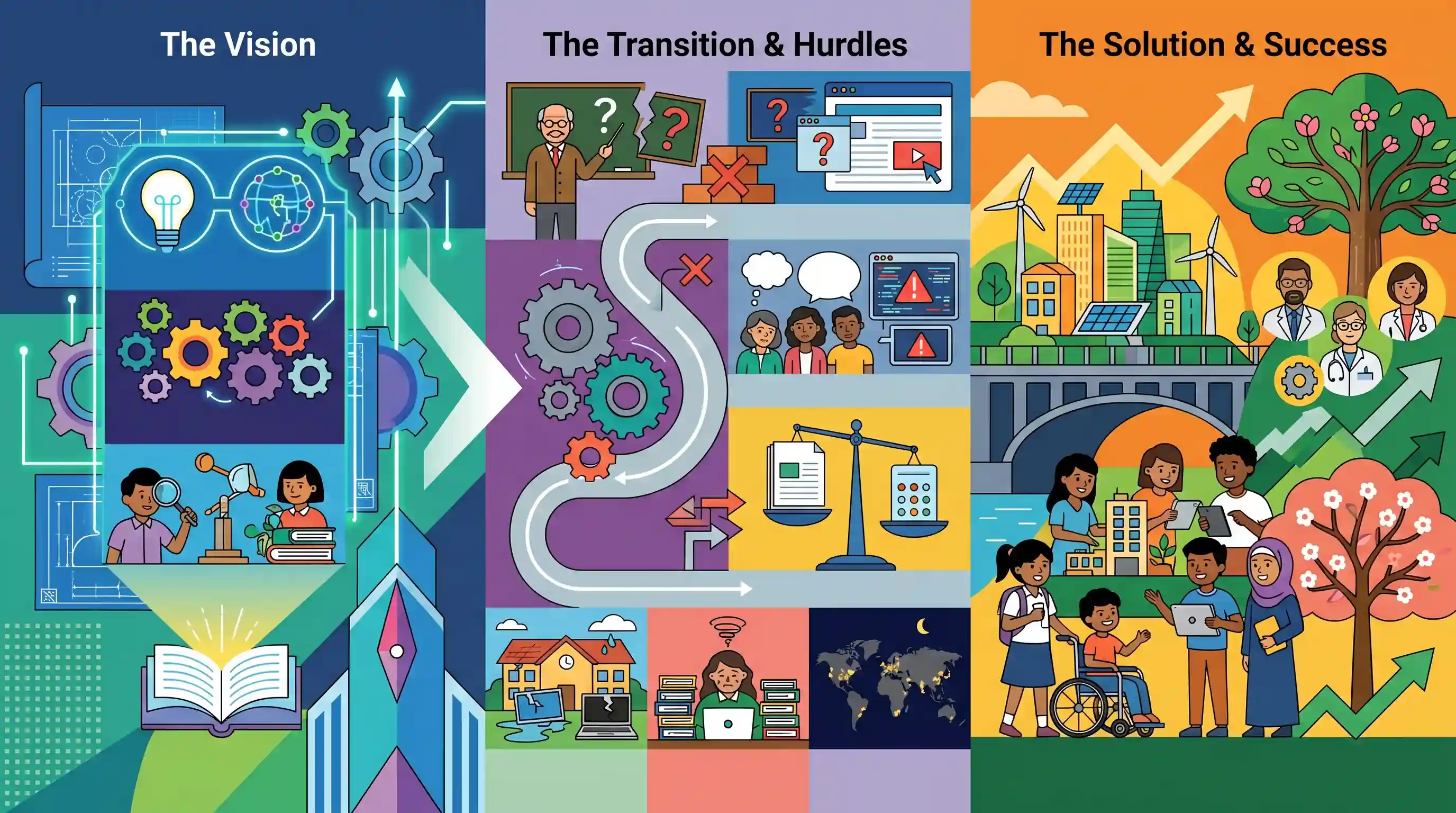
The article analyzes the critical transition of the National Education Policy (NEP) 2020 from a visionary policy document to actual classroom practice. It highlights that while the NEP aims to overhaul India's education system with a focus on holistic, multidisciplinary, and experiential learning, the real challenge lies in execution. Key hurdles include changing entrenched pedagogical practices, comprehensively training and empowering teachers, and aligning curriculum frameworks (NCF) with assessment methods. For the policy to succeed, grassroots realities like infrastructure gaps, administrative burdens on educators, and the need for localized support structures must be urgently addressed to ensure equitable learning outcomes.
Key Points
- The National Education Policy (NEP) 2020 outlines a transformative vision for Indian education, but its success hinges on bridging the gap between policy design and classroom implementation.
- A structural shift in pedagogy is required, moving away from rote memorization towards experiential learning, critical thinking, and multidisciplinary approaches.
- Teacher capacity building is the most critical factor; continuous professional development (CPD), autonomy, and adequate resources are necessary for educators to execute the NEP mandate.
- Systemic alignment across curriculum design (NCF), textbook revision, and assessment reforms (like the holistic progress card under PARAKH) must be cohesive to support classroom realities.
- Grassroots challenges, such as infrastructural deficits, high teacher-pupil ratios, and the digital divide, remain substantial hurdles to the equitable practice of NEP principles.
Important Terms
National Education Policy (NEP) 2020

A comprehensive framework replacing the 1986 policy, introducing a 5+3+3+4 school structure and emphasizing holistic, flexible, and multidisciplinary learning to meet 21st-century needs.
UPSC context
GS Paper II (Education/Government Policies); tests understanding of structural reforms in human capital development.
National Curriculum Framework (NCF)
A technical document that translates NEP 2020’s vision into practical guidelines for school syllabus, textbooks, and classroom teaching methods across India.
UPSC context
GS Paper II (Social Sector); tests practical implementation of education goals and pedagogical shifts.
NIPUN Bharat Mission
A national mission aiming to ensure every child in India achieves Foundational Literacy and Numeracy (FLN) by the end of Grade 3 by the year 2026-27.
UPSC context
GS Paper II (Issues relating to Education); tests specific interventions for improving basic learning outcomes.
PARAKH
India's first national assessment regulator under NCERT, tasked with setting standards for student evaluation and harmonizing assessment patterns across all recognized school boards.
UPSC context
GS Paper II (Governance/Education); tests reforms aimed at standardizing quality and reducing board-level evaluation disparities.
Right to Education (RTE) Act 2009
A landmark law making free and compulsory education a fundamental right for children aged 6–14 under Article 21A, mandating 25% reservation for disadvantaged sections in private schools.
UPSC context
GS Paper II (Social Justice/Fundamental Rights); tests the legal framework for universalizing primary education.
NCERT
An autonomous central body that advises the government on school education policy and designs the national curriculum, model textbooks, and pedagogical research.
UPSC context
GS Paper II (Governance/Education); evaluates the role of institutional frameworks in shaping national standards.
Prelims Trap
"PARAKH is a new centralized board that conducts unified national board examinations, replacing state boards."
PARAKH is a standard-setting body under NCERT that advises on assessment norms to mitigate disparities between state/central boards; it does not conduct unified board exams itself.
Static Concepts Connected
How does the NEP 2020's 5+3+3+4 structure interact with the RTE Act?
- RTE Coverage: The Right to Education (RTE) Act, 2009, currently mandates free and compulsory education for children aged 6 to 14 years (Classes 1 to 8).
- NEP Extension: The NEP 2020 recommends extending this formal educational framework to cover ages 3 to 18 (preschool to Class 12) to ensure holistic developmental continuity.
What are the core functions of PARAKH under the National Education Policy?
- Standard Setting: It acts as a national assessment centre to set norms, standards, and guidelines for student evaluation across all recognized school boards in India.
- Institutional Anchor: It was established as a constituent unit within the NCERT (National Council of Educational Research and Training), not as an independent statutory body.
- Competency Focus: It focuses on shifting school assessments away from rote memorization toward competency-based, holistic evaluation (e.g., holistic progress cards).
Cross-Topic Patterns
Mainstreaming Vocational Education
NEP's push to expose 50% of learners to vocational education by 2025 links GS2 (Education) with GS3 (Skill India), directly targeting India's demographic dividend and the structural graduate employability crisis.
Digital Divide and EdTech Equity
Teacher capacity building via digital continuous professional development (CPD) intersects with rural internet deficits, bridging NEP implementation (GS2) with digital governance, BharatNet, and social equity (GS2/GS3).

Expect a multi-statement Prelims question in 2026 mixing PARAKH's exact mandate, NIPUN Bharat's timelines, and RTE Act age brackets.
Linked PYQs · 3
Linked PYQs · 3
- 2020MainsGS2
National Education Policy 2020 is in conformity with the Sustainable Development Goal-4 (2030). It intends to restructure and reorient education system in India. Critically examine the statement.
- 2023MainsGS2
Skill development programmes have succeeded in increasing human resources supply to various sectors. In the context of the statement analyse the linkages between education, skill and employment.
- 2021MainsGS2
“Earn while you learn' scheme needs to be strengthened to make vocational education and skill training meaningful.” Comment.
