Punjab anti-sacrilege law and Article 26 religious autonomy
Source:Indian Express ↗
Why It Matters
This development highlights the delicate balance between state-enacted criminal laws and the constitutional autonomy granted to religious minorities under Article 26. It serves as an excellent case study of post-independence historical pacts influencing modern federal-state legislative dynamics and demonstrates the thin line between state regulation of secular aspects of religion versus unconstitutional interference in religious traditions.
Summary
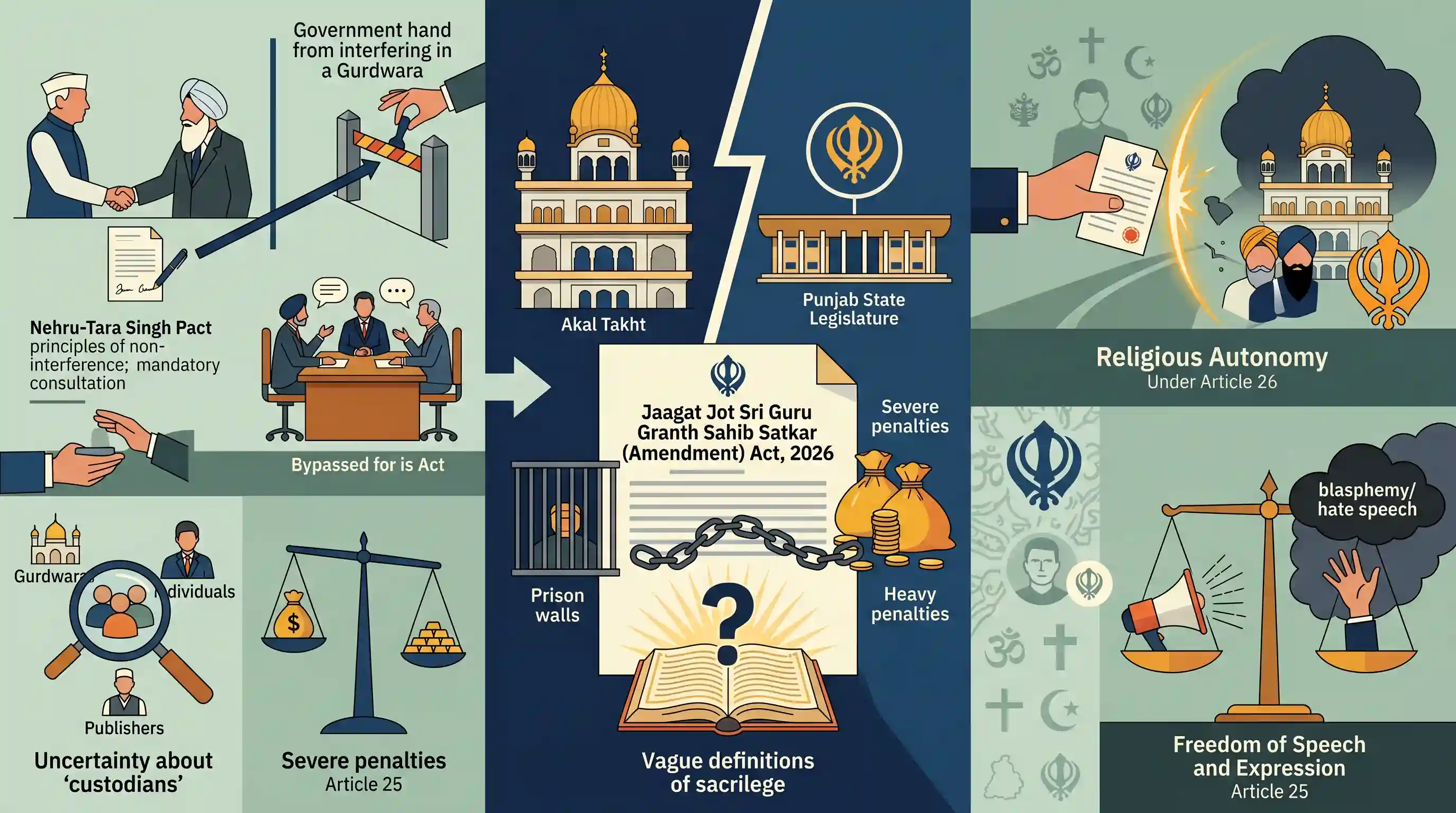
The article discusses the constitutional and historical dispute between the Akal Takht and the Punjab government over the newly passed Jaagat Jot Sri Guru Granth Sahib Satkar (Amendment) Act, 2026. The Akal Takht argues that the state government bypassed the historical precedent established by the 1959 Nehru-Tara Singh Pact, which mandates state non-interference and consultation with Sikh bodies before legislating on Sikh religious affairs. The law, which seeks to severely penalize sacrilege, is being criticized for its vague definitions of 'sacrilege' and 'custodians,' raising concerns over religious autonomy under Article 26 of the Constitution and the freedom of speech.
Key Points
- The Akal Takht has issued a one-month ultimatum to the Punjab government over the passage of the Jaagat Jot Sri Guru Granth Sahib Satkar (Amendment) Act, 2026 (commonly known as Punjab's anti-sacrilege law), citing a lack of prior consultation with Sikh religious bodies.
- The dispute centers on a violation of the 1959 Nehru-Tara Singh Pact, a verbal agreement between PM Jawaharlal Nehru and Akali leader Master Tara Singh. The pact established a historical precedent that the government would not interfere in Sikh religious affairs or amend Gurdwara management laws without consulting the SGPC.
- The 2026 anti-sacrilege amendment prescribes up to life imprisonment for sacrilege (beadbi) of the Guru Granth Sahib but is widely criticized for expanding the definition of sacrilege to 'hurt sentiments' without clearly defining the term.
- Critics argue that the law's vague terminology, such as the ambiguous definition of 'custodian' and 'sacrilege', could result in a chilling effect on the freedom of speech, invite political misuse, and instill fear among priests (Granthis) and devotees.
- The unilateral legislative action raises constitutional concerns under Article 26 (Freedom to manage religious affairs). While Article 25(2)(a) allows the state to regulate secular/financial aspects of religious institutions, scholars argue that Gurdwara management is inseparable from Sikh religious ethics and traditions, making state interference without community consensus an infringement on minority rights.
Important Terms
Nehru-Tara Singh Pact (1959)

A 1959 pact between Prime Minister Nehru and Akali leader Master Tara Singh establishing that the state would not interfere in Sikh religious affairs or amend the Sikh Gurdwaras Act without consulting the SGPC.
UPSC context
GS Paper I (Post-Independence) & GS II (Secularism); tests state-religion relations, conventions of religious autonomy, and federal pacts.
Sikh Gurdwaras Act, 1925
A landmark British-era legislation that legally defined Sikh identity and brought the administration of historical Sikh gurdwaras under the control of an elected, democratic representative body of Sikhs (the SGPC).
UPSC context
GS Paper I (Modern History) & GS II (Statutory Bodies); tests the Gurdwara Reform Movement and autonomous management of shrines.
Jaagat Jot Sri Guru Granth Sahib Satkar (Amendment) Act, 2026
A Punjab state legislation enacted in 2026 that introduces stringent criminal penalties, including life imprisonment and substantial fines, to deter the desecration of the Sri Guru Granth Sahib, sparking religious autonomy debates.
UPSC context
GS Paper II (Constitutional Law/Article 25-26); tests the conflict between state-enacted anti-sacrilege laws and freedom of speech.
Akal Takht
Established in 1606 by Guru Hargobind, it is the highest seat of temporal and spiritual authority in Sikhism, located within the Golden Temple complex, issuing binding edicts (Hukamnamas) to the global community.
UPSC context
GS Paper I (Art & Culture) & GS II (Polity); tests the history of temporal-spiritual authority (Miri-Piri) and religious sovereignty.
Shiromani Gurdwara Parbandhak Committee (SGPC)
An apex, democratically elected religious organization formed in 1920 that manages Sikh places of worship (gurdwaras) in northern India and officially appoints the head (Jathedar) of the Akal Takht.
UPSC context
GS Paper II (Statutory Bodies & Article 26); tests the administration of religious institutions and democratic governance under the 1925 Act.
Shiromani Akali Dal
A major regional political party in Punjab, established in December 1920 during the Gurdwara Reform Movement to represent Sikh interests and spearhead regional movements like the Punjabi Suba demand.
UPSC context
GS Paper I (Post-Independence History) & GS II (Federalism); tests the evolution of regionalism and faith-politics intersection in Punjab.
Prelims Trap
Explanation II of Article 25 defines 'Hindus' to include Sikhs, Buddhists, and Jains for all purposes of the Indian Constitution.
This inclusion is strictly limited to Article 25(2)(b) regarding the opening of public religious institutions, not a blanket constitutional definition.
Static Concepts Connected
What constitutional distinctions exist between individual (Article 25) and collective (Article 26) religious rights?
- Subject to Part III: Article 25 is expressly subject to other fundamental rights in Part III; Article 26's limitation clause conspicuously omits this phrase.
- Individual vs Group: Article 25 protects individual freedom of conscience, whereas Article 26 protects collective rights of religious denominations or sections thereof.
- Secular Regulation: Article 25(2)(a) explicitly empowers the state to regulate financial, political, or other secular activities associated with religious practice.
What is the historical origin and significance of the 'Miri-Piri' concept in Sikhism?
- Sixth Guru: Introduced by Guru Hargobind in 1606 following the martyrdom of Guru Arjan Dev to defend the faith.
- Dual Swords: Symbolized by wearing two swords representing 'Miri' (temporal/political power) and 'Piri' (spiritual authority) working in unison.
- Akal Takht: Established the Akal Takht as the primary seat of temporal authority, separate from the spiritual Golden Temple.
Cross-Topic Patterns
Secularism vs State administration of shrines
State administration of temple boards and Gurdwara laws tests the boundary of Article 25(2)(a), contrasting secular financial control with religious autonomy.
Anti-sacrilege laws and free speech
Vague state blasphemy legislation intersects with Article 19(1)(a) and BNS provisions, creating friction between maintaining public order and preventing censorship.

2026 GS-II may test state power over religious administrations versus Article 26 rights using historical accords like Nehru-Tara Singh.
Linked PYQs · 3
Linked PYQs · 3
- 2024MainsGS2
Discuss India as a secular state and compare with the secular principles of the US constitution.
- 2014MainsGS2
What do you understand by the concept "freedom of speech and expression"? Does it cover hate speech also ? Why do the films in India stand on a slightly different plane from other forms of expression ? Discuss.
- 2019MainsGS2
What can France learn from the Indian Constitution's approach to secularism?
