First Constitutional Amendment and Restrictions on Free Speech
Source:Indian Express ↗
Why It Matters
With the First Amendment nearing its 75th anniversary, its historical context, impact on Fundamental Rights, creation of the Ninth Schedule, and the resulting friction between the legislature and the judiciary are highly relevant for UPSC Prelims and Mains (GS2 Polity).
Summary
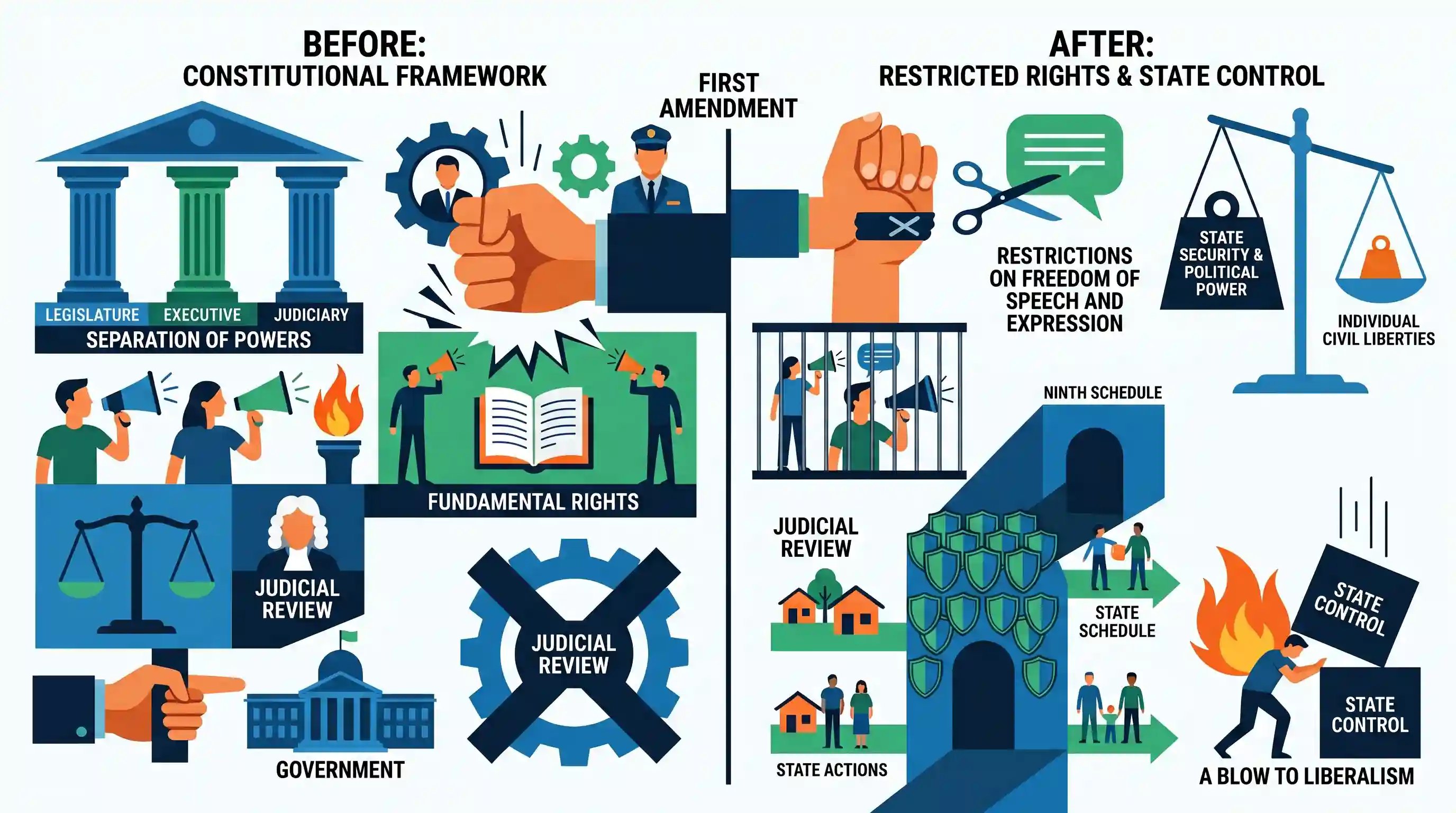
The article reflects on the consequences of the First Amendment to the Indian Constitution, enacted in 1951. Driven by the Nehru government's frustration with judicial checks on its social and political agenda—specifically concerning press censorship, land reforms, and reservations—the amendment significantly altered Fundamental Rights. It introduced the Ninth Schedule to bypass judicial review and expanded restrictions on freedom of speech. The author contends that this amendment dealt a severe blow to nascent Indian liberalism, creating a lasting architecture of state control and setting a dangerous precedent of prioritizing political power and state security over individual civil liberties.
Key Points
- The First Amendment (1951) was enacted by the Nehru government barely a year after the Constitution came into effect, described by scholars as a 'seismic shift' in India's constitutional architecture.
- It was passed in reaction to judicial rulings that struck down press censorship (involving Organiser and Cross Roads), caste-based quotas in Madras (Champakam Dorairajan case), and the Bihar Land Reform Act.
- The amendment created the Ninth Schedule to shield specific laws, particularly land reforms, from judicial review—even if they violated Fundamental Rights.
- It expanded the scope of 'reasonable restrictions' on freedom of speech, adding grounds such as 'public order', 'incitement to offences', and 'relations with foreign states', thereby enabling laws like sedition.
- The author argues that the amendment established a precedent of using parliamentary majority to bypass judicial decisions, permanently altering the balance between civil liberties and state power.
Important Terms
First Amendment Act, 1951

The inaugural modification of the Indian Constitution (1951), enacted to shield land reforms (Ninth Schedule) and expand state power to restrict free speech on grounds like 'public order.'
UPSC context
GS-II: Indian Constitution; tests understanding of historical underpinnings and the early evolution of Fundamental Rights.
Ninth Schedule
A list of laws (Article 31B) initially immune to judicial review, created to protect socio-economic reforms from being struck down for violating Fundamental Rights.
UPSC context
GS-II: Separation of Powers; essential for topics on Judicial Review and the Basic Structure doctrine.
Bihar Land Reform Act, 1950
A 1950 law aimed at abolishing the zamindari system. Its invalidation by the Patna High Court for violating equality rights led to the First Amendment.
UPSC context
GS-II: Land Reforms; tests the legal history of property rights and rural social justice in India.
Article 19(2)
The constitutional clause permitting 'reasonable restrictions' on free speech. The 1951 amendment added 'public order' and 'friendly relations with foreign states' as restrictive grounds.
UPSC context
GS-II: Fundamental Rights; central to debates on Freedom of the Press and Sedition (124A IPC).
Cross Roads
A weekly journal whose successful 1950 Supreme Court challenge (Romesh Thappar case) against a state ban forced the government to widen speech restrictions via amendment.
UPSC context
GS-II: Judiciary; a landmark case study for the evolution of Press Freedom and Article 19(1)(a).
Organiser
An RSS-affiliated weekly whose victory against pre-censorship in the Supreme Court (1950) reinforced judicial protection of expression and prompted legislative pushback via the First Amendment.
UPSC context
GS-II: Fundamental Rights; demonstrates the judiciary's role in limiting prior restraint and executive censorship.
Prelims Trap
Laws placed in the Ninth Schedule are completely immune from judicial review.
Following the I.R. Coelho judgment (2007), laws added to the Ninth Schedule after April 24, 1973, can be reviewed if they violate the basic structure.
Static Concepts Connected
What are the primary constitutional changes introduced by the First Amendment Act, 1951?
- Article 19(2): Expanded restrictions on free speech by adding 'public order', 'friendly relations with foreign states', and 'incitement to an offence'.
- Ninth Schedule: Inserted Articles 31A and 31B, alongside the Ninth Schedule, to protect agrarian reform laws from Fundamental Rights challenges.
- Article 15(4): Empowered the State to make special provisions for the advancement of socially and educationally backward classes.
How has judicial review of the Ninth Schedule evolved over time?
- Initial Absolute Immunity: Originally, Article 31B barred courts from reviewing any legislation placed in the Ninth Schedule, ensuring unchecked legislative power for land reforms.
- I.R. Coelho Case (2007): The Supreme Court ruled there is no blanket immunity; laws added after April 24, 1973, are subject to judicial review if they violate the basic structure.
Cross-Topic Patterns
First Amendment to Basic Structure
The 1951 amendment triggered the Parliament-Judiciary tussle over amending Fundamental Rights (Shankari Prasad case), directly paving the way for the Kesavananda Bharati basic structure doctrine in 1973.
Free speech & colonial-era laws
The addition of 'public order' and 'incitement' to Article 19(2) provided the constitutional shield required to sustain colonial-era laws like Sedition in independent India.

Expect a chronological arrangement question linking early SC cases (Champakam), the 1st Amendment, and evolution of the 9th Schedule.
Linked PYQs · 4
Linked PYQs · 4
- 2019PrelimsGS1
The Ninth Schedule was introduced in the Constitution of India during the prime ministership of
- 2018PrelimsGS1
Consider the following statements: 1. The Parliament of India can place a particular law in the Ninth Schedule of the Constitution of India. 2. The validity of a law placed in the Ninth Schedule cannot be examined by any court and no judgement can be made on it. Which of the statements given above is/are correct?
- 2014MainsGS2
What do you understand by the concept "freedom of speech and expression"? Does it cover hate speech also ? Why do the films in India stand on a slightly different plane from other forms of expression ? Discuss.
- 2025MainsGS2
Indian Constitution has conferred the amending power on the ordinary legislative institutions with a few procedural hurdles. In view of this statement, examine the procedural and substantive limitations on the amending power of the Parliament to change the Constitution.
