NTA Conducts NEET UG Retest Under Strict Security
Source:Indian Express ↗
Why It Matters
The recurring issue of paper leaks highlights systemic vulnerabilities in large-scale public examinations, undermining meritocracy and public trust. The coordinated 'whole-of-government' response and the deployment of advanced technology to restore examination integrity are highly relevant to GS2 (Governance, Accountability, E-Governance) and relate directly to recent legislative measures like The Public Examination (Prevention of Unfair Means) Act, 2024.
Summary
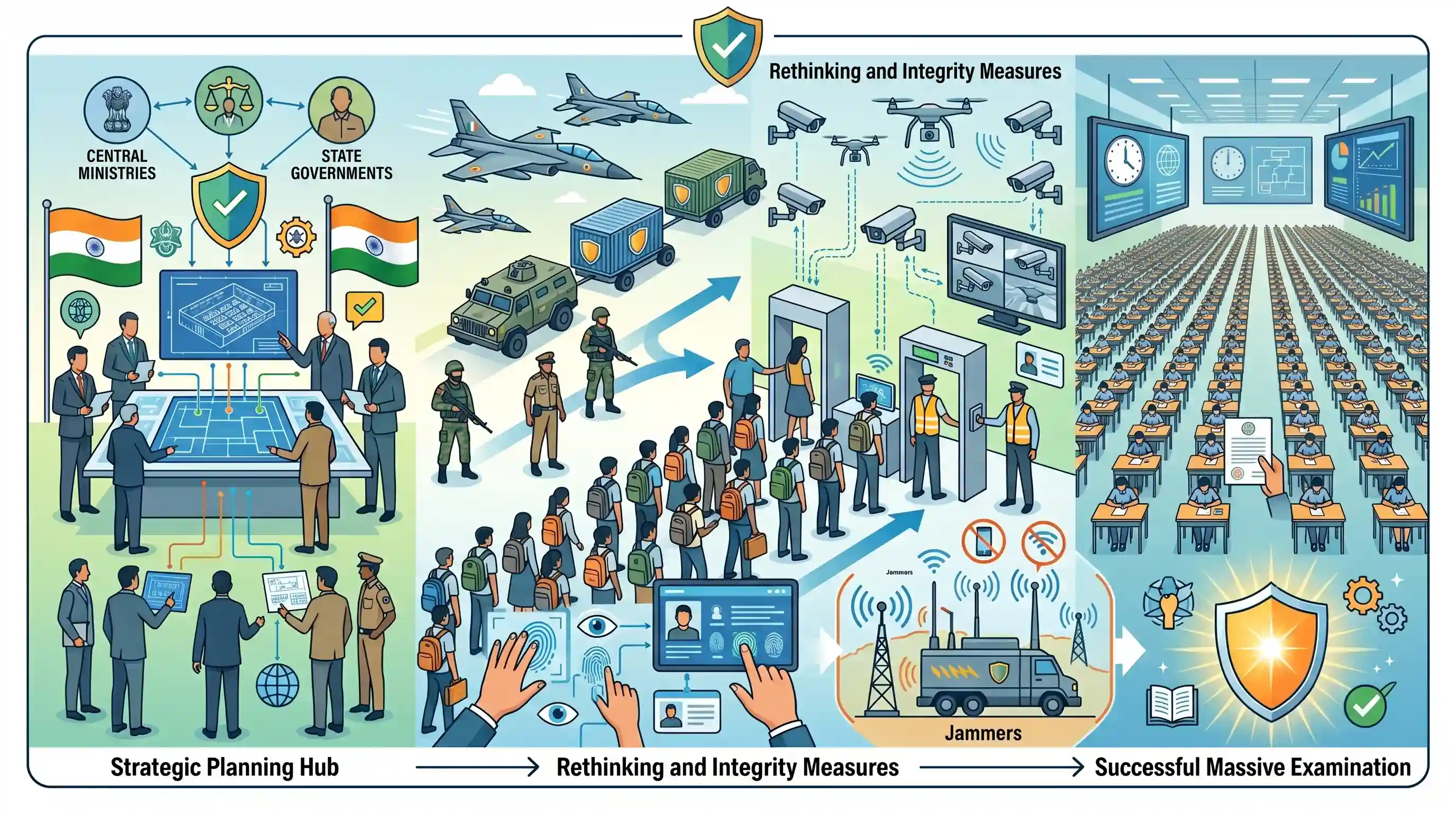
The National Testing Agency (NTA) successfully held a massive NEET-UG retest for over 20 lakh students amid intense scrutiny following the cancellation of the previous exam due to a paper leak. The retest was characterized by a robust 'whole-of-government' effort, bringing together multiple central ministries, state governments, the Indian Air Force, and paramilitary forces to ensure an incident-free process. Rigorous technological and physical security measures, including Aadhaar-based biometrics, CCTVs, and jammers, were implemented to restore the integrity of the examination system.
Key Points
- The National Testing Agency (NTA) conducted a NEET-UG retest for over 20 lakh candidates under stringent security measures, one month after cancelling the original exam due to an alleged paper leak.
- The execution involved a massive 'whole-of-government' approach, coordinating multiple central ministries, the Indian Air Force, CAPF, state governments, and district administrations.
- Advanced technological safeguards were deployed, including Aadhaar-based biometric authentication for candidates and staff, AI-powered CCTV surveillance, thorough frisking, and the use of jammers to prevent cheating.
- Union Education Minister Dharmendra Pradhan appealed to the public to support the students and avoid actions that could jeopardize their mental health or future prospects amidst the ongoing controversy.
Important Terms
National Testing Agency (NTA)

An autonomous, self-sustained organization under the Ministry of Education, established to conduct efficient, transparent, and international-standard entrance examinations for higher educational institutions in India.
UPSC context
GS Paper 2: Statutory, regulatory and various quasi-judicial bodies. Tests knowledge of institutional frameworks for transparent governance in education.
Central Armed Police Forces (CAPF)
Paramilitary forces (such as CRPF and CISF) under the Ministry of Home Affairs tasked with internal security, border guarding, and assisting civil authorities during large-scale public events.
UPSC context
GS Paper 3: Internal Security. Relevant for understanding multi-agency coordination in maintaining public order and exam integrity.
Ministry of Health and Family Welfare (MoHFW)
The union ministry responsible for formulating health policy and medical education standards; it oversees the National Medical Commission and the intake process for medical colleges.
UPSC context
GS Paper 2: Issues relating to development and management of Social Sector/Services relating to Health and Education.
Ministry of Electronics and Information Technology (MeitY)
The nodal ministry for IT policy and e-governance; it manages Aadhaar-based biometric authentication (via UIDAI) to ensure digital identity verification during public examinations.
UPSC context
GS Paper 2: E-governance- applications, models, successes, limitations, and potential. Tests understanding of digital security in administration.
Indian Air Force (IAF)
The aerial branch of the Indian Armed Forces which, in high-security contexts, provides logistical support for the rapid and secure transport of sensitive government materials.
UPSC context
GS Paper 3: Security challenges and their management. Focuses on civil-military cooperation for national logistics.
Department of Posts
A government-operated postal system under the Ministry of Communications that provides last-mile logistics for secure delivery of critical official documents and examination papers.
UPSC context
GS Paper 2: Governance. Relevant for the 'Whole-of-Government' approach in civil administration and logistical efficiency.
Prelims Trap
"The National Testing Agency (NTA) is a statutory body established under the Ministry of Education."
The NTA is not a statutory body. It is an autonomous testing organization registered as a society under the Societies Registration Act, 1860.
Static Concepts Connected
What is the legal status and mandate of the National Testing Agency (NTA)?
- Legal Status: It is an autonomous testing organization registered as a society under the Societies Registration Act, 1860, not a statutory body.
- Mandate: To conduct efficient, transparent, and standardized tests to assess the competency of candidates for admission to higher education institutions.
- Governance: It is chaired by an eminent educationist appointed by the Ministry of Education, relieving bodies like CBSE of testing burdens.
Key features of the Public Examination (Prevention of Unfair Means) Act, 2024?
- Applicability: Covers exams conducted by central bodies like UPSC, SSC, RRB, and NTA. It does not automatically apply to state government exams.
- Penalties: Makes paper leaks and organized malpractices cognizable, non-bailable offenses, punishable by 3 to 10 years of imprisonment and heavy fines.
- Candidate Exemption: The Act targets organized syndicates, paper-solvers, and colluding officials. Individual students taking the exam are exempted from its criminal provisions.
Cross-Topic Patterns
E-governance in public administration
The integration of AI CCTVs, jammers, and Aadhaar biometrics for NEET reflects the broader GS-2 syllabus theme of applying e-governance tools to enhance transparency and eliminate human discretion.
Whole-of-government crisis response
The horizontal (Air Force, CAPF) and vertical (Centre, State) coordination to secure exams mirrors disaster management frameworks, showing how inter-agency synergy is applied to non-traditional governance crises.

Expect a GS-2 Mains question evaluating the 'whole-of-government' approach and the 2024 Public Exam Act in restoring institutional trust.
Linked PYQs · 3
Linked PYQs · 3
- 2024MainsGS2
What are the aims and objects of recently passed and enforced, The Public Examination (Prevention of Unfair Means) Act, 2024? Whether University/State Education Board examinations, too, are covered under the Act ?
- 2023MainsGS2
e-governance, as a critical tool of governance, has ushered in effectiveness, transparency and accountability in governments. What inadequacies hamper the enhancement of these features ?
- 2024MainsGS2
e-governance is not just about the routine application of digital technology in service delivery process. It is as much about multifarious interactions for ensuring transparency and accountability. In this context evaluate the role of the 'Interactive Service Model' of e-governance.
