NEET-UG Exam Reforms and Prevention of AI Forgeries
Source:The Hindu ↗
આ શા માટે મહત્વનું છે
The recurring irregularities in high-stakes public examinations like NEET-UG highlight significant governance and administrative challenges. The incident underscores the relevance of recent legislative measures such as the Public Examination (Prevention of Unfair Means) Act, 2024, and the growing threat of AI-enabled forgery (like fake OMR sheets). The transition to Computer-Based Tests (CBT) represents a crucial governance reform aimed at ensuring transparency and fairness in the education sector.
સારાંશ
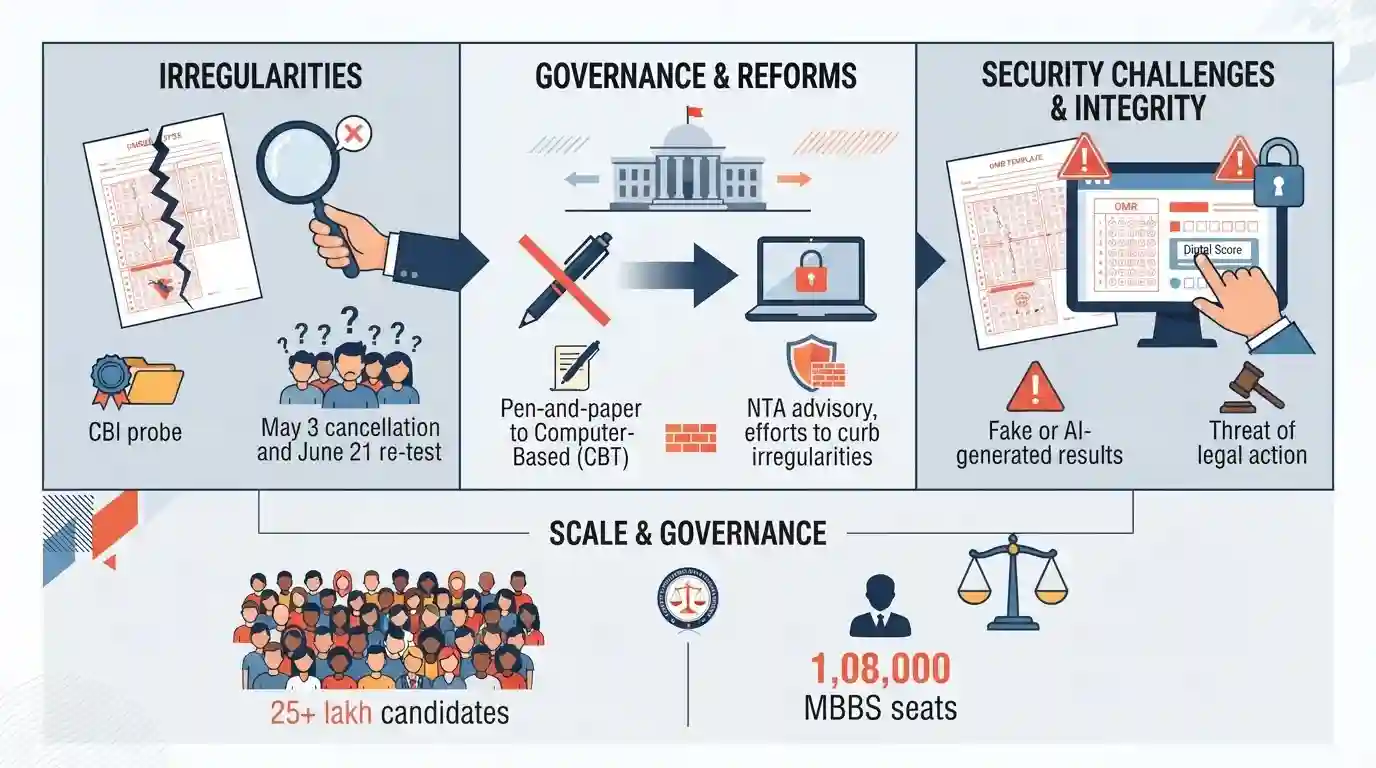
The National Testing Agency (NTA) has issued an advisory warning NEET-UG 2026 candidates against submitting fake or AI-generated OMR sheets to contest their scores, threatening legal action against offenders. This follows the cancellation of the May 3 exam due to paper leak allegations, which led to a CBI probe and a re-test on June 21. To curb such widespread irregularities, the Centre has decided to shift the NEET-UG exam from a pen-and-paper format to a Computer-Based Test (CBT). With over 25 lakh candidates competing for approximately 1,08,000 MBBS seats, ensuring the integrity of the examination process remains a critical governance challenge.
મુખ્ય મુદ્દા
- The NTA warned NEET-UG 2026 candidates against using fake or AI-generated OMR sheets to raise grievances about score discrepancies.
- Following allegations of paper leaks for the May 3 exam, a CBI probe was initiated and the exam was re-conducted on June 21, 2026.
- The Centre has announced that NEET-UG will transition from a pen-and-paper mode to a Computer-Based Test (CBT) to prevent future leaks and irregularities.
- The NEET-UG exam sees over 25 lakh registrations annually for roughly 1,08,000 MBBS seats across India, highlighting the massive scale and stakes of the examination.
- Legal action is anticipated against individuals submitting fabricated or AI-manipulated documents as part of their grievances.
મહત્વપૂર્ણ શબ્દો
National Testing Agency (NTA)

An autonomous, self-sustained testing organization under the Ministry of Education, registered as a society, established to conduct standardized and secure national-level entrance examinations for higher educational institutions in India.
UPSC context
GS Paper II (Governance/Education); evaluates issues concerning educational governance, institutional credibility, and reforms in conducting examinations.
Central Bureau of Investigation (CBI)
India's premier central investigation agency operating under the Ministry of Personnel, Public Grievances, and Pensions, deriving its power from the Delhi Special Police Establishment Act, 1946.
UPSC context
GS Paper II (Polity and Governance); crucial for analyzing federalism, state consent, and anti-corruption machinery in administration.
Computer-Based Test (CBT)
A secure, digital examination format where candidates complete tests on-screen at designated centers, proposed to replace traditional pen-and-paper OMR formats to curb physical paper leaks.
UPSC context
GS Paper II & III (Governance/Cyber Security); tests knowledge on administrative transition towards tech-driven, secure governance models.
Optical Mark Recognition (OMR)
A technology used to capture human-marked data from documents like exam sheets, traditionally used in India's pen-and-paper examinations but prone to scanning errors and logistical vulnerabilities.
UPSC context
GS Paper II (Education/Governance); tests understanding of technical flaws in conventional testing systems and the shift to digital platforms.
Examination Reforms
Systematic shifts in test formats, security protocols, and institutional architectures designed to prevent leakages, reward conceptual learning over rote memorization, and restore public trust.
UPSC context
GS Paper II (Issues relating to Health and Education); evaluates policy formulation, student welfare, and technological integrations.
પ્રિલિમ્સ ટ્રેપ
Individual candidates using fake OMR sheets are prosecuted under the stringent criminal provisions of the Public Examinations (Prevention of Unfair Means) Act, 2024.
The 2024 Act targets institutional actors, organized syndicates, and service providers. Individual candidates are excluded from its penal provisions, falling instead under BNS or specific exam board rules.
સંલગ્ન સ્થિર ખ્યાલો
What is the legal status and administrative mandate of the National Testing Agency (NTA)?
- Legal Status: Established as an autonomous, self-sustained premier testing organization registered under the Societies Registration Act, 1860.
- Parent Ministry: Functions under the Department of Higher Education within the Union Ministry of Education.
- Governance structure: Chaired by an eminent educationist appointed by the Ministry of Education, with a Director-General as the chief executive officer.
What are the key pillars of the Public Examinations (Prevention of Unfair Means) Act, 2024?
- Targeted Scope: Targets organized syndicates, service providers, and officials facilitating leaks, rather than individual student candidates.
- Nature of Offenses: Designates all offenses under the Act as cognizable, non-bailable, and non-compoundable.
- Stringent Penalties: Prescribes imprisonment up to 10 years and a minimum fine of Rs 1 crore for organized cheating crimes.
આંતર-વિષય પેટર્ન
AI deepfakes + Cybersecurity policy
The shift of generative AI tools from media manipulation to administrative document forgery (like fake OMR sheets) challenges traditional evidentiary standards and cyber-forensic capabilities of state agencies.
Examination reforms + Nolan Principles
Systemic examination failures directly compromise "integrity" and "objectivity" (Nolan Principles), eroding public trust in merit-based state-led recruitment and higher education.

Radhakrishnan Committee recommendations and the Public Examinations Act 2024's asymmetric liability clauses likely to be tested in 2026.
સંલગ્ન PYQ · 2
સંલગ્ન PYQ · 2
- 2024MainsGS2
What are the aims and objects of recently passed and enforced, The Public Examination (Prevention of Unfair Means) Act, 2024? Whether University/State Education Board examinations, too, are covered under the Act ?
- 2020MainsGS3
Discuss different types of cyber crimes and measures required to be taken to fight the menace.
