Public Examinations Amendment Bill and Education Reforms in Parliament
Source:Indian Express ↗
આ શા માટે મહત્વનું છે
This article highlights the immediate legislative response (Amendment Bill 2026) to public outrage over high-stakes exam leaks (NEET), representing a core governance issue. It emphasizes the delicate relationship between street agitations (pressure groups) and parliamentary action, illustrating how formal legislative bodies must go beyond punitive measures to execute systemic educational reforms.
સારાંશ
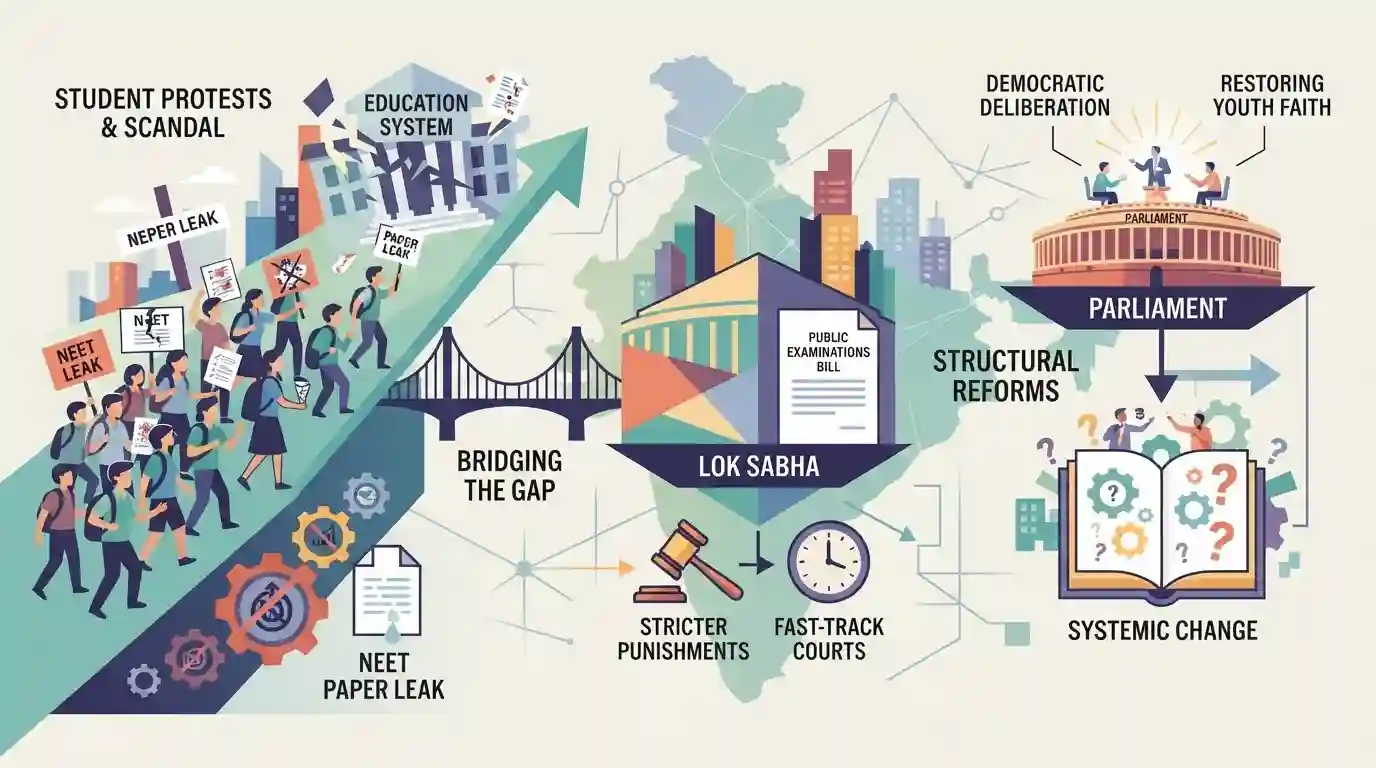
The editorial examines the passage of the Public Examinations (Prevention of Unfair Means) Amendment Bill 2026 in the Lok Sabha, which was catalyzed by intense student-led protests following the NEET paper leak scandal. While the amendment introduces stricter punishments and fast-track courts, the article argues that structural reforms in India's education and evaluation systems are vital. It calls on Parliament to bridge the gap between street protests and formal governance by acting as a robust forum for democratic deliberation to restore youth faith in constitutional systems.
મુખ્ય મુદ્દા
- The Lok Sabha passed the Public Examinations (Prevention of Unfair Means) Amendment Bill 2026 by voice vote amid ongoing political friction and student agitations.
- The legislative push follows a month-long street protest led by the Cockroach Janta Party in the wake of the NEET paper leak, which also compelled the resignation of Union Education Minister Dharmendra Pradhan.
- The 2026 Amendment Bill aims to plug loopholes in the 2024 Act by making punishments and fines far more stringent, and mandating the creation of fast-track courts operating on strict timelines.
- The editorial emphasizes that tougher penal laws and ministerial replacements are only initial steps; true systemic restoration demands extensive structural redesign of educational evaluation and accountability mechanisms.
- The youth protests must be viewed not as mere antagonism toward democratic setups, but as an urgent appeal for formal institutions, especially Parliament, to step up, overcome political polarization, and actively deliberate on the anxieties of the younger generation.
મહત્વપૂર્ણ શબ્દો
Public Examinations (Prevention of Unfair Means) Amendment Bill 2026

A 2026 legislative bill amending the 2024 Act to introduce stricter penalties (up to 10 years imprisonment), special fast-track courts, and a strict two-month investigation timeline to curb public examination leaks and fraud.
UPSC context
GS Paper II: Governance and education policies. Tests knowledge of legislative reforms tackling systemic public examination malpractices.
Public Examinations (Prevention of Unfair Means) Act 2024
India's first dedicated national law designed to prevent unfair means, cheating, and paper leaks in central public examinations, making such offences cognizable, non-bailable, and non-compoundable.
UPSC context
GS Paper II: Social Sector/Education. Tests administrative measures to uphold transparency and public confidence in competitive exam systems.
NEET
A highly competitive, nationwide single-window entrance examination conducted by the National Testing Agency (NTA) for students seeking admission to undergraduate medical and dental programs across India.
UPSC context
GS Paper II: Social Sector/Education. Evaluates issues surrounding educational equity, admissions centralization, and institutional mega-exam management.
Lok Sabha
The lower house of India's bicameral Parliament, composed of directly elected representatives, which holds primary legislative and financial authority, including the power to initiate and pass crucial public bills.
UPSC context
GS Paper II: Parliament and State Legislatures. Tests understanding of legislative procedures and democratic accountability of public representatives.
Union Education Ministry
The central government ministry responsible for formulating the National Policy on Education, improving educational access and quality, and overseeing key testing bodies like the NTA.
UPSC context
GS Paper II: Governance and education. Tests the structural role of central ministries in policy-making and systemic education reforms.
પ્રિલિમ્સ ટ્રેપ
The Public Examinations Act criminally prosecutes students caught cheating with up to 5 years of rigorous imprisonment.
Both laws explicitly exclude bona fide candidates from criminal prosecution under this Act. Students remain governed by administrative rules of the respective exam-conducting bodies.
સંલગ્ન સ્થિર ખ્યાલો
What is the constitutional distribution of legislative power regarding education in India?
- Concurrent List entry: Education was shifted from the State List to Entry 25 of the Concurrent List by the 42nd Amendment in 1976.
- Union coordination role: Entry 66 of the Union List vests coordination and determination of standards in higher education exclusively with the Parliament.
- Doctrine of Repugnancy: Under Article 254, central legislation on concurrent subjects overrides state laws in case of direct conflict or inconsistency.
What parliamentary devices allow discussion on urgent public matters?
- Adjournment Motion: Allows setting aside normal business to discuss a definite, urgent matter of public importance; requires support from 50 members.
- Short-Duration Discussion: Enables members to raise urgent public matters without a formal vote or a substantive motion, lasting up to two hours.
આંતર-વિષય પેટર્ન
Federal friction in standardized examinations
Centralized testing like NEET conflicts with state board curricula, converting technical assessment reforms into active political flashpoints of Union-State legislative friction.
Pressure groups and rapid lawmaking
Youth-led street protests bypass formal policy consultative channels, driving the Union executive to fast-track stringent criminal penal reforms directly through Parliament.

2026 Prelims may test the distinction between candidate exemption and severe institutional/organized crime penalties under the Public Exams Act.
સંલગ્ન PYQ · 2
સંલગ્ન PYQ · 2
- 2024MainsGS2
What are the aims and objects of recently passed and enforced, The Public Examination (Prevention of Unfair Means) Act, 2024? Whether University/State Education Board examinations, too, are covered under the Act ?
- 2021MainsGS2
“Pressure groups play a vital role in influencing public policy making in India.” Explain how the business associations contribute to public policies.
