NEET PG multi shift examination challenge and judicial review plea
Source:The Hindu ↗
Why It Matters
This issue underscores the ongoing administrative and legal challenges in conducting large-scale, high-stakes public examinations in India. It highlights the tension between logistical feasibility and the constitutional mandate for fair and equitable competition, making it highly relevant to discussions on governance, transparency, and the right to equality (Article 14).
Summary
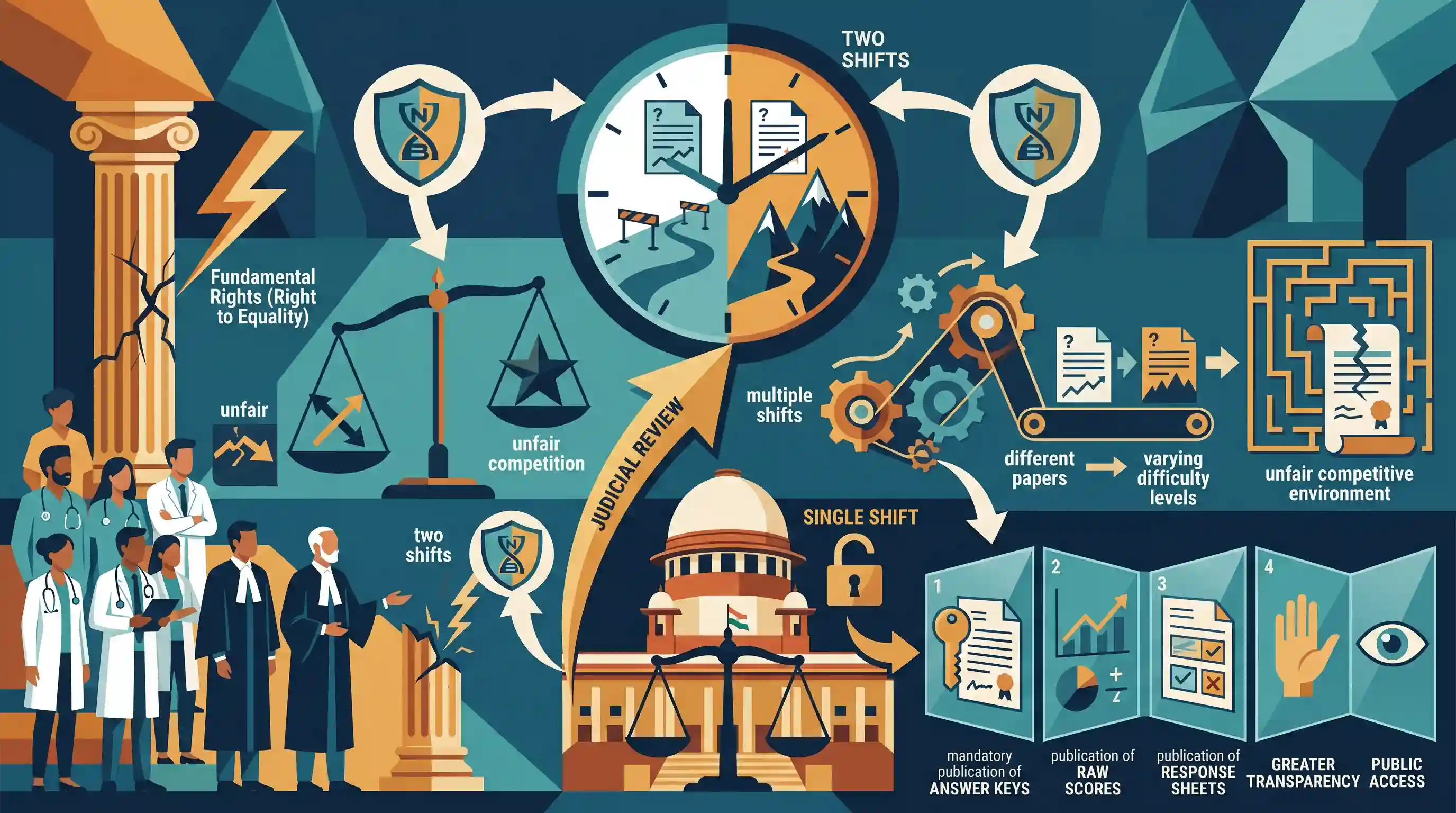
The Supreme Court is set to hear a plea challenging the decision by the National Board of Examinations in Medical Sciences (NBEMS) to conduct the NEET-PG 2025 exam in two shifts. Petitioners argue that using multiple shifts with different question papers leads to varying difficulty levels, creating an unfair competitive environment and violating the right to equality. The plea advocates for reverting to a single-shift exam format and seeks greater transparency through the mandatory publication of answer keys, raw scores, and response sheets.
Key Points
- The National Board of Examinations in Medical Sciences (NBEMS) scheduled the NEET-PG 2025 exam to be held in two shifts on June 15, 2025.
- A plea has been filed in the Supreme Court challenging the two-shift format, arguing that differing difficulty levels between shifts compromise fair competition and violate the right to equality.
- Petitioners are advocating for a single-shift examination to ensure a just and equitable evaluation process.
- The plea also demands the publication of answer keys, response sheets, and raw scores to ensure transparency and accountability in the examination process.
Important Terms
NEET-PG

A national-level computer-based entrance examination for medical graduates seeking admission to MD, MS, and PG Diploma courses in Indian government and private medical colleges.
UPSC context
GS Paper 2: Social Justice; tests knowledge of healthcare education policy and equitable access to higher education.
Supreme Court of India
The highest judicial authority in India, serving as the guardian of the Constitution with powers of judicial review and enforcement of fundamental rights under Article 32.
UPSC context
GS Paper 2: Indian Constitution and Judiciary; tests understanding of judicial review and protection of fundamental rights.
National Medical Commission (NMC)
An autonomous statutory body under the Ministry of Health and Family Welfare responsible for regulating medical education, professionals, and institutions, replacing the Medical Council of India.
UPSC context
GS Paper 2: Governance; tests knowledge of statutory and regulatory bodies in the health sector.
National Board of Examinations in Medical Sciences (NBEMS)
An autonomous academic body under the Ministry of Health and Family Welfare tasked with conducting standardized national-level medical examinations like NEET-PG and FMGE.
UPSC context
GS Paper 2: Statutory/Regulatory Bodies; tests administrative structure and transparency in public examination systems.
Right to Equality (Article 14)
Ensures that all persons are equal before the law and receive equal protection, preventing arbitrary discrimination by the state in administrative actions like exam formats.
UPSC context
GS Paper 2: Fundamental Rights; tests application of legal fairness and non-arbitrariness in government decisions.
Judicial Review
The power of the judiciary to examine the constitutionality of legislative acts and executive orders, ensuring they do not violate fundamental rights.
UPSC context
GS Paper 2: Judiciary; tests the checks and balances mechanism between the judiciary and executive.
Prelims Trap
"Normalisation of marks in multi-shift exams violates the Right to Equality under Article 14."
The Supreme Court has actually ruled the exact opposite: failing to normalize scores across multi-shift exams treats unequal candidates as equal, thereby violating Article 14.
Static Concepts Connected
What is the scope of judicial review over academic and examination bodies?
- Judicial Restraint: Courts generally defer to expert academic bodies, presuming their decisions on exam patterns and syllabi are valid.
- Grounds for Intervention: Intervention is strictly limited to instances of blatant arbitrariness, statutory violations, or breaches of Fundamental Rights.
- Re-evaluation Limits: Courts rarely mandate the re-evaluation of answer sheets unless explicitly permitted by the governing statutory rules.
Are evaluated examination answer sheets accessible under the RTI Act, 2005?
- Information Definition: Evaluated answer sheets are legally considered "information" under Section 2(f) of the RTI Act.
- Fiduciary Exception Invalid: Examining bodies cannot use Section 8(1)(e) (fiduciary relationship) as a blanket defense to deny candidates access to their evaluated scripts.
- Access vs. Re-evaluation: While candidates have the right to access and inspect their sheets, this does not automatically confer a right to re-evaluation.
Cross-Topic Patterns
Public Exam Act & Agency Autonomy
The Public Examination (Prevention of Unfair Means) Act, 2024 aims to enforce procedural transparency, directly addressing systemic governance and accountability deficits seen in autonomous testing bodies like NBEMS and NTA.
Article 14 & Intelligible Differentia
Exam score normalisation perfectly illustrates Article 14's reasonable classification doctrine—it prevents the equal treatment of unequal candidates who face varying paper difficulties across shifts.

Exam normalization via Article 14 and RTI access to answer sheets overriding 'fiduciary' exemptions are prime candidates for 2026 Prelims.
Linked PYQs · 1
Linked PYQs · 1
- 2024MainsGS2
What are the aims and objects of recently passed and enforced, The Public Examination (Prevention of Unfair Means) Act, 2024? Whether University/State Education Board examinations, too, are covered under the Act ?
