CBI Uncovers Interstate Conspiracy Network in NEET Examination Leak
Source:Indian Express ↗
Why It Matters
The incident underscores systemic vulnerabilities in conducting large-scale competitive examinations in India, highlighting issues of governance, corruption, and the critical need for robust institutional mechanisms (like the recently enacted Public Examination Act). It also demonstrates the vital role of central investigative agencies like the CBI in tackling interstate organized crime and ensuring accountability among public servants.
Summary
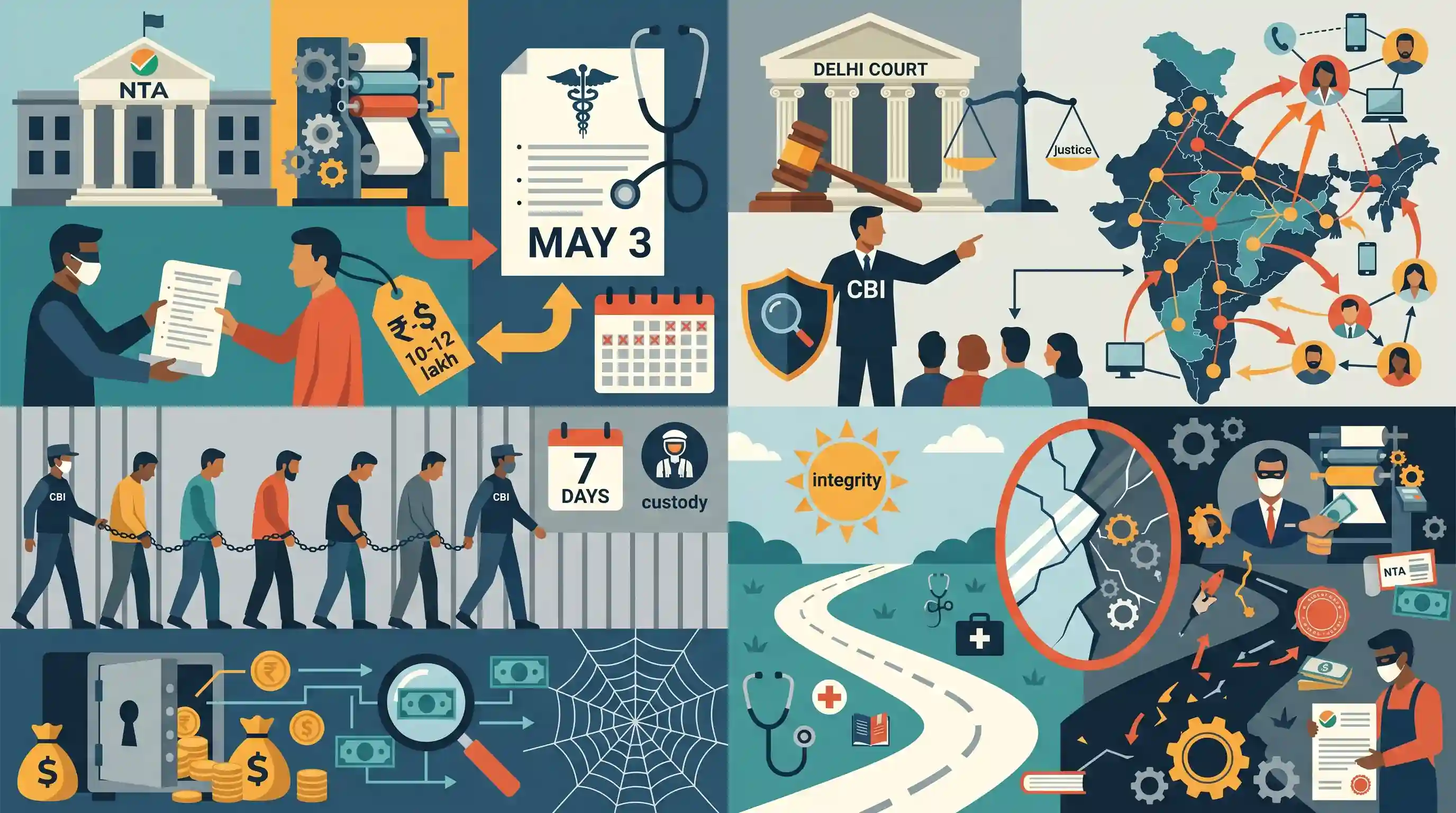
The Central Bureau of Investigation (CBI) informed a Delhi court that the NEET-UG 2026 question paper was sold for Rs 10-12 lakh, facilitated by a widespread network across multiple states. The agency secured seven-day custody of five accused to investigate the financial trail and uncover a larger nationwide conspiracy. A significant aspect of the probe aims to identify the complicity of public servants, specifically officials from the National Testing Agency (NTA) and personnel at the printing press, in leaking the paper weeks before the scheduled exam on May 3.
Key Points
- The CBI informed a Delhi court that the NEET-UG 2026 question paper was leaked and sold to candidates for Rs 10-12 lakh per copy.
- The leak involved an interstate network stretching across Maharashtra, Rajasthan, and Haryana, utilising courier chains and social media apps like Telegram and WhatsApp.
- The CBI secured a 7-day remand of five accused to uncover the financial trail and investigate a wider nationwide conspiracy.
- A key focus of the investigation is to ascertain the involvement of public servants, particularly officials from the National Testing Agency (NTA) and printing press personnel.
- A 150-page "guess paper" containing actual exam questions was circulated weeks before the May 3 test, severely compromising the exam\'s integrity.
Important Terms
National Testing Agency (NTA)

An autonomous, self-sustained agency under the Ministry of Education established to conduct efficient, transparent, and international-standard entrance tests for higher educational institutions in India.
UPSC context
GS Paper II (Statutory/Regulatory Bodies); tests knowledge of institutional reforms and transparency in the education sector.
Central Bureau of Investigation (CBI)
India's premier investigating agency under the Ministry of Personnel; it handles high-profile corruption and economic offenses, deriving its authority from the Delhi Special Police Establishment (DSPE) Act, 1946.
UPSC context
GS Paper II (Governance/Accountability); tests understanding of central investigative agencies and their jurisdictional challenges.
NEET-UG
The mandatory uniform entrance examination conducted for admission to undergraduate medical (MBBS), dental (BDS), and AYUSH courses in all recognized medical institutions across India.
UPSC context
GS Paper II (Education/Social Justice); tests awareness of challenges in uniform education standards and examination integrity.
Rouse Avenue Court
A specialized court complex in New Delhi primarily dedicated to adjudicating cases investigated by the CBI and Enforcement Directorate (ED), particularly those involving public servants.
UPSC context
GS Paper II (Judiciary); tests knowledge of the specialized judicial framework for handling corruption and economic crimes.
Probity in Governance
The adherence to highest ethical standards like integrity, transparency, and honesty in public service, essential for maintaining public trust and ensuring fair administration.
UPSC context
GS Paper IV (Ethics); tests the ability to analyze ethical failures in administration and the impact on meritocracy.
Prelims Trap
"The National Testing Agency (NTA) is a statutory body created by an Act of Parliament."
The NTA is not a statutory body. It is an autonomous testing organization registered as a society under the Indian Societies Registration Act, 1860.
Static Concepts Connected
What is the legal basis for CBI's jurisdiction and the requirement of state consent?
- Legal Origin: CBI is not a statutory body; it derives its investigatory authority from the Delhi Special Police Establishment (DSPE) Act, 1946.
- Section 6 DSPE: Mandates that CBI must obtain consent from the respective state government to exercise its powers and jurisdiction within that state.
- General vs Specific: General consent allows seamless, continuous probes without case-by-case permission. Withdrawal forces CBI to seek specific consent for every new investigation.
What are the penalties under the Public Examination (Prevention of Unfair Means) Act, 2024?
- Individual Offenders: Imposes 3 to 5 years of imprisonment and fines up to Rs 10 lakh for individuals resorting to unfair means.
- Organized Crime: Organized paper leak syndicates face 5 to 10 years of imprisonment and a minimum fine of Rs 1 crore.
- Service Providers: Complicit providers face fines up to Rs 1 crore, recovery of proportionate exam costs, and a four-year ban from conducting public exams.
Cross-Topic Patterns
Administrative Ethics & Institutional Trust
GS4 frequently frames case studies around exam leaks. This tests institutional accountability, probity in governance, and mechanisms to restore public confidence in compromised autonomous bodies like the NTA.
CBI Jurisdiction & Federal Friction
Investigating multi-state leaks requires state consent under the DSPE Act, making this a classic GS2 federalism issue regarding a central agency's operational constraints across state borders.

Expect a multi-statement Prelims question mixing NTA's non-statutory society status with the new Public Examination Act 2024 penalties.
Linked PYQs · 4
Linked PYQs · 4
- 2024MainsGS2
What are the aims and objects of recently passed and enforced, The Public Examination (Prevention of Unfair Means) Act, 2024? Whether University/State Education Board examinations, too, are covered under the Act ?
- 2021MainsGS2
The jurisdiction of the Central Bureau of Investigation (CBI) regarding lodging an FIR and conducting probe within a particular State is being questioned by various States. However, the power of the States to withhold consent to the CBI is not absolute. Explain with special reference to the federal character of India.
- 2019MainsGS4
What do you understand by probity in governance ? Based on your understanding of the term, suggest measures for ensuring probity in government.
- 2024MainsGS4
“The 'Code of Conduct' and 'Code of Ethics' are the sources of guidance in public administration. There is code of conduct already in operation, whereas code of ethics is not yet put in place. Suggest a suitable model for code of ethics to maintain integrity, probity and transparency in governance.”
