Structural Failures and Meritocracy Crisis in Centralized Exams
Source:Indian Express ↗
ఇది ఎందుకు ముఖ్యం
This article provides an excellent multidimensional analysis of educational reforms and governance. Rather than just focusing on the legal aspects of paper leaks, it connects the issue to broader themes of federal decentralization, social justice (class/language bias), and the sociology of 'meritocracy'—all highly relevant for UPSC GS2 and Essay papers.
సారాంశం
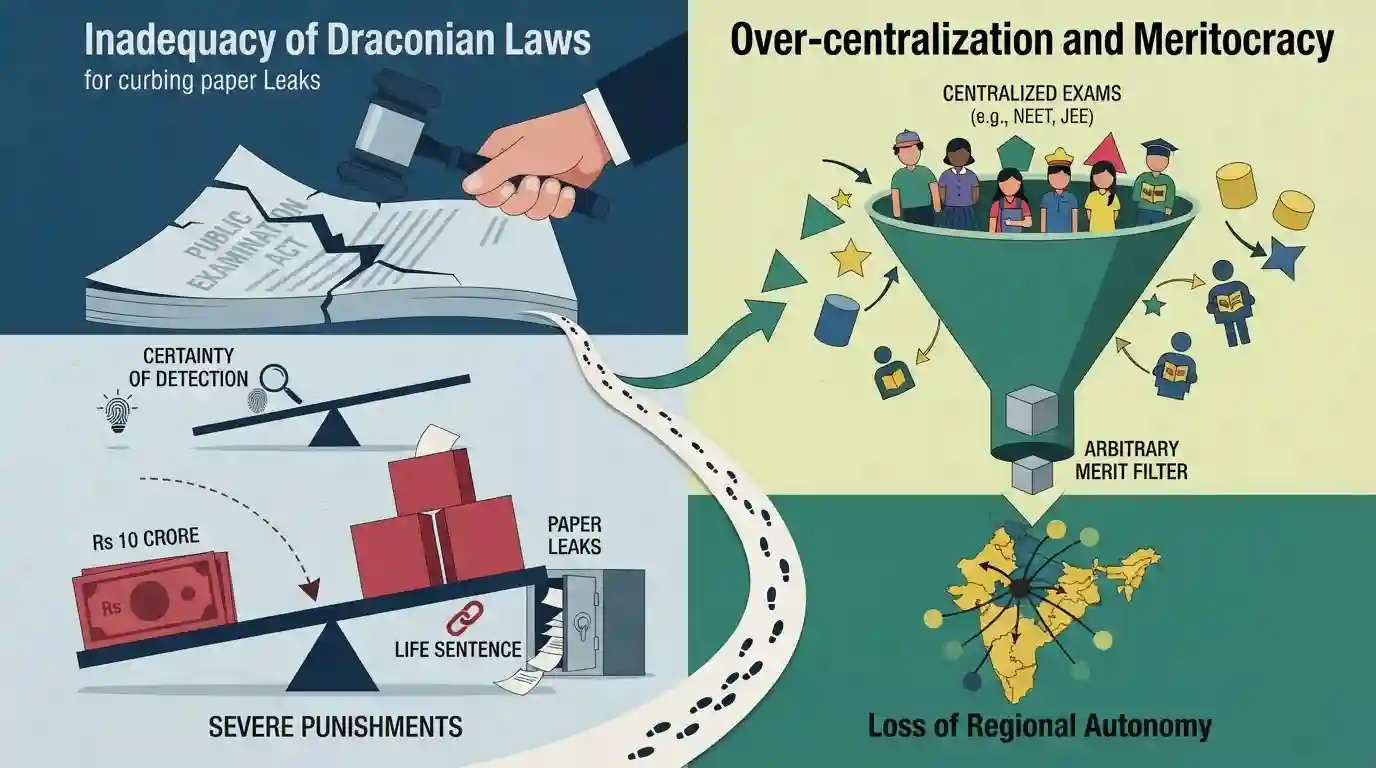
The article, authored by Faizan Mustafa, critically examines the rising trend of introducing draconian laws (like the Public Examination Act, 2024) to curb paper leaks. Using criminological principles, he argues that severe punishments alone (like Rs 10 crore fines or life sentences) are ineffective without the certainty of detection. Moreover, the piece presents a structural critique of over-centralisation in competitive exams (e.g., NEET, JEE), pointing out how they strip regional autonomy, promote socio-economic inequality (urban vs. rural/vernacular medium), and fail to measure true academic merit, acting instead as arbitrary filters of exclusion.
ముఖ్య అంశాలు
- Criminal Deterrence Fallacy: The Public Examination (Prevention of Unfair Means) Act, 2024, and several state laws impose heavy penalties (up to life imprisonment and Rs 10 crore fine) for paper leaks. However, historical and criminological evidence shows that the 'certainty of detection and conviction' deters crime, not the 'severity' of the punishment.
- Flaws of Over-Centralisation: Forcing a single nationwide exam like NEET erodes state and institutional autonomy. It eliminates the crucial safety net of multiple state-level entrance tests, making students highly vulnerable to single-point systemic failures.
- Class and Vernacular Bias: Centralised examinations favor affluent, urban, English-medium students who have access to commercial coaching hubs, disproportionately marginalizing rural and vernacular-medium aspirants. It also introduces translation errors (as seen in Tamil translation issues in NEET 2018) that penalize non-English students.
- Deconstructing 'Meritocracy': Standardised testing is a mechanical tool of exclusion ('elimination') rather than a true selector of 'merit'. It fails to evaluate essential learning traits such as imagination, curiosity, motivation, or specific vocational aptitude.
ముఖ్యమైన పదాలు
The Public Examination (Prevention of Unfair Means) Act, 2024

A central law designed to deter organized paper leaks and malpractices in recruitment and entrance exams through strict penalties, including up to 10 years imprisonment and Rs 10 crore in fines.
UPSC context
GS Paper 2 (Governance). Relevant to debates on legislative deterrence versus the certainty of enforcement in curbing corruption.
National Eligibility cum Entrance Test (NEET)
India’s centralized qualifying exam for undergraduate medical and dental programs. It serves as the sole gateway for admissions to government and private medical institutions nationwide.
UPSC context
GS Paper 2 (Federalism). Highlights issues of over-centralization, regional exclusion, and socio-economic disparities in merit-based selection processes.
Joint Entrance Examination (JEE)
A highly competitive national-level entrance exam conducted by the NTA for admissions to premier engineering and architectural institutions like the IITs and NITs.
UPSC context
GS Paper 2 (Education). Pertinent to analyzing structural critiques of centralized testing, the urban-rural divide, and India's excessive coaching culture.
Central Bureau of Investigation (CBI)
India's premier central investigating agency, operating under the Ministry of Personnel. It tackles complex cases involving corruption, economic offenses, and organized crime, like widespread exam paper leaks.
UPSC context
GS Paper 2 (Statutory/Non-Statutory Bodies). Tests knowledge of its jurisdiction, autonomy, and functioning under the Delhi Special Police Establishment Act.
Supreme Court of India
The apex judicial body in India, authorized to adjudicate disputes, interpret the Constitution, and protect fundamental rights, including reviewing controversial systemic examination failures.
UPSC context
GS Paper 2 (Judiciary). Essential for understanding judicial review, Article 14, and balancing systemic fairness versus individual student impact.
ప్రిలిమ్స్ ఉచ్చు
The Union government derives its sole power to mandate unified nationwide exams like NEET exclusively from Entry 25 of the Concurrent List.
While 'Education' is Concurrent (Entry 25), the SC has ruled that 'coordination and standards' under Entry 66 of the Union List overrides the Concurrent List, empowering the Centre to mandate uniform exams.
అనుసంధానమైన స్థిర భావనలు
How does Article 254(2) resolve conflicts on Concurrent List subjects?
- State Precedence: Allows a State-legislated law on a Concurrent subject to prevail over an inconsistent earlier Union law within that specific state.
- Presidential Assent: The State legislation must be reserved for and receive the assent of the President of India to override the Central law.
- Parliamentary Override: Parliament retains the power to subsequently enact legislation that can amend, vary, or repeal such a State-made law at any time.
What is the scope of Entry 66 of List I (Union List)?
- Core Definition: Grants the Centre exclusive power over 'coordination and determination of standards' in higher education or research and scientific/technical institutions.
- Supremacy Principle: It acts as a limitation on the State's power under Entry 25 of List III, meaning state education laws cannot dilute central standards.
అంతర-అంశ నమూనాలు
Article 201 + Federal friction
The TN NEET Exemption Bill highlights federal friction where Governors reserve bills indefinitely, forcing scrutiny of the President's discretionary powers under Article 201 without constitutional timelines.
Penology + Criminal Justice Reform
Severe penalties (life terms/₹10cr fines) fail to deter white-collar syndicates when systemic investigation capacity is low, proving that certainty of conviction outperforms statutory severity.

Entry 66 of List I vs Entry 25 of Concurrent List, alongside Presidential withholding of assent under Article 201, will frame a 2026 question.
అనుసంధాన PYQలు · 3
అనుసంధాన PYQలు · 3
- 2024MainsGS2
What are the aims and objects of recently passed and enforced, The Public Examination (Prevention of Unfair Means) Act, 2024? Whether University/State Education Board examinations, too, are covered under the Act ?
- 2014MainsEssay
Are the standardized tests good measure of academic ability or progress?
- 2014MainsGS2
Should the premier institutes like IITs/IIMs. be allowed to retain premier status, allowed more academic independence in designing courses and also decide mode/criteria of selection of students. Discuss in light of the growing challenges.
