CBI Raids and Arrests in Exam Leak Case
Source:Indian Express ↗
Why It Matters
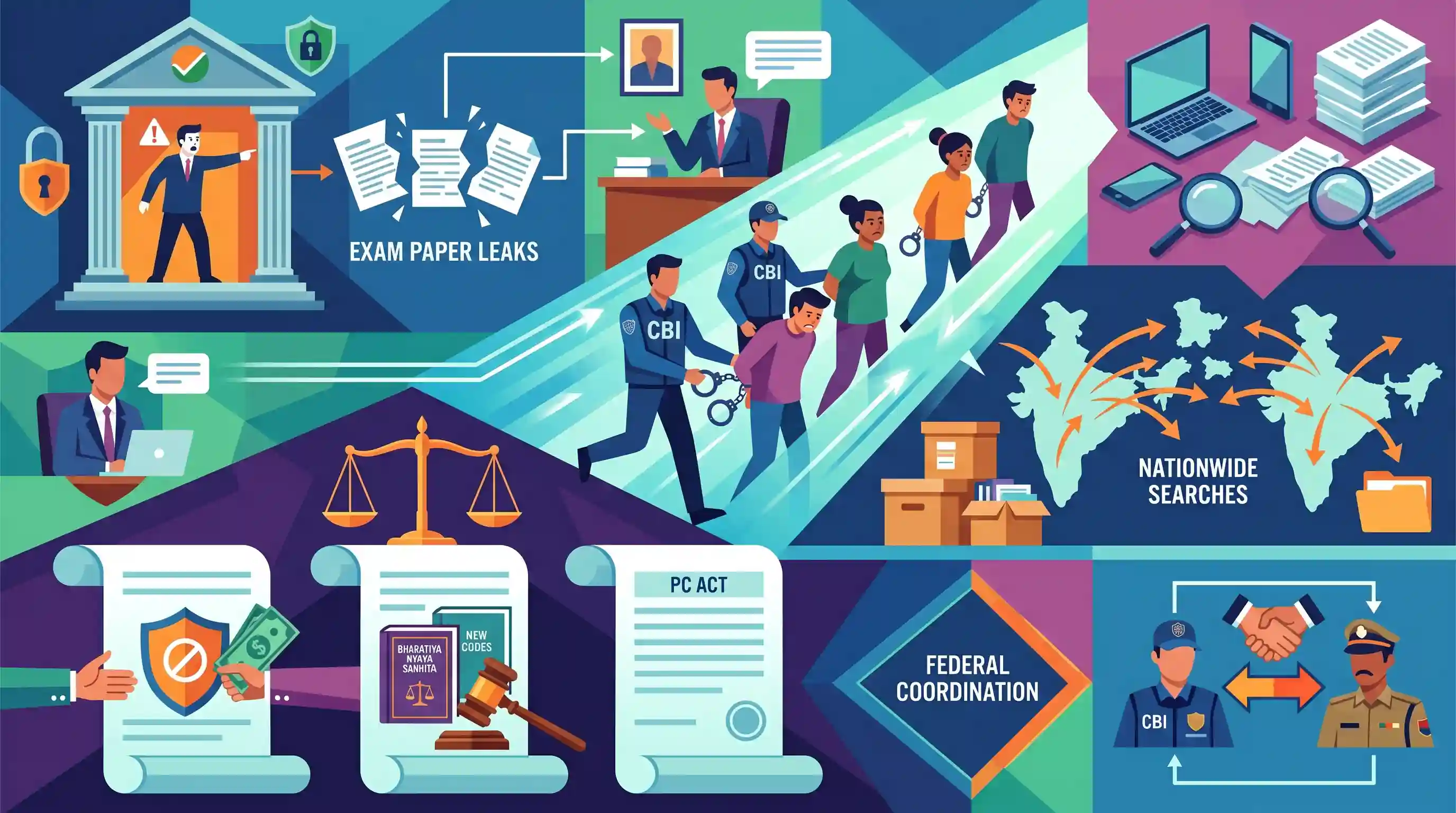
This incident illustrates the pressing governance challenge of ensuring integrity in large-scale public examinations in India. It also practically demonstrates the application of newly legislated frameworks—namely the Bharatiya Nyaya Sanhita and the Public Examinations (Prevention of Unfair Means) Act, 2024—and highlights the importance of federal cooperation between central agencies (CBI) and state police units.
Summary
The Central Bureau of Investigation (CBI) has arrested five individuals and conducted nationwide searches in connection with alleged irregularities and paper leaks in the NEET UG-2026 examination. The swift crackdown followed a complaint by the Ministry of Education, prompted by inputs from the National Testing Agency (NTA) about the unauthorized circulation of exam materials. Charges were filed under the Bharatiya Nyaya Sanhita (BNS), Prevention of Corruption Act, and the Public Examinations (Prevention of Unfair Means) Act, 2024. The CBI is collaborating with Rajasthan's Special Operations Group (SOG) in an ongoing investigation involving seized electronic devices and further suspects.
Key Points
- The CBI arrested five individuals from Jaipur, Gurugram, and Nashik following nationwide raids concerning the NEET UG-2026 paper leak.
- The investigation stems from a formal complaint by the Ministry of Education after the NTA reported unauthorized circulation of examination documents.
- Serious charges have been invoked under the Bharatiya Nyaya Sanhita (BNS), the Prevention of Corruption Act, and the newly enacted Public Examinations (Prevention of Unfair Means) Act, 2024.
- The central agency is working collaboratively with state police forces, particularly Rajasthan\'s Special Operations Group (SOG), indicating coordinated efforts in cross-jurisdictional law enforcement.
Important Terms
Public Examinations (Prevention of Unfair Means) Act, 2024

Legislation enacted to curb malpractices in public examinations like paper leaks and tampering. It prescribes stringent penalties, including imprisonment up to 10 years and fines up to ₹1 crore for organized crimes.
UPSC context
GS Paper 2 (Governance/Statutory Bodies); focuses on exam integrity, transparency, and legal deterrents against organized cheating syndicates.
Bharatiya Nyaya Sanhita (BNS)
India's official substantive criminal code, effective July 2024, replacing the colonial-era Indian Penal Code (IPC). It modernizes criminal law, introducing specific provisions for organized crime, terrorism, and community service.
UPSC context
GS Paper 2 (Criminal Justice System); critical for questions on decolonizing laws and contemporary legal reforms in India.
National Testing Agency (NTA)
An autonomous premier testing organization under the Ministry of Education, established to conduct standardized, transparent entrance examinations (e.g., NEET, JEE) for higher educational institutions in India.
UPSC context
GS Paper 2 (Statutory/Autonomous Bodies); relevant for discussions on educational governance and the integrity of national-level examinations.
Central Bureau of Investigation (CBI)
India's premier federal investigative agency, deriving powers from the Delhi Special Police Establishment Act, 1946. It probes high-profile corruption, economic offenses, and serious multi-state or international crimes.
UPSC context
GS Paper 2/3 (Governance/Security); examines federal policing, state-center friction (consent issues), and anti-corruption frameworks.
Prevention of Corruption Act
A 1988 law (amended in 2018) aimed at combating corruption among public servants. It criminalizes bribery, misappropriation, and possession of disproportionate assets, requiring prior sanction for prosecuting officials.
UPSC context
GS Paper 2/4 (Governance/Ethics); key to understanding legal mechanisms for administrative accountability and ethical conduct in public service.
Prelims Trap
The Public Examinations Act 2024 applies to all state-level recruitment and entrance examinations.
The Act applies exclusively to central examination authorities like UPSC, SSC, RRB, and NTA. State government exams are explicitly excluded from its purview.
Static Concepts Connected
How does the CBI exercise jurisdiction in States under the constitutional framework?
- Governing Statute: The CBI derives its powers from the Delhi Special Police Establishment (DSPE) Act, 1946, not a standalone statutory CBI Act.
- State Consent: Under Section 6 of the DSPE Act, the CBI requires general or specific consent from a State government to investigate within its territory.
- Constitutional Division: 'Police' is a State subject (List II). Central agencies rely on cross-jurisdictional collaboration or Constitutional Court directives to operate inside state boundaries.
What is the structural and legal status of the National Testing Agency (NTA)?
- Legal Status: It is not a statutory body; it is registered as an autonomous society under the Indian Societies Registration Act, 1860.
- Parent Ministry: It operates under the Department of Higher Education, Ministry of Education, created to be a premier, self-sustaining testing organization.
Cross-Topic Patterns
CBI Jurisdiction & Federal Friction
CBI collaborating with Rajasthan's SOG highlights cooperative federalism, contrasting with recent political trends where several states withdrew 'general consent' for CBI under the DSPE Act.
Legislating against organized exam syndicates
The new Public Examinations Act bridges enforcement gaps in the BNS and Prevention of Corruption Act by explicitly defining and heavily penalizing 'organized syndicates' involved in exam leaks.

Public Examinations Act applicability (Central vs State) & NTA's status (Society) are prime multi-statement targets for 2026 Prelims.
Linked PYQs · 2
Linked PYQs · 2
- 2024MainsGS2
What are the aims and objects of recently passed and enforced, The Public Examination (Prevention of Unfair Means) Act, 2024? Whether University/State Education Board examinations, too, are covered under the Act ?
- 2021MainsGS2
The jurisdiction of the Central Bureau of Investigation (CBI) regarding lodging an FIR and conducting probe within a particular State is being questioned by various States. However, the power of the States to withhold consent to the CBI is not absolute. Explain with special reference to the federal character of India.
