Parliamentary Panel to Examine Functioning of NTA and NMC
Source:Indian Express ↗
Why It Matters
The article illustrates the mechanism of parliamentary oversight over executive and regulatory bodies in India (GS2 Polity). It highlights the ongoing debates regarding structural reforms in public examination bodies, specifically the transition of testing bodies like the NTA from registered societies to statutory bodies to secure independence, legal teeth, and robustness in executing high-stakes competitive examinations.
Summary
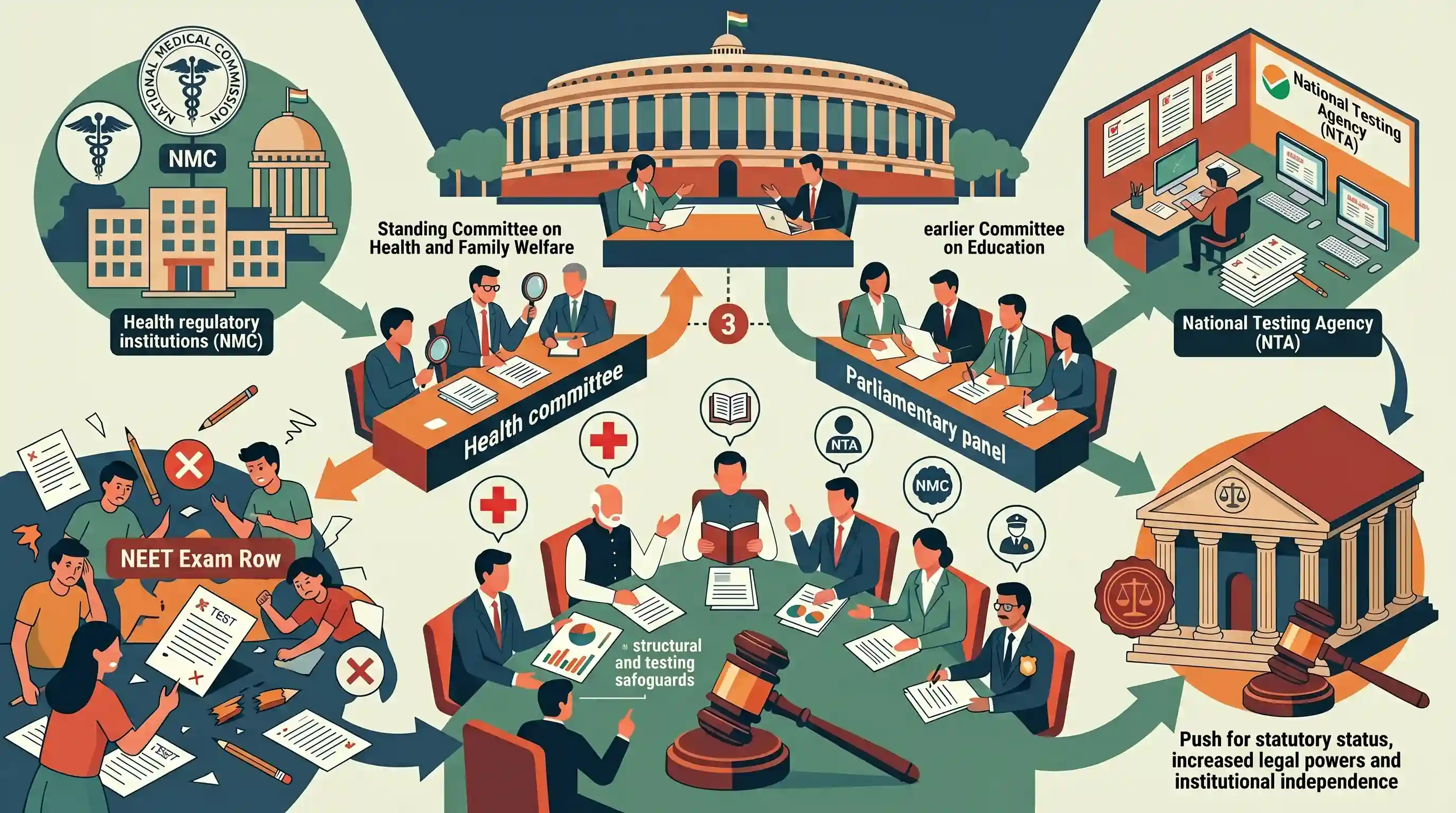
A Parliamentary Standing Committee on Health and Family Welfare is set to review the functioning, structural proficiency, and mandates of health-related regulatory institutions—including the National Medical Commission (NMC)—in the wake of the NEET exam row. This marks the third parliamentary panel to investigate the issue. Earlier, the Parliamentary Committee on Education scrutinized the National Testing Agency (NTA), with members advocating for granting statutory status to the NTA to enhance its legal powers and institutional independence. Key officials from the education and health ministries, NTA, NMC, and CBI have been summoned to outline structural and testing safeguards.
Key Points
- The Parliamentary Standing Committee on Health and Family Welfare (led by Ram Gopal Yadav) is scheduled to examine the organizational structure, mandate, and functional proficiency of regulatory institutions under the MoHFW, along with the conduct of the NEET examination under the NMC Act, 2019.
- This is the third parliamentary panel to scrutinize the NEET examination controversy, alongside the Parliamentary Committee on Education, Women, Children, Youth and Sports, and the Parliamentary Committee on Government Assurances.
- The Parliamentary Committee on Education, Women, Children, Youth and Sports (led by Mukul Wasnik) previously discussed structural reforms for the NTA, with members strongly pushing to grant statutory status to the NTA to ensure legal authority, stronger investigative powers, and functional independence.
- The panels have summoned senior officials including Higher Education Secretary Vineet Joshi, NTA Director General Abhishek Singh, the NMC chairperson, and CBI representatives who are probing the alleged paper leaks.
- In addition to examination regulatory systems, the health committee will discuss the affordability and accessibility of public and private healthcare facilities.
Important Terms
National Testing Agency (NTA)

An autonomous, premier testing organization under India's Ministry of Education, registered under the Societies Registration Act, 1860. It conducts standardized, transparent, and secure entrance examinations (like NEET-UG and JEE) for higher education.
UPSC context
GS Paper II (Polity & Governance). Tests executive accountability, statutory vs. non-statutory bodies, and institutional reforms in the education sector.
National Medical Commission (NMC)
A statutory regulatory body established to oversee medical education and professionals in India. It replaced the Medical Council of India (MCI) in 2020, aiming to improve accessibility and standards of medical education.
UPSC context
GS Paper II (Social Sector/Education & Governance). Evaluates regulatory bodies, healthcare management, and statutory reforms in professional licensing.
National Medical Commission (NMC) Act, 2019
The parliamentary legislation that repealed the Indian Medical Council Act, 1956, and dissolved the Medical Council of India. It established the NMC to reform medical training, accreditation, and ethical practices in healthcare.
UPSC context
GS Paper II (Governance & Legislation). Analyzes legislative designs of regulatory bodies and critical policy initiatives in medical education.
Parliamentary Standing Committee on Health and Family Welfare
A Department-related Standing Committee (DRSC) consisting of 31 members from both Houses. It scrutinizes policies, budgets, and regulatory institutions (like the NMC) related to health under executive oversight.
UPSC context
GS Paper II (Parliamentary Committees). Tests executive accountability, checks and balances, and the role of standing committees in governance.
Parliamentary Committee on Education, Women, Children, Youth and Sports
A joint Department-related Standing Committee that reviews the performance, bills, and demands for grants of ministries overseeing education and social sectors. It recently scrutinized the National Testing Agency (NTA).
UPSC context
GS Paper II (Social Sector/Education & Parliament). Tests parliamentary control over social infrastructure, education reforms, and institutional accountability.
Central Bureau of Investigation (CBI)
India's premier central investigating agency, established on the recommendations of the Santhanam Committee. It derives its investigative powers from the Delhi Special Police Establishment Act, 1946, to probe corruption and major crimes.
UPSC context
GS Paper II (Statutory & Regulatory Bodies). Tests institutional autonomy, federal conflicts (state consent), and anti-corruption machinery.
Prelims Trap
The National Testing Agency (NTA) is a statutory regulatory body established by an Act of Parliament.
NTA is not a statutory body; it is registered as an autonomous society under the Societies Registration Act, 1860. Parliamentary panels are currently recommending statutory status.
Static Concepts Connected
What are the key features and composition of Department-related Parliamentary Standing Committees (DRSCs)?
- Strength and Ratio: Consists of 31 members, with 21 from Lok Sabha and 10 from Rajya Sabha.
- Minister Exclusion: Ministers cannot be nominated as members to ensure unbiased executive oversight.
- Term Limit: Members are nominated for a term not exceeding one year.
What is the structural difference between the NMC and the NTA?
- NMC legal status: The National Medical Commission is a statutory body established under the NMC Act, 2019.
- NTA legal status: The National Testing Agency is a registered society under the Societies Registration Act, 1860, lacking statutory status.
Cross-Topic Patterns
Executive accountability & DRSCs
Examines how parliamentary committees enforce continuous legislative oversight over executive actions and non-statutory testing organizations.
Centralised testing vs. Federalism
Illustrates the ongoing friction between national-level uniform testing (NEET) and the states' constitutional right to manage professional education admissions.

A 2026 multi-statement question may test the statutory status of the NTA versus the NMC, alongside DRSC membership exclusions.
Linked PYQs · 3
Linked PYQs · 3
- 2021MainsGS2
Do Department-related Parliamentary Standing Committees keep the administration on its toes and inspire reverence for parliamentary control? Evaluate the working of such committees with suitable examples.
- 2015MainsGS2
For achieving the desired objectives, it is necessary to ensure that the regulatory institutions remain independent and autonomous. Discuss in the light of the experiences in recent past.
- 2019PrelimsGS1
In India, which of the following review the independent regulators in sectors like telecommunications, insurance, electricity, etc.? 1. Ad Hoc Committees set up by the Parliament 2. Parliamentary Department Related Standing Committees 3. Finance Commission 4. Financial Sector Legislative Reforms Commission 5. NITI Aayog Select the correct answer using the code given below.
