Fast Track Court Hearing in NEET Paper Leak Case Adjourned
Source:Indian Express ↗
ఇది ఎందుకు ముఖ్యం
This development highlights the gap between policy announcements (setting up fast-track courts to tackle high-profile exam leaks) and ground-level execution in India's judicial machinery. Understanding the structural issues of Fast Track Courts (FTCs), such as prosecution delays and lack of infrastructure, is crucial for answering GS2 questions on judicial reforms and administrative efficiency. Additionally, it directly links to India's legislative measures (Public Examinations Act, 2024) to secure the integrity of national-level examinations like NEET.
సారాంశం
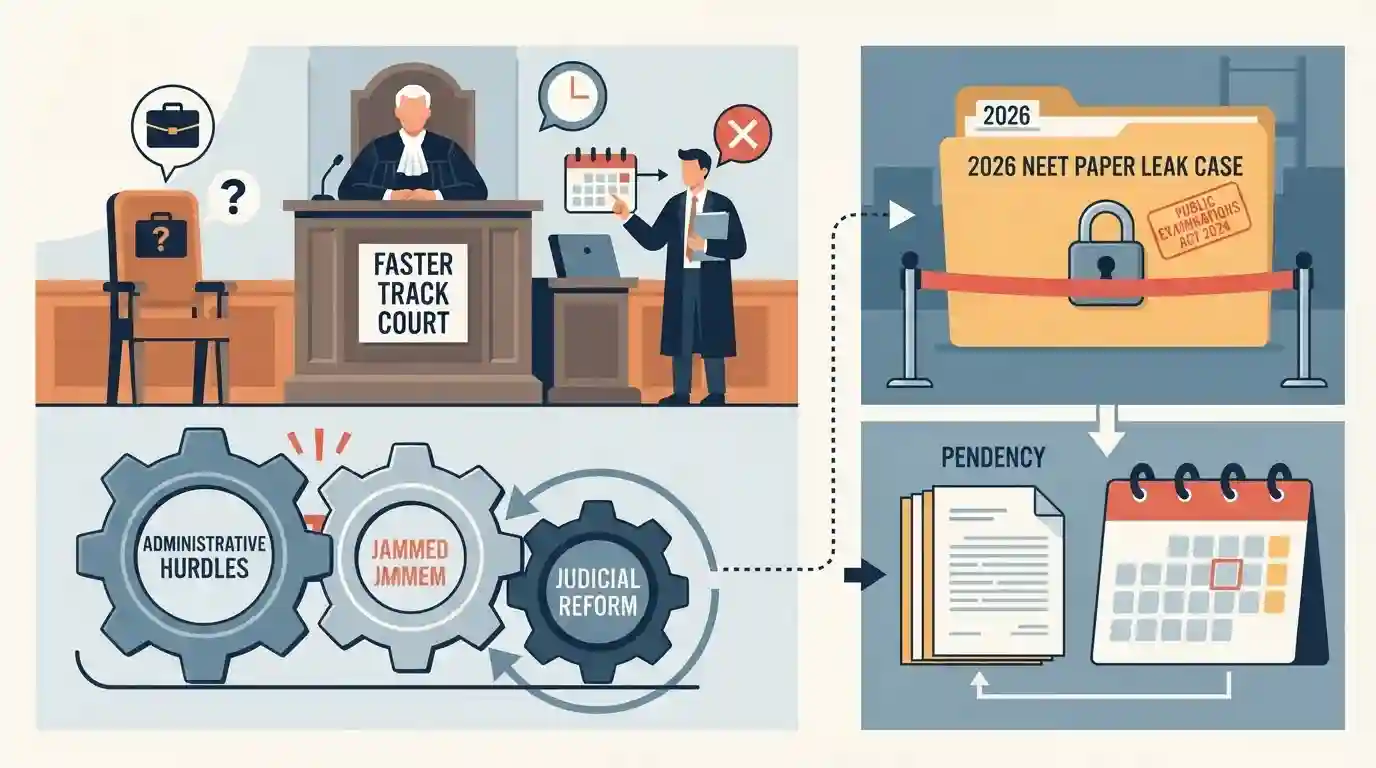
The first hearing in the newly established specially designated fast-track court for the 2026 NEET paper leak case, presided over by Special Judge Anu Grover Baliga, was adjourned due to the absence of the CBI prosecutor at the outset and a subsequent scheduling conflict of the defence counsel. The court was designated under the Public Examinations (Prevention of Unfair Means) Act, 2024, following a central push for swift trials. The adjournment underscores the persistent administrative and operational hurdles that slow down fast-track judicial initiatives in India.
ముఖ్య అంశాలు
- The first hearing in the newly established Specially Designated Fast Track Court for the 2026 NEET paper leak case was adjourned on its very first day to August 3, 2026.
- The adjournment resulted from the CBI counsel's initial absence at the scheduled time, followed by a request from the defence counsel (A P Singh) to postpone the hearing due to scheduling conflicts at another court (Rohini courts).
- The court, presided over by Special Judge Anu Grover Baliga, was designated as a fast-track court by the Delhi High Court on July 23, 2026, under the Public Examinations (Prevention of Unfair Means) Act, 2024, following Prime Minister Narendra Modi's directive to tackle paper leaks swiftly.
- The trial currently concerns the bail applications of accused Dinesh and Vikas Biwal, alongside medical applications for another accused, Manisha Sanjay Hawaldar.
- The incident highlights the persisting operational challenges in the Indian judicial system, where even specially designated fast-track courts face delays due to systemic issues like procedural lapses, coordinator absences, and advocate scheduling conflicts.
ముఖ్యమైన పదాలు
Public Examinations (Prevention of Unfair Means) Act, 2024

A central Indian legislation enacted to prevent and penalize malpractices—such as paper leaks, cheating, and organized cartels—in national public recruitment and entrance examinations like UPSC and NEET.
UPSC context
GS Paper II (Governance and Polity); tests legislative measures against administrative corruption, institutional reforms in educational governance, and transparency in public exams.
Fast-Track Courts (FTCs)
Special courts established in India to prioritize and quickly resolve specific categories of cases (e.g., heinous crimes, paper leaks), helping reduce overall case backlogs and deliver prompt justice.
UPSC context
GS Paper II (Judiciary and Judicial Reforms); evaluates systemic judicial delays, pendency reduction strategies, and structural reforms in criminal justice administration.
Fast-Track Special Courts (FTSCs)
Dedicated judicial tribunals launched in 2019 under a Centrally Sponsored Scheme to conduct time-bound trials specifically for rape cases and offences under the POCSO Act.
UPSC context
GS Paper II (Judiciary, Social Justice); assesses specialized legal protection for vulnerable sections like women and children, and centrally-sponsored judicial funding models.
Central Bureau of Investigation (CBI)
India's premier central investigating agency, operating under the Ministry of Personnel, Public Grievances and Pensions, tasked with probing high-profile corruption, economic offences, and complex interstate crimes.
UPSC context
GS Paper II (Statutory/Non-Statutory Bodies); assesses the efficacy of central investigating authorities, administrative accountability, and federal challenges in criminal investigations.
ప్రిలిమ్స్ ఉచ్చు
Fast-Track Courts are constitutionally mandated bodies established directly by the Supreme Court.
Fast-Track Courts are not constitutional entities. They are administrative arrangements established by State Governments in consultation with High Courts, first recommended by the 11th Finance Commission.
అనుసంధానమైన స్థిర భావనలు
How are Fast-Track Courts (FTCs) established in India?
- Origin: Recommended by the 11th Finance Commission in 2000 to tackle pendency in subordinate courts.
- Establishment: Set up by State Governments in consultation with their respective High Courts as administrative arrangements, not independent constitutional bodies.
What are the key features of the Public Examinations Act, 2024?
- Jurisdiction: Applies only to central recruitment and entrance exams (UPSC, NTA, SSC). It explicitly excludes university and state board exams.
- Nature of Offences: All offences under this Act are strictly cognizable, non-bailable, and non-compoundable to ensure stringent enforcement against paper leaks.
- Penalties: Organised paper leak crimes attract 5 to 10 years of imprisonment and a minimum fine of ₹1 crore.
అంతర-అంశ నమూనాలు
FTCs vs. Systemic Judicial Rot
The adjournment shows that merely designating a court as "fast-track" fails to cure pendency if structural issues like prosecutor shortages and scheduling conflicts remain unaddressed.
Legislative Intent vs. State Capacity
Passing strict laws like the 2024 Public Exams Act remains ineffective if the judicial infrastructure cannot support the mandated expedited timelines for investigation and trial.

Expect a multi-statement question combining the 2024 Public Exams Act's jurisdiction (central only) with the administrative setup of FTCs.
అనుసంధాన PYQలు · 1
అనుసంధాన PYQలు · 1
- 2024MainsGS2
What are the aims and objects of recently passed and enforced, The Public Examination (Prevention of Unfair Means) Act, 2024? Whether University/State Education Board examinations, too, are covered under the Act ?
