Ecological Threats to Neelakurinji in Western Ghats
Source:The Hindu ↗
Why It Matters
The article provides an excellent case study on the impact of anthropogenic activities (tourism, infrastructure) and ecological changes (invasive species, altered fire regimes) on endemic species in fragile ecosystems like the Western Ghats. It also illustrates the proactive role of environmental tribunals (NGT) in biodiversity conservation, making it highly relevant for GS3 (Environment) and GS2 (Statutory bodies/Judiciary).
Summary
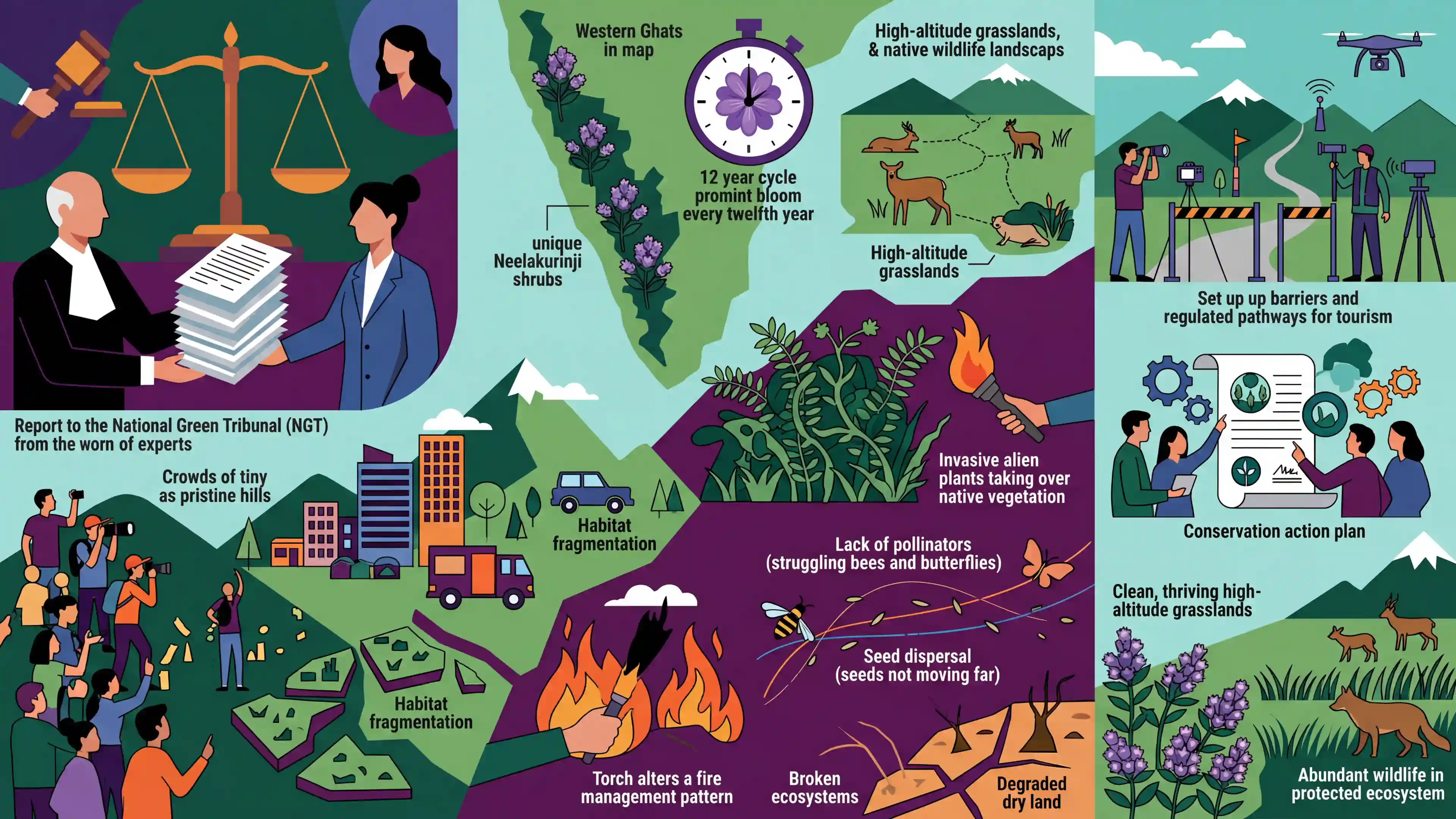
A report submitted by the Jawaharlal Nehru Tropical Botanic Garden and Research Institute (JNTBGRI) to the National Green Tribunal (NGT) has highlighted severe threats to Neelakurinji (Strobilanthes kunthiana), a rare shrub endemic to the Western Ghats. Following suo motu cognisance by the NGT, the expert assessment revealed that unregulated tourism, infrastructure expansion, and habitat fragmentation are severely degrading the high-altitude grassland ecosystems where the plant thrives. The 12-year blooming cycle of Neelakurinji is further threatened by the spread of invasive alien species and altered fire management practices that disrupt essential ecological processes like pollination and seed dispersal. The findings underscore the urgent need for a robust conservation action plan, including strict regulations on tourism infrastructure and long-term ecological monitoring to protect this ecologically vital species.
Key Points
- Neelakurinji (Strobilanthes kunthiana) is an endemic shrub in the high-altitude montane grasslands of the Western Ghats, famous for blooming once every 12 years.
- The National Green Tribunal (NGT) took suo motu cognisance of the threats facing the species, prompting an expert assessment.
- A report by the JNTBGRI identifies unregulated tourism, infrastructure expansion, and road construction as major drivers of habitat fragmentation and degradation.
- Altered fire management practices in the grasslands disrupt critical ecological processes, negatively impacting the plant's unique pollination and seed dispersal cycles.
- The spread of invasive alien species such as Lantana and bracken ferns further encroaches upon the natural habitat of Neelakurinji, stunting its regeneration.
- The report calls for a comprehensive conservation action plan, strict regulation of tourism infrastructure, and sustained ecological monitoring in the region.
Important Terms
National Green Tribunal (NGT)

A statutory judicial body established under the NGT Act 2010 for specialized environmental adjudication. It follows the 'principles of natural justice' and is mandated to resolve cases within six months.
UPSC context
GS II: Statutory Bodies; GS III: Environmental Governance. Tests knowledge of environmental law enforcement and specialized tribunals.
Neelakurinji (Strobilanthes kunthiana)
A rare purplish-blue flowering shrub endemic to high-altitude Western Ghats. It is semelparous (flowers once before dying) with a 12-year blooming cycle. It is listed as 'Vulnerable' on the IUCN Red List.
UPSC context
GS III: Biodiversity. Tests awareness of endemic flora, conservation status under WPA 1972, and threats to fragile ecosystems.
Shola-Grassland Ecosystem
A tropical montane forest-grassland mosaic found above 1500m in the Western Ghats. These ecosystems act as 'water towers,' harvesting monsoon rain and supporting endemic species like the Nilgiri Tahr.
UPSC context
GS I: Geography; GS III: Environment. Tests understanding of unique Indian vegetation types and their hydrological significance.
Suo Motu Cognisance
The legal power of a court or tribunal to initiate proceedings on its own motion without a formal complaint. The Supreme Court recently confirmed this unique power for the NGT.
UPSC context
GS II: Judiciary/Governance. Tests knowledge of judicial activism and the procedural authority of environmental tribunals.
Invasive Alien Species (IAS)
Non-native species that disrupt local ecosystems by outcompeting native flora. In the Western Ghats, species like wattle (Acacia) and eucalyptus threaten the survival of native grasslands and Neelakurinji.
UPSC context
GS III: Biodiversity. Tests awareness of biological threats to native species and ecosystem stability.
JNTBGRI
An autonomous research institute under the Government of Kerala focused on tropical biodiversity conservation. It manages a premier botanic garden and research facility for endemic and threatened plant species.
UPSC context
GS III: Environment/S&T. Tests knowledge of national/regional research institutions contributing to ecological conservation and reporting.
Prelims Trap
Neelakurinji is a widespread shrub found throughout all forest types of the Western Ghats.
It is highly restricted to high-altitude (above 1,500m) Shola grasslands in the southern Western Ghats, making it extremely vulnerable to micro-climate changes.
Static Concepts Connected
What are the key ecological characteristics of Shola forests?
- High-altitude ecosystem: They are stunted tropical montane forests occurring above 1,500 meters, interspersed with extensive rolling grasslands in South India.
- Water harvesting: They act as critical natural sponges, retaining heavy monsoon rainfall and slowly releasing it to feed perennial streams.
- Fragility & Endemism: Geographic isolation leads to high endemism, but makes the ecosystem highly fragile and notoriously slow to regenerate if destroyed.
What does it mean for a plant species to be monocarpic?
- Single reproductive cycle: Monocarpic plants flower, set seeds, and then die. They undergo only one reproductive cycle in their entire lifetime.
- Masting behavior: They often exhibit synchronized mass blooming (masting) after long intervals to overwhelm seed predators and maximize seed survival.
Cross-Topic Patterns
Invasive species vs. Endemic flora
Lantana camara threatening Neelakurinji echoes similar crises in Central India, where invasive flora alters natural fire regimes and degrades critical wildlife habitats.
NGT suo motu powers and conservation
The NGT's independent intervention here connects to Polity debates on environmental jurisprudence and the Supreme Court's 2021 affirmation of the tribunal's suo motu authority.

Expect a multi-statement question in 2026 linking endemic flora (like Neelakurinji) to niche micro-habitats and invasive species impacts.
Linked PYQs · 3
Linked PYQs · 3
- 2025PrelimsGS1
Regarding Peacock tarantula (Gooty tarantula), consider the following statements : I. It is an omnivorous crustacean. II. Its natural habitat in India is only limited to some forest areas. III. In its natural habitat, it is an arboreal species. Which of the statements given above is/are correct?
- 2017PrelimsGS1
From the ecological point of view, which one of the following assumes importance in being a good link between the Eastern Ghats and the Western Ghats?
- 2022MainsGS2
“The most significant achievement of modern law in India is the constitutionalization of environmental problems by the Supreme Court.” Discuss this statement with the help of relevant case laws.
