Mission Karmayogi Capacity Building and Citizen Centric Governance
Source:The Hindu ↗
Why It Matters
Civil service reform is a recurring theme in UPSC examinations, both in GS2 (Governance) and GS4 (Ethics). Initiatives like Mission Karmayogi represent the modern institutionalization of capacity building. The PM's emphasis on attitude shift ("Nagrik Devo Bhavah") and the integration of AI directly address evolving requirements for public administration and e-governance.
Summary
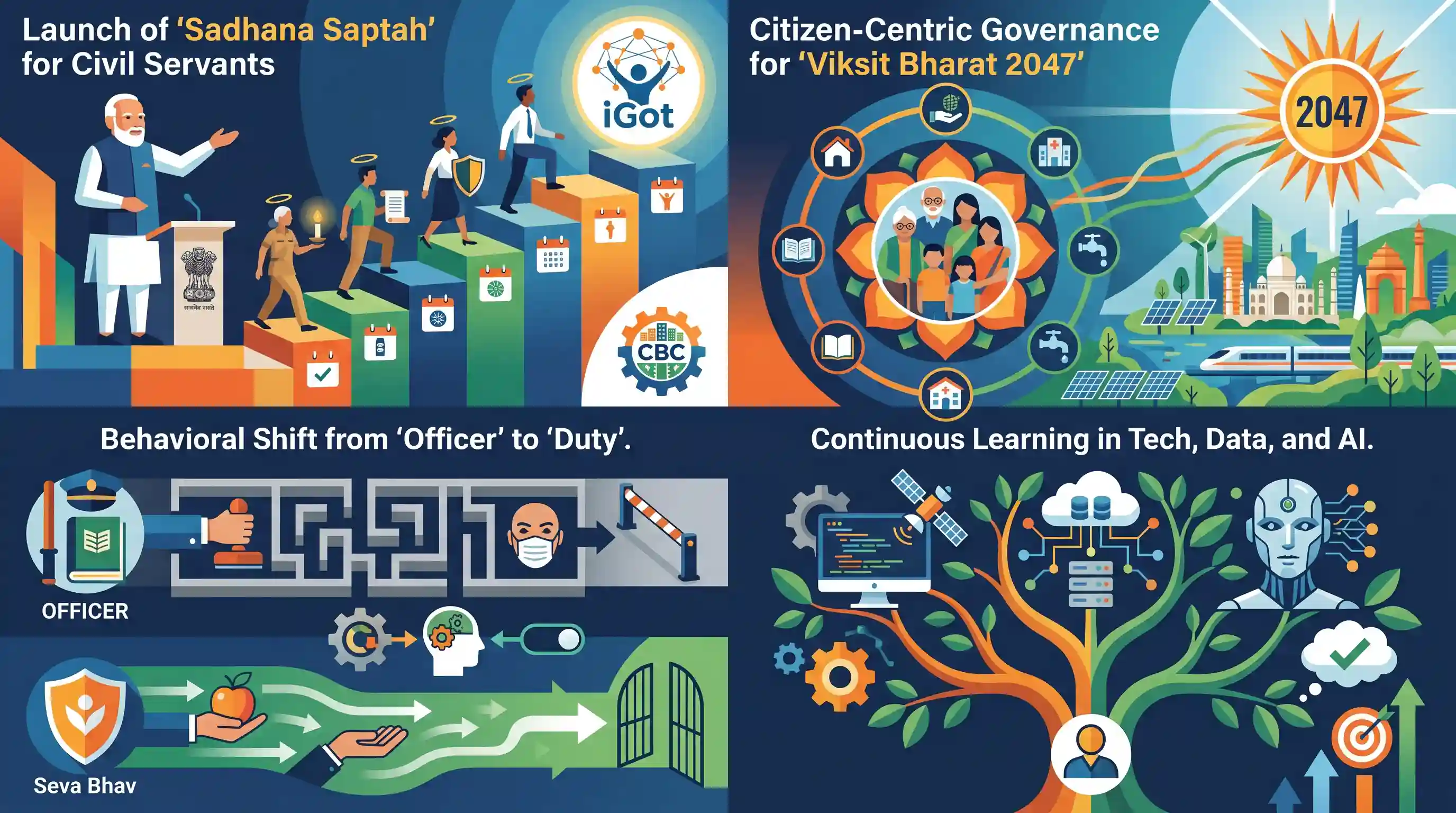
Prime Minister Narendra Modi launched 'Sadhana Saptah', a week-long capacity-building initiative for civil servants under Mission Karmayogi, organized by the Capacity Building Commission (CBC). Emphasizing the mantra "Nagrik Devo Bhavah", he urged a behavioral shift from an 'officer' mindset to a sense of duty, aiming to make governance more citizen-centric to achieve 'Viksit Bharat' by 2047. He also underscored the essential role of continuous learning in technology, data, and Artificial Intelligence (AI) for effective administrative decision-making.
Key Points
- PM Modi virtually addressed the launch of 'Sadhana Saptah', a week-long collaborative capacity-building initiative under Mission Karmayogi.
- The governance approach is guided by "Nagrik Devo Bhavah" (citizens are like gods) to foster capable and sensitive public services.
- Modi emphasized a behavioral shift in public servants from an 'officer' mindset to a 'sense of duty', aligning efforts with the vision of 'Viksit Bharat' by 2047.
- Continuous learning in emerging technologies, particularly Artificial Intelligence (AI) and data analytics, was highlighted as essential for modern decision-making.
- The initiative is organized by the Capacity Building Commission (CBC), which drives competency-based learning to make governance future-ready.
Important Terms
Mission Karmayogi

The National Programme for Civil Services Capacity Building (NPCSCB) aimed at transforming the Indian bureaucracy from 'rule-based' to 'role-based' through continuous, competency-driven learning and digital training.
UPSC context
GS Paper II (Governance) and GS Paper IV (Ethics); crucial for questions on civil service reforms and administrative efficiency.
Sadhana Saptah
A week-long (April 2-8, 2026) intensive capacity-building exercise under Mission Karmayogi focusing on the 'three sutras': Technology, Tradition, and Tangible Outcomes to enhance public service delivery.
UPSC context
GS Paper II (Governance); relevant for current affairs questions regarding recent initiatives in administrative training and innovation.
Capacity Building Commission (CBC)
An independent body established in 2021 to harmonize training standards, oversee central training institutions, and drive the institutional framework of Mission Karmayogi across all government ministries.
UPSC context
GS Paper II (Governance/Statutory Bodies); tests knowledge of the institutional architecture driving Indian civil service reforms.
Viksit Bharat @ 2047
The Government of India's long-term vision to transform the nation into a developed, high-income economy with inclusive growth and robust governance by the centenary of its independence.
UPSC context
GS Paper II and III; foundational for discussing long-term economic planning, inclusive development, and governance goals.
Nagrik Devo Bhavah
A governance mantra meaning 'Citizen is God,' emphasizing a behavioral shift from an 'officer' mindset to selfless service and citizen-centric administrative decision-making.
UPSC context
GS Paper IV (Ethics); vital for answers on public service values, attitude, and the emotional intelligence of civil servants.
iGOT Karmayogi
The 'Integrated Government Online Training' digital platform that hosts a massive repository of competency-based learning content for over 1.5 crore government officials.
UPSC context
GS Paper II (E-Governance); highlights the role of digital technology in institutional capacity building and administrative reform.
Prelims Trap
Mission Karmayogi seeks to transition civil services from a role-based to a rule-based administration.
It is exactly the opposite. The core philosophy of Mission Karmayogi is transitioning from a rigid 'rule-based' system to a competency-driven 'role-based' framework.
Static Concepts Connected
What is the institutional framework of Mission Karmayogi?
- PM's HR Council: The apex body headed by the Prime Minister that provides strategic direction to civil service reforms.
- Capacity Building Commission: An executive body that supervises central training institutions and facilitates Annual Capacity Building Plans across departments.
- Karmayogi Bharat (SPV): A Special Purpose Vehicle (not-for-profit company) that owns, manages, and operates the iGOT digital learning platform.
What is the difference between Rule-based and Role-based administration?
- Rule-based (Traditional): Focuses on strict adherence to procedures, hierarchies, and manuals, often leading to red-tapism and delayed public service delivery.
- Role-based (Karmayogi): Focuses on mapping specific competencies (behavioral, functional, domain) required for a particular role, ensuring the right person is in the right job.
Cross-Topic Patterns
Ethics + Administrative Reforms
The shift from a colonial 'officer' mindset to "Nagrik Devo Bhavah" directly maps to GS4 topics on empathy, compassion, and foundational values of civil services.
Emerging Tech + E-Governance
Integrating AI and data analytics into the iGOT learning platform highlights the convergence of emerging technologies with public administration, a key theme for GS2 E-Governance.

Expect a 2026 GS2 Mains question linking Mission Karmayogi's 'rule-to-role' shift with AI integration for citizen-centric governance.
Linked PYQs · 5
Linked PYQs · 5
- 2020MainsGS2
Institutional quality is a crucial driver of economic performance". In this context suggest reforms in Civil Service for strengthening democracy.
- 2017MainsGS2
Initially Civil Services in India were designed to achieve the goals of neutrality and effectiveness, which seems to be lacking in the present context. Do you agree with the view that drastic reforms are required in Civil Services? Comment.
- 2024MainsGS2
e-governance is not just about the routine application of digital technology in service delivery process. It is as much about multifarious interactions for ensuring transparency and accountability. In this context evaluate the role of the 'Interactive Service Model' of e-governance.
- 2018MainsGS2
E-governance is not only about utilization of the power of new technology, but also much about critical importance of the 'use value' of information. Explain.
- 2023MainsGS2
e-governance, as a critical tool of governance, has ushered in effectiveness, transparency and accountability in governments. What inadequacies hamper the enhancement of these features ?
